

Investment in Syrian Industrial Cities is governed by specific rules for industrial plot allocation, ownership, construction, and expansion. Under the new investment system, investors must understand the applicable contract terms, licensing requirements, and implementation deadlines before committing to a site. Failure to meet certain contractual or construction obligations can result in cancellation of the allocation and termination of the investment contract.
At Qiwaa Advance, we explain the new investment rules, plot selection and payment options, licensing procedures, expansion requirements, and contractual risks. For investors planning to establish or expand a factory in Syria, we also highlight the technical factors that affect project feasibility, including site suitability, utility capacity, infrastructure readiness, and construction requirements.
The new industrial cities investment system
Syria’s Ministry of Economy and Industry introduced the new industrial cities investment system through Decision No. 432 of June 18, 2025. The new system, announced by the Ministry, regulates industrial plot allocation, investment arrangements, pricing, construction obligations, and project operations.
The system establishes several governing principles:
- Equal opportunity: Applying non-discriminatory criteria when allocating plots and evaluating investors.
- Transparency: Using clear and publicly accessible procedures for allocation, contracting, and oversight.
- Industrial specialization: Aligning projects with the approved industrial activities and zoning of each city.
- Environmental compliance: Meeting applicable environmental standards throughout project development and operation.
- Administrative flexibility: Simplifying procedures within established governance and regulatory requirements.
- Social responsibility: Encouraging industrial projects to contribute to surrounding communities and local development.
The system also permits plot purchases, including installment arrangements, long-term leases, and certain public-private partnerships. However, a common regulatory framework does not mean identical investment conditions across all Syrian industrial cities. Plot availability, applicable prices, building restrictions, and infrastructure capacity can differ by location.
Before applying for a plot, investors should confirm the current requirements with the relevant industrial city administration, including any subsequent decisions affecting their project.
If you are evaluating an industrial site, contact Qiwaa Advance to discuss its technical suitability, infrastructure requirements, and construction needs before committing to equipment or site development.
Read also: Investment in Syria 2026: Practical Opportunities
Industrial plot allocation in Syria
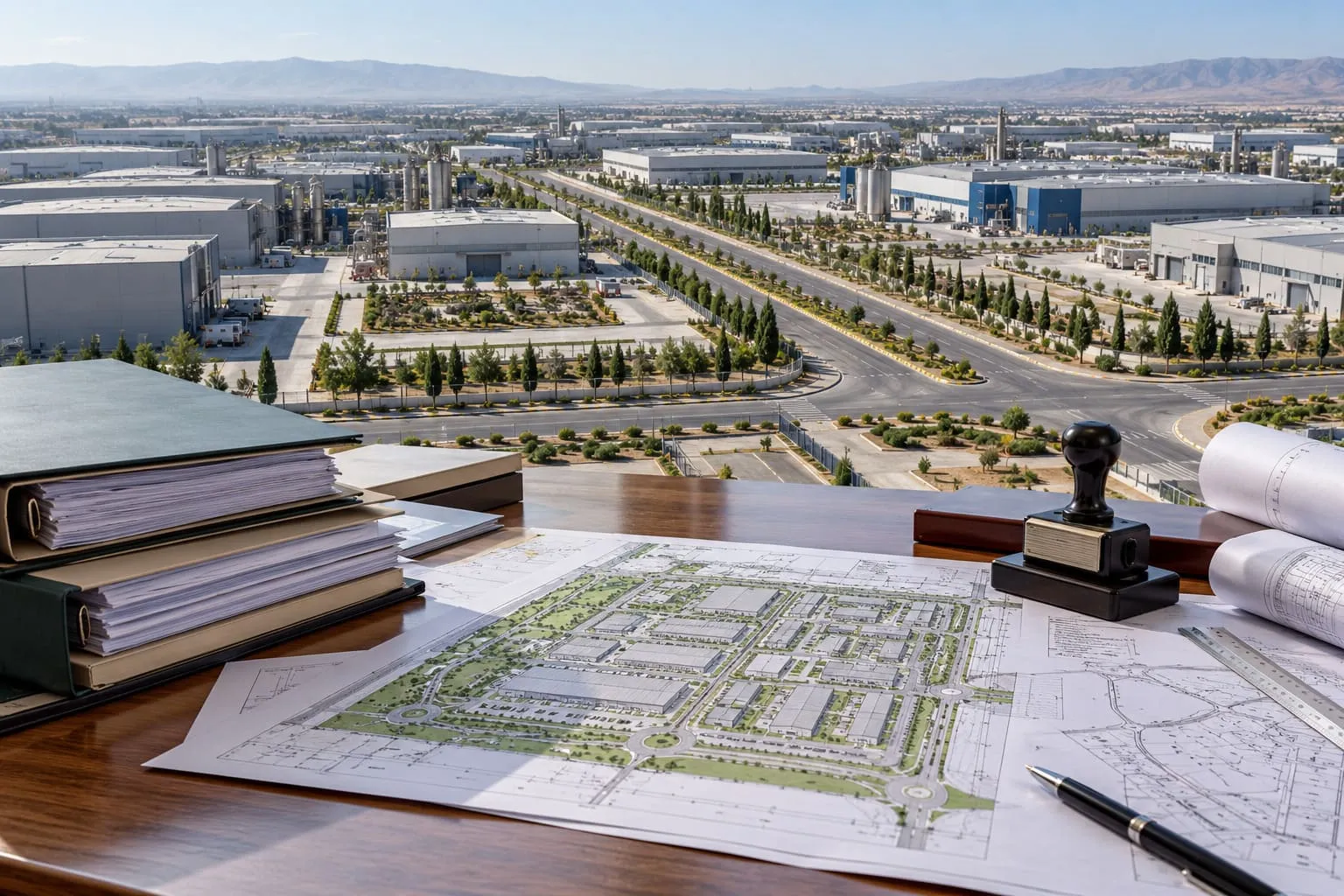
Under the new investment system, industrial plots in Syria can be allocated through direct applications, investment invitations, or public auctions. Before applying, investors should verify that the proposed site can accommodate their production facilities, utility requirements, and future expansion without creating avoidable construction or operating costs.
Selecting the right industrial plot
The most suitable plot is not necessarily the largest or cheapest. Its value depends on how well it meets the factory’s technical and operational requirements. Assess five factors before making a decision:
- Industrial zoning: Confirm that the proposed activity is permitted within the plot’s designated industrial classification.
- Building regulations: Check permitted building coverage, setbacks, heights, and space available for production lines, storage, and supporting facilities.
- Utilities: Compare the factory’s estimated electricity loads, water demand, and drainage requirements with the capacity available at the site.
- Transport access: Verify truck access, loading areas, internal circulation, and connections to main roads.
- Future expansion: Assess adjacent plot availability and whether a future merger could meet the applicable ownership, zoning, and approval conditions.
An existing utility connection does not guarantee sufficient capacity. Before committing to a plot, obtain confirmation of available electricity and water capacity from the industrial city administration. If upgrades or independent utility systems are necessary, include their costs and delivery times in the project feasibility study.
Applying for plot allocation
Under Decision No. 432 of 2025, the Ministry of Economy and Industry provides three allocation procedures for industrial projects:
- Direct application: Submit the prescribed application to the industrial city administration after vacant plots are announced and pay the applicable application fee.
- Investment invitation: Participate in a public or targeted invitation issued by the Ministry for specified projects.
- Public auction: Apply for plots offered through a competitive auction under published investment conditions.
For direct applications, the administration evaluates projects against technical, economic, and operational criteria, including feasibility, capital investment, machinery value, technology, employment, local raw-material use, and export potential.
To present a credible project proposal, prepare information covering:
- Industrial activity: The proposed products, manufacturing processes, and expected production capacity.
- Investment and equipment: Estimated capital expenditure, principal machinery, and technological requirements.
- Operations: Raw materials, workforce requirements, and projected employment.
- Site requirements: Required plot area, preliminary layout, utility loads, and infrastructure connections.
- Implementation: The proposed construction schedule and expected start of production.
These details support the assessment, but the exact documents required should be confirmed with the relevant industrial city administration.
Once a direct application receives preliminary allocation approval, the investor must attend the industrial city administration within 30 days of the decision to sign the contract and take possession of the plot. Failure to meet this deadline results in cancellation of the preliminary allocation.
For investors evaluating a factory site, Qiwaa Advance can discuss the technical requirements affecting site preparation, construction, and industrial material supply. Contact our team before finalizing your project requirements.
Read also: Foreign Investment in Syria: How to Enter the Syrian Market Step by Step.
Industrial plot prices in Syria
Under the industrial cities investment system, industrial plot prices in Syria are determined annually by ministerial decision and expressed in US dollars. Payments may be made in dollars or the equivalent in Syrian pounds at the official Central Bank selling rate applicable on the payment due date.
The valuation takes account of the following:
- Plot area: The pricing mechanism provides for a lower unit price as plot size increases.
- Location and services: Topography, location, and infrastructure access affect the valuation, including a plot-specific weighting factor of up to 25%.
- Payment method: Installment purchases have a higher price per square meter than cash purchases.
Before choosing a plot, request its current official valuation under both payment methods. Compare the total acquisition cost alongside any additional spending required for utility connections, site preparation, and construction.
Cash and installment purchases
Investors may purchase an industrial plot through a single cash payment or an installment arrangement. Under Decision No. 432, installment purchases follow these terms:
- Initial payment: 5% of the plot value, paid before contract signing as a security deposit and credited toward the purchase price.
- Remaining balance: 20 quarterly installments over five years.
- First installment: Due three months after signing the contract.
- Ownership transfer: Permitted after full payment and three months of actual production at the facility.
The deposit may be forfeited if the investor withdraws or breaches the investment system. Failure to meet payment obligations can also expose the allocation and contract to cancellation.
Investors should compare the higher installment purchase price with the cash-flow benefit of spreading payments over five years, while accounting for construction and equipment costs during the same period.
Long-term lease
Long-term leasing provides an alternative to purchasing an industrial plot. The system allows:
- Lease agreements lasting up to 49 years.
- Renewal subject to ministerial approval.
- Annual rent determined by the Ministry on a three-year review cycle.
- Transfer of lease rights to another investor with ministerial approval, subject to the applicable investment conditions.
Before selecting this model, consider the total lease commitment, future rent reviews, and restrictions on transferring rights or expanding operations.
Public–private partnerships
Under Syria’s industrial cities investment system, public–private partnerships (PPPs) are permitted for strategic industrial projects and supporting services. These arrangements may include Build–Operate–Transfer (BOT) contracts, with financing, operational responsibilities, and asset transfer terms defined in the project agreement.
Unlike a standard plot purchase or lease, a PPP requires a project-specific agreement defining financing, construction, operation, risk allocation, and the ownership or eventual transfer of assets.
The appropriate model depends on the project’s purpose, capital requirements, and expected operating structure. Investors should verify the terms applicable to their proposed activity before committing to a contractual arrangement.
Industrial project licenses and deadlines in Syria
An industrial plot allocation in Syria does not automatically authorize construction or production. Under the industrial cities investment system, investors must complete the required contracting, building permit, and industrial licensing procedures before operating their facilities.
The main steps include:
- Contract and handover: Sign the plot investment contract, take possession of the allocated land, and obtain the official plot boundaries and survey documentation.
- Engineering approvals: Prepare the factory’s drawings and obtain approval for the site layout, buildings, and technical specifications.
- Building permit: Obtain the required construction permit before beginning work, and comply with the applicable environmental, health, and fire-safety requirements.
- Construction and inspection: Complete the buildings, install production equipment, and meet the industrial safety and environmental conditions required for administrative operating approval.
- Industrial registration: Obtain the administrative authorization required for the completed facility and the industrial register entry before starting production.
Investors should coordinate these procedures with the industrial city administration and relevant licensing authorities to avoid delays affecting the project’s implementation schedule.
Industrial plot construction deadlines
Decision No. 432 of 2025 establishes specific deadlines affecting the validity of an industrial plot allocation:
- 30 days from preliminary allocation: Sign the investment contract and take possession of the plot.
- 90 days from contract signing: Obtain the building permit and begin construction in accordance with the approved plans.
- 18 months from building permit issuance: Bring the facility into operation and start actual production.
Under the system, construction is considered to have started when the foundations have been poured and the boundary wall completed in accordance with the building permit. The permitted building area generally ranges from 30% to 65% of the plot, subject to the city’s building regulations and specific industrial exceptions.
Missing the construction or production deadlines can lead to cancellation of the allocation and termination of the contract. Investors should therefore align permitting, procurement, utility connections, and construction schedules before committing to equipment delivery dates.
For investors holding permits issued under previous investment systems, an April 20, 2026 ministerial decision introduced transitional provisions, including a one-time renewal for certain expired building permits. Existing permit holders should obtain written confirmation of their applicable deadlines from the industrial city administration.
Industrial plot expansion in Syria
Expanding an industrial facility may require merging adjacent plots or adding a complementary production activity. Both options are permitted under the investment system, subject to specific conditions and approvals.
Merging industrial plots
Industrial plot merging in Syria is permitted for justified production needs or future expansion, provided that:
- The plots are directly adjacent.
- They belong to the same owner.
- They are allocated to the same primary industrial activity.
- The merger serves an industrial requirement or planned expansion.
- The plots are free from registered encumbrances or third-party rights.
The investor must also comply with the industrial city’s building regulations and administrative merger conditions and cover the associated costs.
Before requesting a merger, assess whether the combined site can accommodate the proposed production layout, truck circulation, fire access, and utility connections without conflicting with existing permits or building setbacks.
Adding a complementary industry
Under Decision No. 432, an investor may add a complementary industrial activity to an already licensed primary industry, subject to Ministry approval and applicable environmental and health requirements. The industrial register entry remains associated with the primary industry.
To support the proposed expansion, investors should prepare a technical assessment covering:
- Production compatibility: How the additional activity relates to the existing manufacturing process.
- Equipment and layout: Machinery requirements, production space, and material flows.
- Utility demand: Additional electricity, water, drainage, and other infrastructure requirements.
- Environmental and safety impact: Waste, emissions, fire protection, and occupational safety considerations.
These are recommended technical assessment elements, not a universal statutory checklist.
Do not order equipment or modify the facility for the new activity before obtaining the necessary written approvals. A complementary activity may be commercially viable but still require changes to the approved layout, infrastructure, or operating conditions.
At Qiwaa Advance, our contracting and industrial supply capabilities can support the technical planning of factory expansions, including infrastructure requirements, construction work, and material sourcing. Contact our team to discuss your proposed expansion and its execution requirements.
Industrial plot allocation cancellation in Syria
Under Decision No. 432 of 2025, industrial plot allocation in Syria can be cancelled and the investment contract terminated if the investor fails to meet specified payment, construction, production, or licensing obligations.
The main grounds for cancellation include:
- Construction delays: Failure to begin construction within 90 days of signing the contract. Commencement requires completing the foundations and boundary enclosure in accordance with the approved building permit.
- Payment default: Failure to pay two consecutive installments, or exceeding the six-year maximum repayment period in cases of default. The standard installment schedule remains five years.
- Production delays: Failure to start actual production within 18 months of obtaining the building permit.
- Unauthorized activities: Using the plot for an industrial activity inconsistent with its approved license or industrial classification.
- Technical violations: Failing to comply with the approved drawings, building regulations, investment system, or technical conditions specified in the permit.
What happens after cancellation?
Article 20 provides for the facility to be sold in its existing condition through a public auction following cancellation. The proceeds are used to settle the industrial city’s claims, including the security deposit and outstanding amounts, together with claims owed to public authorities. Any remaining balance is returned to the investor.
Investors facing justified financial, construction, or production difficulties may submit a formal hardship request to the industrial city administration. Article 7 allows such requests to be reviewed, but approval or an extension is not automatic.
Before a missed deadline becomes a contractual dispute, investors should document the causes of delay, outstanding obligations, construction progress, and a realistic completion schedule. Investors with older allocations should also check whether a specific settlement decision applies to their contracts.
Industrial plot contract review in Syria
An industrial plot investment contract in Syria should be reviewed against the proposed factory’s financing, construction, and operating requirements before signing. The critical issue is whether the rights granted, payment obligations, and implementation deadlines are compatible with the project’s actual delivery plan.
Key provisions to examine include:
- Investor and plot details: Confirm the contracting entity, plot number, area, boundaries, industrial classification, and registered third-party rights.
- Ownership and investment rights: Identify whether the agreement provides for purchase, long-term lease, or another investment arrangement, and the conditions governing ownership transfer.
- Payment obligations: Verify the purchase price or rent, security deposit, installment dates, applicable exchange rate, and consequences of payment default.
- Construction and production deadlines: Check the dates triggering permit, construction, and production obligations against the proposed engineering and procurement schedules.
- Infrastructure responsibilities: Establish who is responsible for electricity, water, drainage, road connections, and any additional infrastructure needed to operate the facility.
- Expansion and transfer rights: Review restrictions on assignment, mortgage arrangements where applicable, plot merging, and adding complementary industrial activities.
- Default and dispute resolution: Examine the grounds for termination, applicable notification and settlement procedures, and the dispute-resolution provisions.
Article 19 of the industrial cities investment system provides for arbitration in disputes involving investors and government or local authorities. The applicable procedure and its relationship to the specific contract should be reviewed by qualified legal counsel.
Investors should also distinguish the contractual rights granted by the industrial city administration from the protections and incentives potentially available under Investment Law No. 18 of 2021, as amended by Decree No. 114 of 2025. The applicable legal framework and project approvals must be assessed separately.
Before signing, confirm that the contractual implementation schedule matches the factory’s actual site, utility, construction, and equipment requirements. A technically unsuitable site or unrealistic delivery schedule can create significant costs even when the contract terms appear commercially acceptable.
For industrial investors assessing these requirements, Qiwaa Advance can support technical planning, infrastructure assessment, construction requirements, and industrial material supply. Contact our team to discuss the execution scope of your proposed project.

How Qiwaa Advance supports industrial city projects
Successful investment in Syrian industrial cities requires more than securing a plot and obtaining permits. The site must accommodate the factory’s production capacity, equipment layout, utility demands, and construction schedule. At Qiwaa Advance, we combine contracting, trading, and industrial capabilities to help investors translate these requirements into a practical project execution scope.
Depending on your project’s needs, our support includes:
- Site and layout assessment: Reviewing plot dimensions, building requirements, access roads, and available space for production lines, warehouses, and future expansion.
- Utility and infrastructure planning: Identifying electricity, water, drainage, fuel, and fire-protection requirements, including additional infrastructure needed for the proposed operation.
- Engineering and execution scope: Coordinating technical specifications, preliminary layouts, bills of quantities, and relevant civil, structural, and utility works.
- Materials and equipment supply: Sourcing construction materials, industrial inputs, and equipment through our trading services, aligned with the project’s specifications and delivery schedule.
- Construction coordination: Supporting the interface between equipment suppliers, engineering consultants, and execution teams to identify installation requirements and avoid conflicts between site readiness and equipment delivery.
Early technical coordination helps investors identify whether the selected plot can accommodate their production requirements and what additional costs or construction work may be necessary.
Planning a factory in a Syrian industrial city? Contact Qiwaa Advance with your proposed plot location, production capacity, preliminary drawings, or equipment requirements to discuss suitable infrastructure, supply, and contracting solutions.
Read also: Cement Industry in Syria: Market Challenges and Investment Opportunities in 2026.
FAQs about investment in syrian industrial cities
Does industrial plot allocation grant land ownership?
No. Preliminary allocation does not transfer ownership. Under the purchase arrangement, ownership transfers after the plot price has been paid in full and the facility has completed three months of actual production, subject to the applicable contractual requirements.
Can construction start immediately after plot allocation?
No. Investors must sign the investment contract, take possession of the plot, and obtain the required building permit and technical approvals before construction. Under Decision No. 432 of 2025, the building permit must be obtained and construction started within 90 days of contract signing.
Can industrial plots with different activities be merged?
The standard merger conditions require adjacent plots under the same ownership and allocated to the same primary industry. A complementary industrial activity may be approved separately by the Ministry, but that approval does not automatically authorize merging plots with different classifications.
Does an investment license replace industrial city permits?
No. An investment license under Syria’s general investment framework does not automatically replace the industrial city’s building permit, administrative operating authorization, industrial registration, or other activity-specific approvals.
Sources
- Decision No. 1 of 2025 containing the executive instructions
- Approval of the investment system for industrial cities in Syria
- Legislative Decree No. 114 of 2025 amending the Investment Law
- Confirmation of investment system No. 432 of 2025 in a subsequent decision
- Announcement of the executive instructions for the Investment Law and its amendments