
Gulf investments in Syria span major projects in energy, airports, ports, telecommunications, and industry. However, announced investments do not always translate into funded projects or immediate contracting opportunities. For investors, contractors, and suppliers, the challenge is identifying which projects are progressing toward execution, what opportunities they may offer, and what conditions must be met before entering them.
To help you assess these opportunities, this Qiwaa Advance guide examines Gulf and Arab investment projects in Syria, their current stages, and the requirements for potential participation. It covers:
- Major investment projects by country, sector, and execution status.
- Investment models, including direct investment, concessions, and memoranda of understanding.
- Factors attracting Gulf and Arab investors and the risks of entering the Syrian market.
- Contracting, equipment supply, and local partnership opportunities.
- Key steps for evaluating projects and preparing for implementation.
Gulf and Arab investment projects in Syria by country
Gulf investments in Syria cover energy, transport, telecommunications, industrial development, and real estate, with projects at different stages of implementation. For investors, contractors, and suppliers, the distinction between announced agreements, signed contracts, and active projects is essential when assessing business opportunities.
The following table summarizes major Gulf and Arab investment initiatives in Syria, their reported values, and their latest publicly documented stages as of October 15, 2026.
Gulf and Arab investment projects in Syria by country
Gulf investments in Syria are progressing at different stages, from preliminary agreements and technical studies to signed contracts and active operations. The following overview compares major initiatives and their documented status as of October 15, 2026.
| Country | Major Projects | Documented Status |
|---|---|---|
| Saudi Arabia | SilkLink, Aleppo airports, cement projects | Project award, technical studies, and inaugurated facilities |
| Qatar | Power plants, Damascus Airport, Baladna | Signed concessions, initial works, and announced plans |
| UAE | Tartus Port, Damascus Metro, Arada, Eagle Hills | Operating port and developments at earlier planning or agreement stages |
| Kuwait | Zain Syria, Damascus–Nasib highway | Telecom licence awarded; road assessment conducted |
| Jordan | Jaber Border Crossing, natural gas supply | PPP prequalification re-tendered; supply agreement signed |
| Egypt | Construction and airport rehabilitation | Investment discussions without confirmed project contracts |
| Iraq | Al-Qaim trade route, oil pipelines | Reopened crossing and preliminary pipeline studies |
| Oman and Bahrain | Trade and investment cooperation | No comparable major funded project verified in this review |
Announced project values should not be combined into a single investment total. They may represent different measures, including proposed investments, contractual commitments, and projected development values rather than capital already disbursed.
Read also: Syria Reconstruction Projects 2026: How to Read Opportunities and Costs Before Investing
Forms of Gulf and Arab investment and financing in Syria
Gulf investments in Syria take different forms that carry different financial obligations and execution requirements. Understanding these distinctions helps investors, contractors, and suppliers assess the level of commitment behind each announced project.
Direct investment and project company formation
Direct investment involves acquiring an ownership stake in an existing business or establishing a new operating company. Investors contribute capital, assume business risks, and participate in returns according to their ownership and contractual rights.
For example, Zain Group’s announced entry into Syria involves establishing a local operating entity with a planned ownership structure of 75% for Zain and 25% for a Syrian government entity, alongside a long-term telecommunications licence.
Concession and build-operate contracts
Concession agreements grant investors defined rights to develop, operate, and sometimes transfer infrastructure assets under contractual conditions. The investment obligations, operating period, revenue arrangements, and allocation of risks depend on each agreement.
Examples include DP World’s 30-year concession for Tartus Port and the UCC-led consortium’s agreements to build and operate eight power plants. These contracts establish a framework for development and operation, but financing and implementation milestones must still be assessed separately.
Signed contracts and project readiness
A signed investment contract defines binding rights and obligations, including the project’s scope, responsibilities, and commercial terms. However, contractual commitment does not necessarily mean that financing is complete or all construction activities can begin.
The Damascus International Airport development agreement, signed in November 2025, illustrates this distinction. Final concession contracts were signed and initial development works began, while the wider project follows a phased implementation programme.
Memoranda of understanding and agreements in principle
Memoranda of understanding (MoUs) and preliminary agreements establish a framework for cooperation or negotiation. Their legal effect depends on their terms, and they do not automatically confirm financing, permits, or construction commitments.
For example, the October 2026 framework agreement with Eagle Hills covers proposed real estate and tourism developments in Damascus and Latakia. The project’s detailed contractual arrangements and execution readiness must be assessed separately from the announcement.
Non-investment financial and development support
Development assistance, grants, and financial support differ from commercial investment because they do not necessarily involve equity ownership or an expected financial return for the contributor.
In May 2025, Saudi Arabia and Qatar settled approximately USD 15.5 million in Syria’s arrears to the International Development Association, restoring eligibility for new World Bank operations subject to applicable policies. This was financial support, not a direct investment in a commercial project.
When assessing Gulf and Arab investment projects in Syria, distinguish between the investment model, the legal status of the agreement, and the project’s actual readiness for financing, procurement, and execution. A large announced value alone does not establish that contracting opportunities are available.
Read also: Foreign Investment in Syria: How to Enter the Syrian Market Step by Step
Why are Gulf and Arab investors considering Syria?
Several developments have changed the conditions for Gulf investments in Syria, particularly in financial transactions, investment regulations, development funding, and reconstruction demand. Their significance depends on how they affect each project’s financing, approvals, and execution requirements.
Easing of economic sanctions
The United States ended its comprehensive Syria sanctions program effective July 1, 2025, while the European Union lifted broad economic sanctions in May 2025, retaining security-related restrictions. These changes reduced major barriers to cross-border transactions, but targeted sanctions and export controls still apply. Investors must verify counterparties, banking arrangements, and equipment restrictions before contracting.
Updated investment regulations
Decree No. 114 of 2025 amended Syria’s Investment Law No. 18 of 2021, followed by implementing instructions covering licensing procedures, investment incentives, and investor rights. These reforms provide an updated framework for Arab investment in Syria, but applicable benefits and approvals must be verified according to the sector, project structure, and competent authority.
Renewed development financing
Saudi Arabia and Qatar’s settlement of Syria’s arrears to the International Development Association (IDA) in May 2025 restored eligibility for new World Bank operations. The Bank subsequently approved a USD 146 million grant for electricity infrastructure rehabilitation. Such funding supports essential public infrastructure but does not automatically provide financing for private investments.
Demand for reconstruction and infrastructure rehabilitation
The World Bank estimated Syria’s reconstruction needs at USD 216 billion in October 2025, covering damaged infrastructure and buildings. This points to substantial requirements for engineering, construction, equipment, and materials. For contractors and suppliers, however, actual opportunities depend on funded projects and the release of procurement packages.
Gradual recovery of trade and logistics infrastructure
Port modernization and regional connectivity initiatives are creating potential improvements in the movement of construction materials and equipment. DP World’s development of Tartus Port is one example, although infrastructure readiness remains uneven. Project budgets must therefore account for actual customs procedures, inland transport, storage, and utility availability rather than assuming that announced upgrades are already operational.
Key Gulf and Arab investment projects in Syria
Major Gulf investments in Syria span infrastructure, energy, telecommunications, aviation, and industrial development. However, the opportunities available to contractors and suppliers depend on each project’s progress, from preliminary agreements and technical studies to construction and operation.
Saudi investments and reconstruction projects
Saudi investments in Syria cover infrastructure, telecommunications, aviation, manufacturing, and water projects. At the Syrian-Saudi Investment Forum in July 2025, 47 agreements and memoranda of understanding worth approximately SAR 24 billion were announced. Subsequent agreements in 2026 expanded the investment portfolio, although project readiness and procurement opportunities vary.
1. Cement manufacturing projects
Northern Region Cement inaugurated the Al-Fayhaa white cement plant in Adra, with a reported investment of USD 20 million and annual production capacity of 150,000 tons. Al-Badia Cement also announced investments exceeding USD 200 million to expand existing operations and develop a second production line. These projects reflect industrial expansion, with future equipment and supply opportunities depending on individual procurement requirements.
2. SilkLink telecommunications project
Saudi Telecom Company (stc) was awarded the SAR 3 billion SilkLink project in February 2026. The scope includes more than 4,500 km of fiber-optic networks, data centers, and international submarine cable landing stations. Potential contracting packages may involve civil works, fiber infrastructure, power systems, and equipment supply, subject to the project’s procurement arrangements.
3. Aleppo airports development
The Saudi-backed Elaf investment initiative announced approximately SAR 7.5 billion to upgrade the existing Aleppo airport and develop a new international facility. According to the September 2026 project update, preliminary technical studies are underway, with upgrades to the existing airport scheduled to begin in early 2027. The development may require airport infrastructure, utilities, construction materials, and specialized systems as approved work packages become available.
4. Establishment of flynas Syria
flynas and the Syrian General Authority of Civil Aviation signed an agreement in February 2026 to establish a joint airline, with 51% Syrian ownership and 49% held by flynas. Operations were initially scheduled for the fourth quarter of 2026, subject to licensing and operational approvals. Unlike airport construction projects, this initiative primarily concerns aviation operations and related services.
5. Water desalination and transmission projects
Saudi Arabia’s ACWA and Water Transmission Company (WTCO) signed a joint development agreement with Syria’s Ministry of Energy to study desalination and water transmission projects. The proposed system is being assessed for capacity of up to 1.2 million m³ per day and approximately 400 km of transmission infrastructure.
In September 2026, the consortium advanced technical studies with Fichtner. The project remains in the study phase, with potential future requirements for pipelines, pumping stations, treatment facilities, and associated civil works.
6. Al-Jawhara tower in Damascus
Al-Jawhara Tower is a Saudi-Syrian real estate investment announced at SAR 375 million in the Al-Bahsa district of Damascus. The development combines commercial, hospitality, and retail facilities across more than 25,000 m². Opportunities for contractors and suppliers depend on confirmed construction schedules, approved designs, and procurement packages.
7. Mining and industrial projects under study
In April 2026, Saudi company SAMIROCK signed a memorandum of understanding to study the use of oil shale in phosphate fertilizer production. The proposed development in the Khanasser area requires geological assessment, industrial feasibility studies, and site planning before major construction commitments can be established.
These Saudi reconstruction projects in Syria represent opportunities at different stages, from industrial operations and awarded infrastructure projects to investments undergoing technical evaluation. For companies considering participation, the priority is to verify project status, identify relevant contracting packages, and assess local execution and supply requirements.
If your company is preparing a contracting or supply project in Syria, Qiwaa Advance can support discussions on engineering requirements, EPC execution, and material sourcing through its contracting and trading capabilities. Contact our team to discuss your project’s technical scope and supply needs.
Major Qatari investments in Syria
Qatari investments in Syria focus on power generation, airport development, offshore energy exploration, and agricultural production. The projects range from signed concession contracts and initial construction works to preliminary exploration agreements and phased investment plans.
1. Power generation projects
In November 2025, a consortium led by Qatar’s UCC Holding signed final concession agreements to develop and operate eight power plants with a combined capacity of 5,000 MW, under an investment programme valued at approximately USD 7 billion.
Preparatory engineering studies were completed, and construction of the 1,000 MW Deir ez-Zor plant was formally launched in December 2025. Project execution depends on plant construction, fuel supply, transmission infrastructure, and grid connections, creating requirements for specialized engineering, equipment, and construction services.
2. Damascus international airport development
A UCC-led consortium signed final concession contracts in November 2025 for a USD 4 billion programme to develop and operate Damascus International Airport, targeting an eventual capacity of 31 million passengers annually.
Initial works have begun on Terminal 2, airport facilities, and access infrastructure. Subsequent phases include terminal expansion, aircraft stands, cargo facilities, and supporting utilities. Contracting and supply opportunities depend on approved designs and procurement packages for each phase.
3. Offshore oil and gas exploration
In February 2026, the Syrian Petroleum Company, Chevron, and Qatar’s Power International Holding signed a memorandum of understanding to assess offshore oil and gas exploration opportunities.
The agreement establishes an exploration framework rather than a confirmed production project. Any future engineering, drilling, or marine services contracts depend on geological findings, regulatory approvals, and subsequent investment decisions.
4. Baladna agricultural and food processing project
In July 2026, Qatar’s Baladna announced a USD 3.3 billion agricultural and food-processing programme in Syria, covering approximately 2,400 square kilometres, primarily in the Euphrates basin.
The initiative includes crop production, dairy processing, and related industries. Its phased development could create demand for irrigation systems, processing facilities, storage infrastructure, and industrial equipment, depending on confirmed implementation plans.
Major Emirati Investment projects in Syria
UAE investments in Syria include an operational port concession, proposed urban transport infrastructure, and major real estate developments. Their commercial implications differ according to contractual commitments and project readiness.
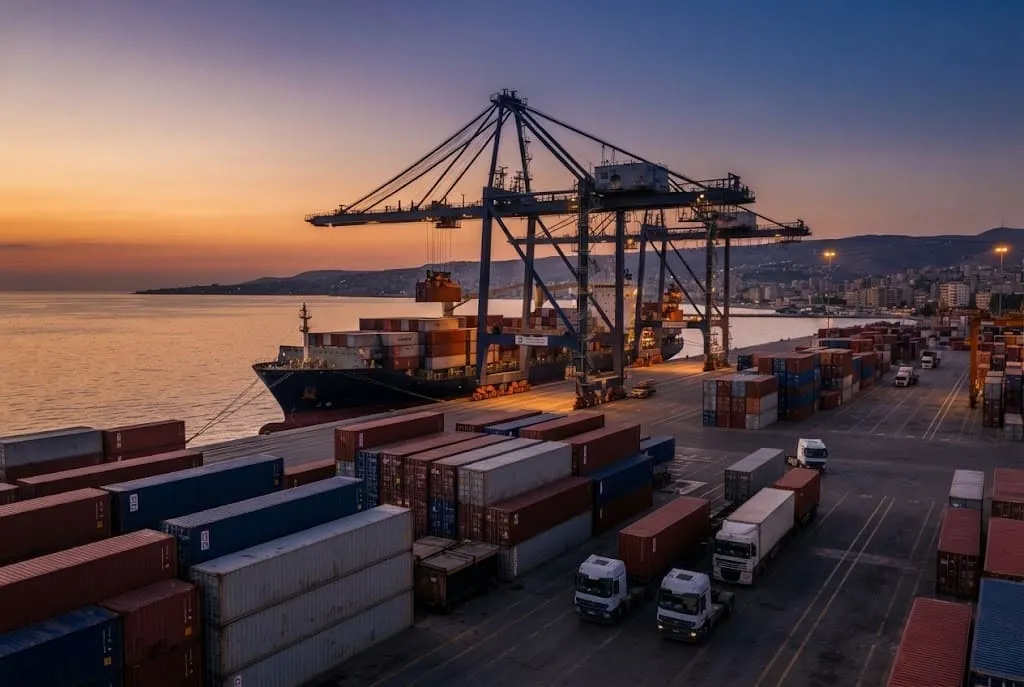
1. Tartus port development and operation
DP World began operating Tartus Port under a 30-year concession agreement, involving a planned USD 800 million investment in infrastructure, cargo-handling equipment, and digital systems.
By August 2026, the company had completed delivery of three mobile harbour cranes, marking progress in its modernization programme. Further development includes port infrastructure and logistics systems, with procurement opportunities determined by the operator’s implementation plans.
2. Damascus metro project
A USD 2 billion investment agreement was announced in August 2025 for a metro system in Damascus involving a UAE investment company.
The project remains at an early development stage, with detailed financing, design, and construction arrangements requiring confirmation. Potential future work includes civil engineering, stations, rail systems, electrical infrastructure, and supporting equipment, subject to approved execution packages.
3. Arada’s new Damascus development
In September 2026, UAE developer Arada announced a joint venture with the Syrian Sovereign Fund to develop a four-million-square-metre mixed-use community near Mezzeh.
The project has an estimated gross development value of USD 7 billion, covering housing, hospitality, healthcare, education, and commercial facilities. This figure represents projected development value, not capital already invested. The project remains subject to detailed planning and phased execution.
4. Eagle hills urban and turism developments
On October 5, 2026, UAE-based Eagle Hills signed a framework agreement for urban and tourism developments in Damascus and Latakia. On October 14, the company’s chairman outlined proposed investments of USD 16–17 billion.
These are planned developments rather than completed investments. Their future contracting and supply requirements depend on finalized designs, financing arrangements, approvals, and implementation schedules.
Kuwaitiinvestments and infrastructure projects in Syria
Kuwaiti investments in Syria include a major telecommunications commitment and technical cooperation in infrastructure assessment. These initiatives differ in scale and maturity, making it important to distinguish confirmed investment obligations from preliminary engineering activities.
1. Zain Syria telecommunications project
In June 2026, Kuwait’s Zain Group secured a 25-year telecommunications licence following a USD 747 million bid. The company also announced plans to invest more than USD 800 million over ten years in network expansion and modernization.
Zain intends to establish a Syrian operating company with 75% ownership, targeting commercial launch in the first quarter of 2027, subject to regulatory conditions. Network development may involve telecommunications equipment, towers, fiber infrastructure, and supporting power systems.
2. Damascus–nasib road assessment
In April 2026, Kuwait’s Combined Group Contracting Company worked with Syria’s Ministry of Transport on a technical assessment of the Damascus–Nasib highway, using laser scanning and three-dimensional road-surface analysis.
The assessment was presented as a technical contribution to identifying maintenance and rehabilitation requirements, not as a confirmed road reconstruction contract. Any subsequent works depend on the assessment findings, approved specifications, financing, and procurement decisions.
Jordan’s role in trade and infrastructure connectivity with Syria
Jordan provides an important overland route for trade and equipment shipments between Gulf markets and Syria. In April 2026, the two countries agreed to advance cooperation in border infrastructure, energy, railways, telecommunications, and transit.
A more concrete development is the Jaber border crossing project. On October 11, 2026, Jordan’s Ministry of Investment reissued the prequalification tender under a public-private partnership model covering design, construction, financing, operation, and maintenance. The project has reached procurement prequalification, not construction. Its planned scope includes freight and passenger facilities and supporting infrastructure.
For contractors and logistics companies, the distinction matters: border development represents a defined procurement process, while broader transport and energy integration remains subject to separate project approvals.
Egyptian investment and infrastructure cooperation in Syria
Egyptian construction group Hassan Allam Holding held investment discussions with Syrian authorities in May 2026 concerning real estate development, construction, and infrastructure rehabilitation. Further discussions addressed the potential development of Deir ez-Zor and Qamishli airports.
These initiatives indicate possible opportunities in airport rehabilitation, utilities, and construction. However, the reported meetings do not establish finalized investment contracts, approved project budgets, or available subcontracting packages.
Iraqi trade and energy projects in Syria
The reopening of the Al-Qaim border crossing in June 2025 restored an important trade and passenger route between Iraq and Syria.
Energy infrastructure is a separate potential investment area. In July 2026, Iraq approved preliminary agreements to study strategic oil export pipelines, including a proposed route toward Syria’s Mediterranean coast. These agreements concern feasibility studies and do not constitute final construction or financing commitments.
For logistics and infrastructure companies, existing cross-border trade provides a more immediate operating context, while pipeline-related opportunities depend on technical feasibility, financing, and final approvals.
Investment cooperation with Oman and Bahrain
Oman and Syria have discussed cooperation in trade, transport, investment, and reconstruction. In November 2025, Oman’s Ministry of Commerce, Industry and Investment Promotion reported discussions on facilitating business activities, transport connections, and potential participation by Omani companies in Syrian reconstruction projects.
Bahrain and Syria have existing bilateral investment and economic cooperation agreements. However, no comparable major new project with independently verified financing and execution arrangements was established for this review.
These developments indicate commercial engagement, but they should not be presented as confirmed investment projects without identifiable investors, contractual commitments, and implementation plans.
Key challenges facing Gulf and Arab investment in Syria
Despite growing opportunities, Gulf and Arab investments in Syria face challenges that can affect project costs, financing, and execution. Before committing capital or entering a contract, investors, contractors, and suppliers should assess six key risks:
- Project readiness: Announced investments and MoUs do not guarantee execution. Verify financing, approved project scope, permits, and procurement schedules before committing resources.
- Land ownership and approvals: Unresolved property rights, occupancy claims, and regulatory requirements can delay construction. Confirm land ownership, development rights, and necessary permits.
- Banking and compliance: Payment restrictions, exchange-rate exposure, and remaining targeted sanctions can affect transactions. Verify banking arrangements, counterparties, and applicable export controls.
- Infrastructure conditions: Inadequate utilities, damaged networks, or incomplete site data can increase costs. Assess access, power, water, and existing infrastructure before finalizing budgets.
- Procurement and logistics: Customs procedures, shipping costs, and equipment lead times can disrupt schedules. Establish realistic delivery costs and alternative supply arrangements.
- Contractual and partner risks: Unverified counterparties or unclear responsibilities can lead to disputes. Assess partners’ technical and financial capacity and define contractual obligations, payment terms, and performance requirements.
Addressing these risks requires coordination between investors, technical contractors, suppliers, and qualified legal and financial advisers. For construction and infrastructure projects, at Qiwaa Advance, we can help address relevant engineering, execution, and supply requirements through our EPC contracting and material sourcing capabilities.
If you are evaluating a project in Syria, contact usto discuss its technical scope, infrastructure requirements, and procurement needs.

From investment agreements to project execution
Not every announced investment creates an immediate contracting opportunity. For companies assessing Gulf investments in Syria, the key is determining when an agreement has progressed into a project with confirmed financing, defined technical requirements, and an executable scope of work.
Four milestones help establish project readiness:
- Commercial and investment viability: The project has a defined business model, identified demand, and an investment structure that establishes the parties’ roles and expected returns.
- Technical feasibility and project scope: Site assessments, preliminary engineering, capacity requirements, and cost estimates establish what needs to be built, supplied, or rehabilitated.
- Contractual and financial commitments: Binding agreements define responsibilities, risks, and payment obligations, while required permits and financing arrangements are secured for the relevant execution stage.
- Procurement and execution readiness: Approved specifications, work packages, schedules, and procurement procedures allow contractors and suppliers to assess opportunities and prepare proposals. Actual mobilization depends on contractual authorization and applicable project conditions.
For investors, these milestones help distinguish announced opportunities from projects ready for capital commitment. For contractors and suppliers, the decisive factor is whether a defined, authorized work package is available for bidding or negotiation—not the total value of the announced investment.
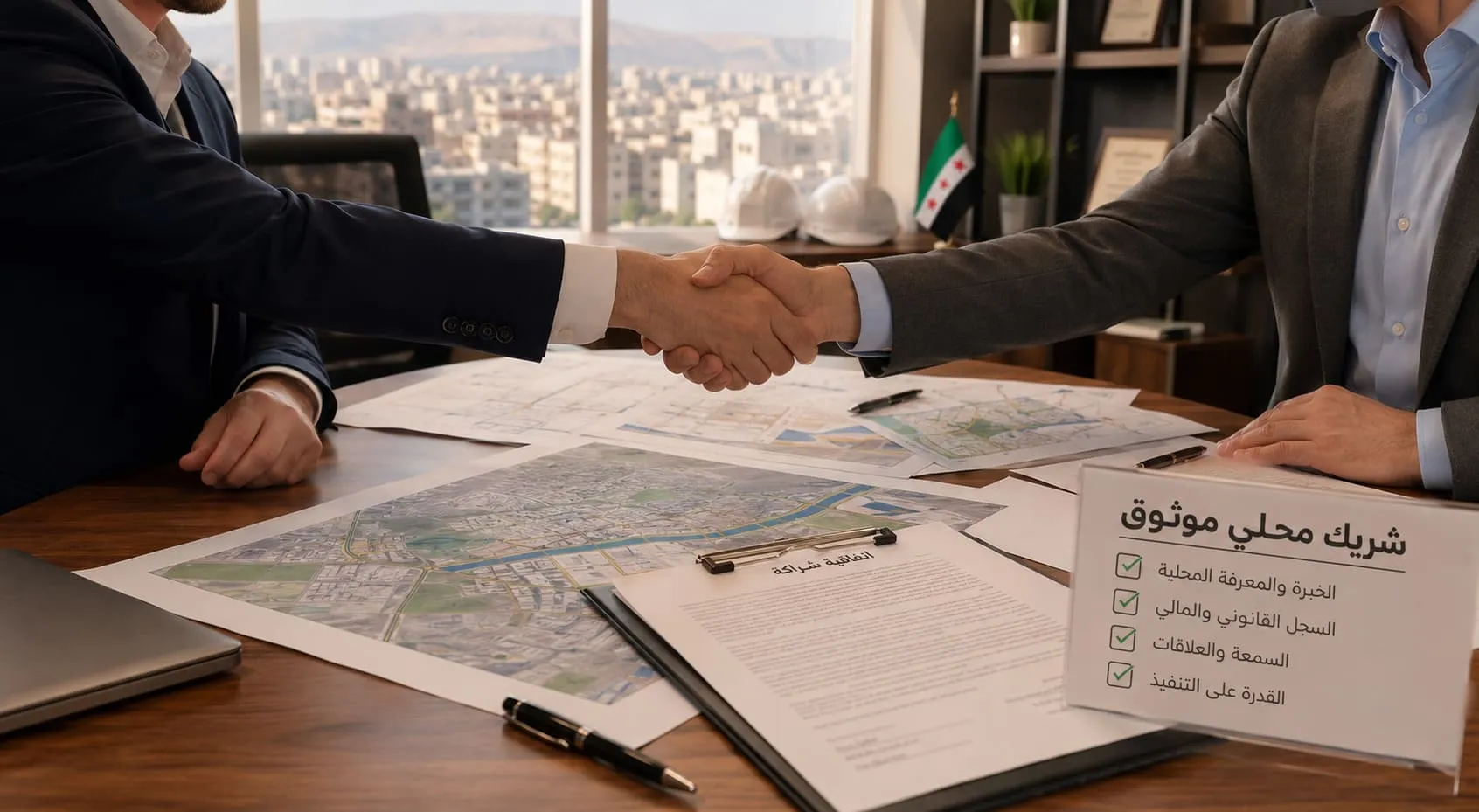
How to choose a local partner for investment pojects in Syria
For Gulf and Arab investors, choosing a local partner in Syria requires more than verifying commercial registration or business connections. The partner must demonstrate the technical, financial, and operational capabilities needed for the proposed project.
Evaluate prospective partners against the following criteria:
- Relevant project experience: Review completed projects of comparable scope and complexity, supported by client references and execution records.
- Engineering and execution capacity: Verify the availability of qualified technical teams, project management resources, and established quality and safety procedures.
- Procurement and supply capabilities: Examine supplier relationships, material sourcing options, delivery lead times, and alternatives for critical equipment.
- Cost and schedule management: Request evidence of budgeting, bills of quantities, procurement planning, progress reporting, and change-order controls.
- Local market knowledge: Assess familiarity with site conditions, regulatory procedures, labor availability, and transport and utility infrastructure.
- Legal and financial transparency: Verify ownership, contracting authority, financial capacity, banking arrangements, and relevant compliance records.
- Coordination and accountability: Confirm the ability to work with international teams, provide technical documentation, and meet agreed reporting and performance requirements.
For major Syria reconstruction projects, consider starting with a clearly defined engineering, construction, or supply package. Its delivery provides a practical basis for assessing the partner’s performance before expanding the relationship.
How Qiwaa Advance Supports Investment Projects in Syria
For Gulf and Arab investors entering Syria, translating an investment plan into an executable project requires coordination between engineering, procurement, and construction. At Qiwaa Advance, we support these requirements through our contracting, trading, and industrial capabilities, aligning the services we provide with each project’s technical scope.
Engineering and EPC Contracting
Through Qiwaa Contracting, we provide engineering, procurement, and construction (EPC) solutions for infrastructure projects, including water networks, desalination and treatment facilities, and concrete structures. Our capabilities also include specialized formwork systems for residential and commercial developments, where suitable for the approved design and execution schedule.
Construction Materials and Equipment Supply
Through Qiwaa Trading, we source construction and industrial materials, equipment, and infrastructure components through international suppliers and manufacturing partnerships. We also coordinate logistics and deliveries according to project specifications, quantities, and procurement schedules.
Rehabilitation and Industrial Solutions
Our services extend to building rehabilitation, heritage restoration, and commercial interior fit-out. Through our industrial capabilities, we also provide solutions for ready-mix concrete plants and construction-related materials, depending on the project’s production and technical requirements.
If you are evaluating a construction, infrastructure, or industrial investment project in Syria, contact Qiwaa Advance with its location, current stage, technical scope, and available drawings or material requirements. We can discuss the engineering, contracting, and supply solutions relevant to your project.
Read also: Infrastructure Contracting in Syria – Choosing the Right Contractor
FAQs about Gulf investments in Syria
Which Gulf country has invested the most in Syria?
There is no comprehensive, verified ranking based on capital actually invested. Qatar has announced major energy and airport investments, Saudi Arabia has signed numerous investment agreements, and the UAE and Kuwait have significant commitments in ports, real estate, and telecommunications. Announced values are not directly comparable because they represent different investment stages and financial measures.
Have Gulf investment projects in Syria started?
Yes, but progress varies. DP World operates Tartus Port, and the Al-Fayhaa cement plant has been inaugurated. Initial development works have also been reported at Damascus International Airport. Other projects, including Damascus Metro, remain at earlier stages. The award of a project such as SilkLink does not, by itself, establish that construction has begun.
What is the difference between an MoU and a final investment contract?
A memorandum of understanding generally establishes a framework for negotiation, although some provisions may be binding. A final contract defines enforceable rights and obligations, but construction may still depend on financing, permits, and other conditions.
Are Gulf investments in Syria free from sanctions restrictions?
No. The United States ended its comprehensive Syria sanctions programme in July 2025, and the European Union lifted broad economic sanctions in May 2025. However, targeted sanctions and certain export controls remain, requiring transaction-specific compliance checks.
Which sectors offer investment opportunities in Syria?
Energy, transport, telecommunications, water infrastructure, construction materials, real estate, and food production feature in announced Gulf and Arab investment projects in Syria. The commercial attractiveness of each opportunity depends on verified demand, financing, project readiness, and the investor’s capabilities.
Can Gulf companies enter Syria without major capital investment?
Yes. Depending on the activity and applicable requirements, companies may enter through supply contracts, subcontracting packages, technical services, or local distribution partnerships. These options allow companies to evaluate demand before committing to larger facilities or equity investments.
How can a Gulf company evaluate an investment opportunity in Syria?
Start by verifying the project’s commercial demand, legal status, financing, and implementation stage. Then assess site conditions, technical requirements, procurement opportunities, and the capabilities of potential local partners before committing capital or signing contracts.