

On 5 July 2026 the Syria Housing Establishment, formally the General Establishment for Housing, called on allocatees of ready homes in eight governorates to sign contracts and take possession. The deadline passed on 4 October, and we found no announcement of results by 31 October 2026. In parallel, the Establishment is moving to projects where the state provides the land and a partner developer builds. This article answers three questions for contractors and suppliers: where the remaining work really is, who the employer is on the new projects, and when demand for each material starts. It relies on official announcements and on the published decision and instruction numbers.
What the Syria Housing Establishment Announced in July-September 2026
In a circular issued on 5 July 2026, the Establishment asked allocatees of ready homes in eight governorates to sign contracts and collect their homes before 4 October 2026. Between August and September it turned to partnership projects, in which developers build on land the state provides.
The circular rests on Minister of Public Works and Housing Decision No. 3718 of 3 June 2026, executive Instructions No. 6283/K of 25 June 2026, and the Establishment’s Operations Regulation No. 8 of 2016.
Subscriptions for Abyat Hills in Qudsaya, a partnership with the Saudi company Abyat, opened on 5 August 2026. In September came Sham View, with the Saudi developer Thra, between Qudsaya and the Dummar project.
Syria Ready Homes Handover Circular: Eight Governorates, One Deadline
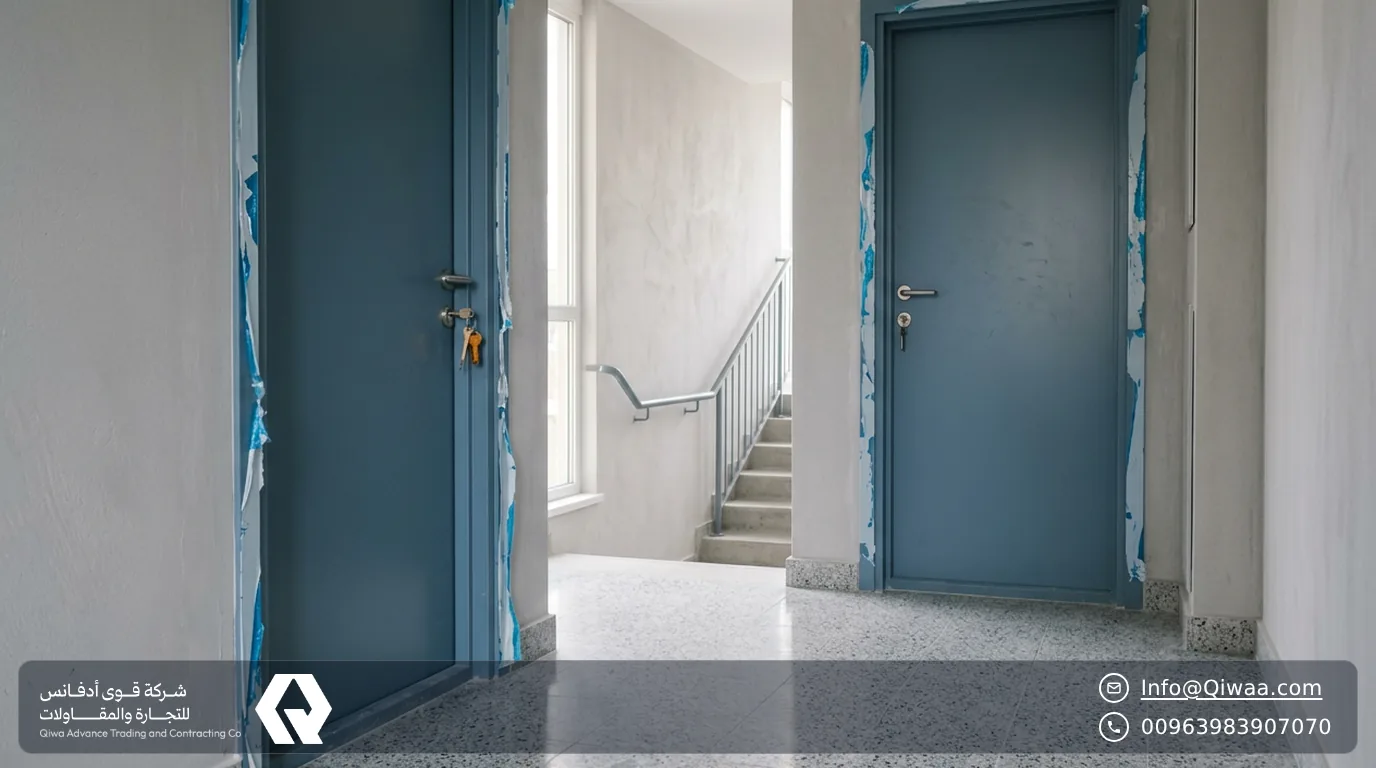
The circular told allocatees to report to the Establishment’s head office or its governorate branches to sign contracts and take delivery. It covered youth, savings and workers’ housing in Rural Damascus, Homs, Hama, Latakia, Tartus, Aleppo, Quneitra and Deir ez-Zor. The Establishment declared the notice personal notification and a final warning for anyone who did not report within the period.
The schemes named include youth housing in the Qudsaya expansion, savings housing north-west of Dummar and workers’ housing in Adra al-Ummaliya. We took the content of the circular from published coverage. We have not seen the attached tables, which are the reference for which buildings are covered.
We found no announcement of results, or of next steps, by 31 October 2026. On 29 September the ministry announced that deadlines for signing contracts, completing allocation procedures and paying obligations were extended to 15 December 2026, with late-payment fines waived. The text of those decisions defines who is covered. It was not clear to us whether they reach the ready-home allocatees named in the circular.
Who Is the Employer on New Syria Government Housing Projects?
Contractors are used to the Establishment being the contracting party: it tenders against a tender book and pays from its budget. Imad Al-Masri, assistant minister of public works and housing, described the partnership model in a statement on 24 September. The state provides the land, and the investor develops the project and its infrastructure.
Two things change. The partner developer tenders the packages and picks contractors on its own contract terms. And stage-linked payment schedules, such as the one published for Sham View, suggest that construction is funded largely from buyers’ instalments. That last point is our reading of the schedule, not an official statement, which is why each project’s contract has to be read before pricing.
Syria Two Million Homes by 2035: The Demand Behind the Programme
| Indicator | Published figure | Stated by |
|---|---|---|
| Existing housing stock | About 4.25 million units | Assistant Minister of Public Works and Housing, 24 September 2026 |
| Damaged units | About 1.32 million, to varying degrees | Same |
| Housing shortfall | About 1.9 million units in 2025, possibly 2.5 million by 2030 if supply does not accelerate | Same |
| Ministry target | Build or rehabilitate about two million units by 2035, cutting the deficit by more than 70% | Same |
| Private sector share | About 80% of need, through developers, real estate development and cooperatives | Establishment Director General Tammam Debl, August 2026 |
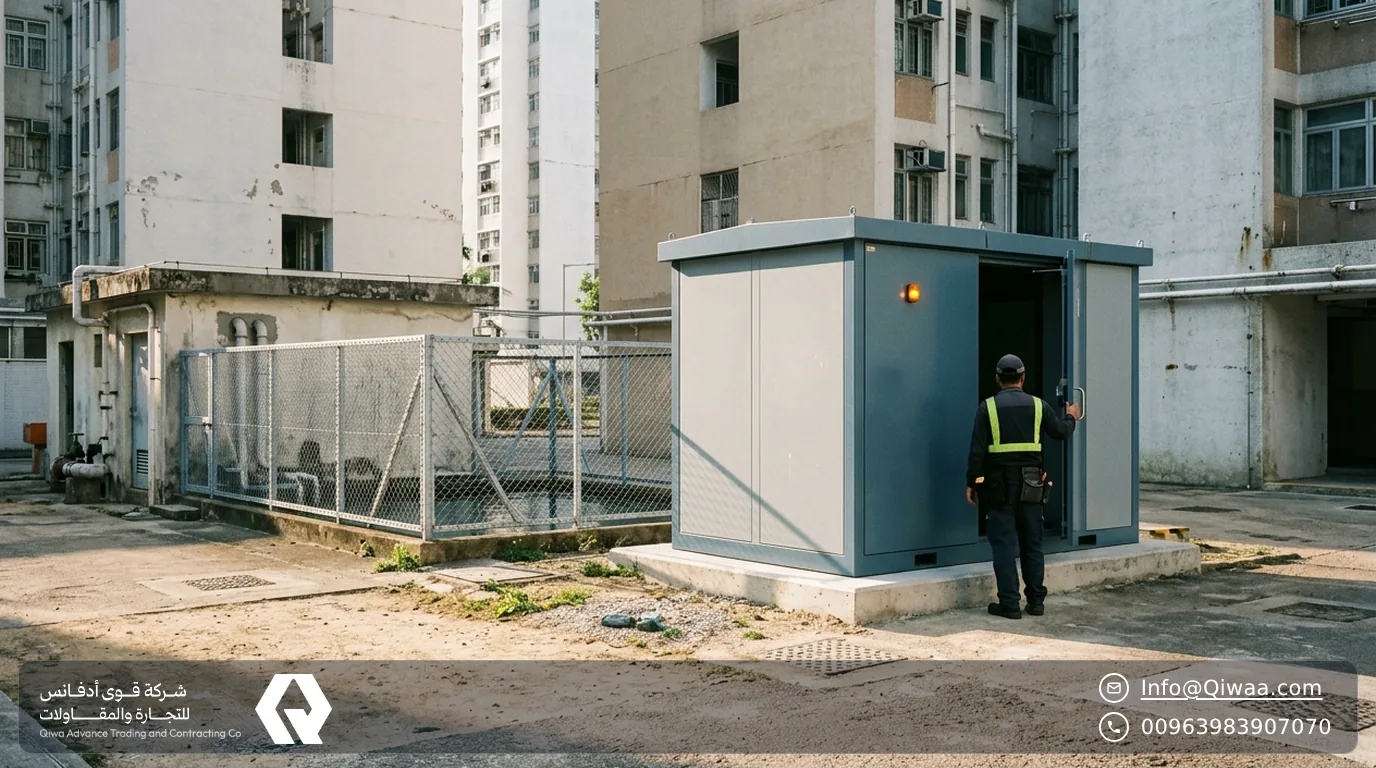
Al-Masri announced these figures and named two parallel tracks: completing delayed projects and handing over finished units, and developing new projects with private investors. Debl put need at more than 1.3 million destroyed homes plus a shortfall of over 400,000 units from population growth, and said the private sector, developers and cooperatives could cover about 80% of it.
These numbers show the ceiling of demand. They carry no annual schedule, no quantities and no sites. Readers following other sectors will find a wider view in our guide to Syria reconstruction projects in 2026.
Sham View Syria: What Payment Schedules Reveal About Material Demand
The official Sham View payment schedule was published on 22 September, with each instalment tied to a construction stage. We added a column that reads it from the supplier’s side. That column is our reading, not an official statement.
| Stage | Buyer payment | Expected material demand |
|---|---|---|
| Allocation (subscription deposit deducted) | 25% | Site preparation, excavation, early infrastructure |
| Foundations complete | 25% | Ready-mix concrete, rebar, foundation waterproofing, formwork |
| Concrete frame complete | 20% | Concrete, rebar, formwork and shoring, blockwork |
| Facades and corridors complete | 10% | Facade cladding, windows, balustrades |
| Interior finishing complete | 10% | Tiles, paint, sanitaryware, cabling |
| Final handover | 10% | Snagging and shared facilities |
About 45% of buyer payments fall at foundations and frame, the stages that consume concrete, rebar and formwork. A finishing supplier should not expect real orders before the frame is up. According to the official announcement, handover begins in 2029 and the estimated price of USD 1,180 to 1,460 per m² is fixed at allocation.
Published unit counts disagree. The 22 September announcement said the project exceeds 10,000 units across all phases, with 2,000 in phase one, while Al-Masri’s remarks on 24 September gave more than 7,500. We do not settle the difference here. The payment schedule remains the firmest information available.
Why Stalled Syria Youth Housing Projects Need Completion, Not Frames
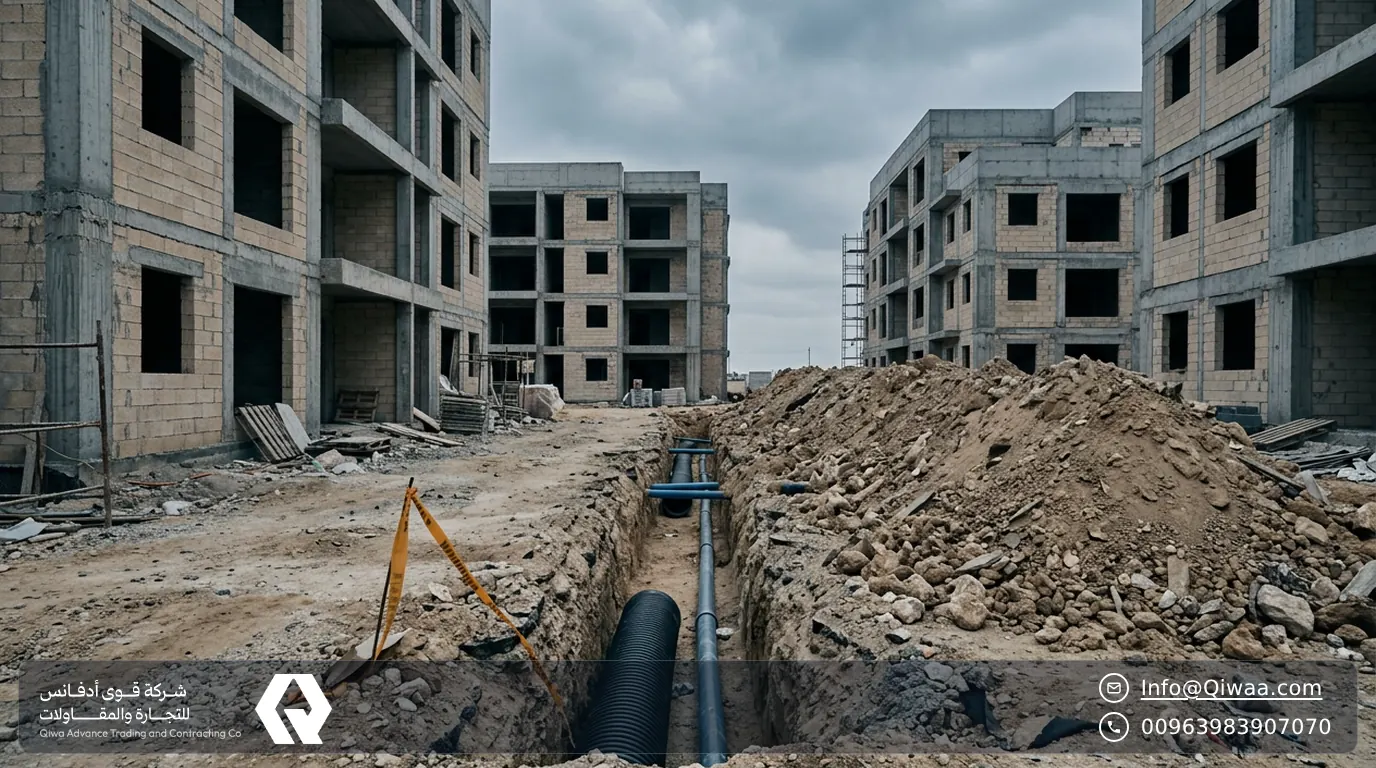
Our view at Qiwaa Advance is that the frames on most delayed schemes already stand, and that what remains is finishing, water and sewer networks, internal roads and services. We base this on a statement by Walid Maad, a former head of the Adra housing branch, not on a field survey of our own. He said many flats in the New Dimas project are built and finished but cannot be handed over for lack of infrastructure, sewage in particular. The original statement dates from September 2025, so conditions may have changed.
The opportunity therefore sits with an infrastructure contractor and a finishing supplier more than with a frame contractor. The work comes in mid-sized packages across several governorates, often inside a complex that may be partly occupied.
Syria Youth Housing Instalments and Price Variations: An Audit Lesson
In January 2026 the Central Organization for Financial Control said that the Establishment had paid price variations in breach of contract terms to a building contractor that installed lifts in housing projects in Latakia and Aleppo. Inspectors put the financial impact on the 2021 and 2022 contracts at about SYP 15.8 billion. Of that, SYP 4.8 billion was deducted and a claim of SYP 11 billion was raised. The report does not say whether these amounts are in old or new pounds.
The lesson is specific. A price-adjustment clause in a public contract is audited later, and money paid under it can be recovered years afterwards. Support every variation claim with the agreed index, the base date, the calculation method and signed committee minutes.
The monthly instalment for youth and workers’ housing stood at 25,000 old pounds, or 250 new pounds, as of July 2026. Mohammed Badawi, the ministry’s government communications director, spoke of a study to raise it, while Hassan Fallah, the Establishment’s director of social housing, said no decision had been issued. On 29 September the ministry decided to recalculate the value of allocated homes on actual costs, allowing for inflation. We found no decision on a new instalment by 31 October 2026.
How Contractors Can Work with the Syria Housing Establishment
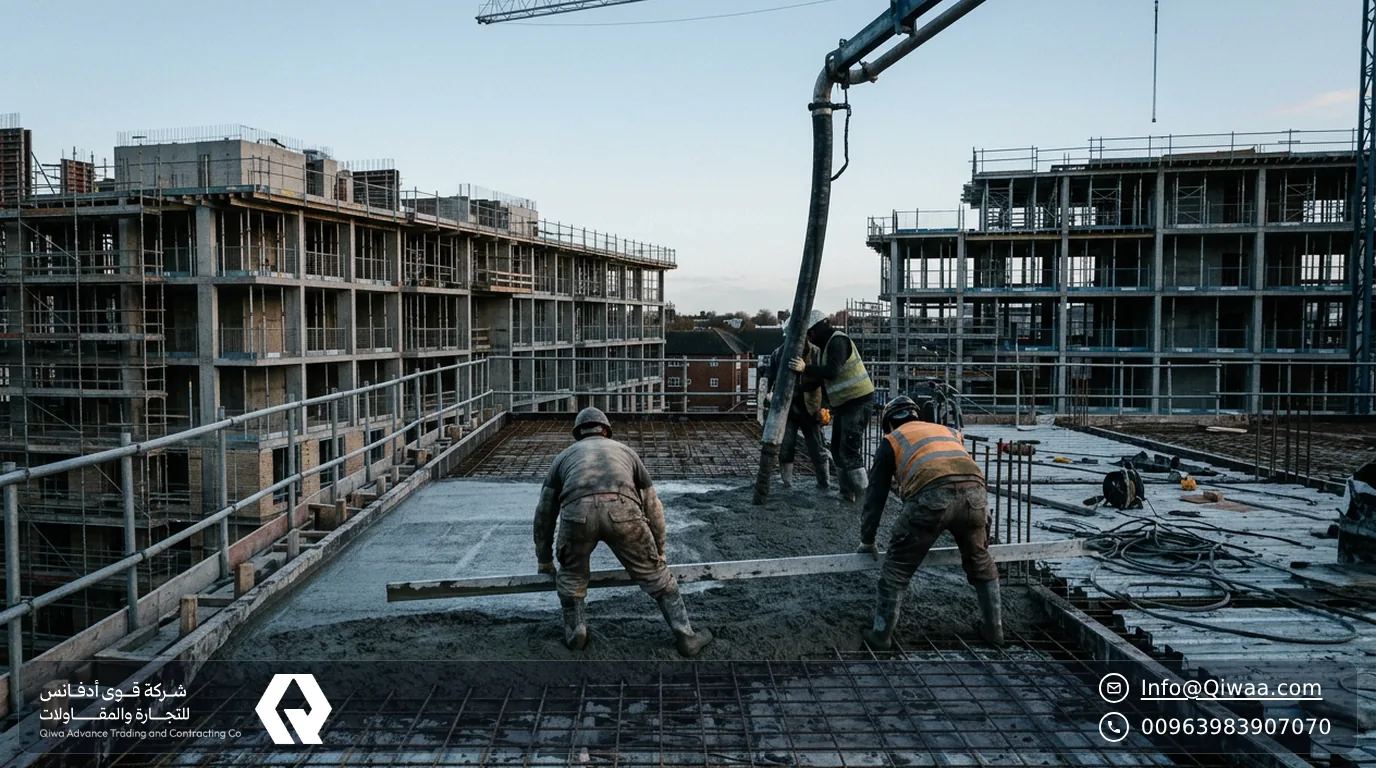
There are two routes in, and each has a different employer. The first is completion work on existing schemes. The second runs through the partner developer on partnership projects. We found no announced tender dates for either route as of 31 October 2026.
Contracting with Developers on Syria Housing Establishment Land
- Follow partnership announcements on the ministry’s and the Establishment’s official pages. The ministry published its latest decisions on its Telegram channel.
- Identify which developer holds the employer role on each project, and who its engineering consultant and supervisor are.
- Prepare a prequalification file with documented completed projects, equipment and staff. A company not yet registered should complete its registration first.
- Read the payment terms and ask whether your payments follow construction stages or the developer’s collections from buyers.
- Register as a supplier with the developer, with a materials list, monthly supply capacity and dated prices.
Our articles on tenders in Syria and on contractor prequalification cover public bidding and what owners check before awarding work.
Estimating Completion Packages on Syria Ready Homes Handover Projects
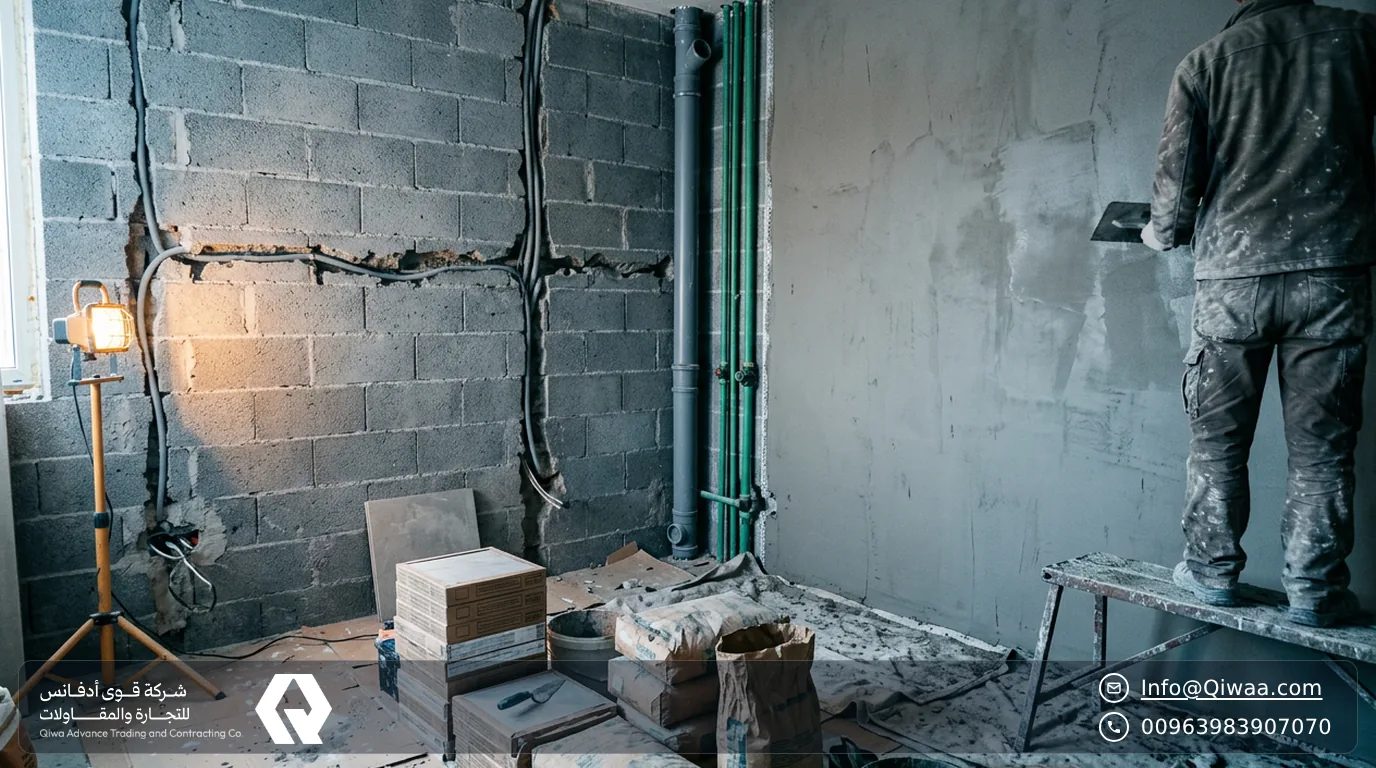
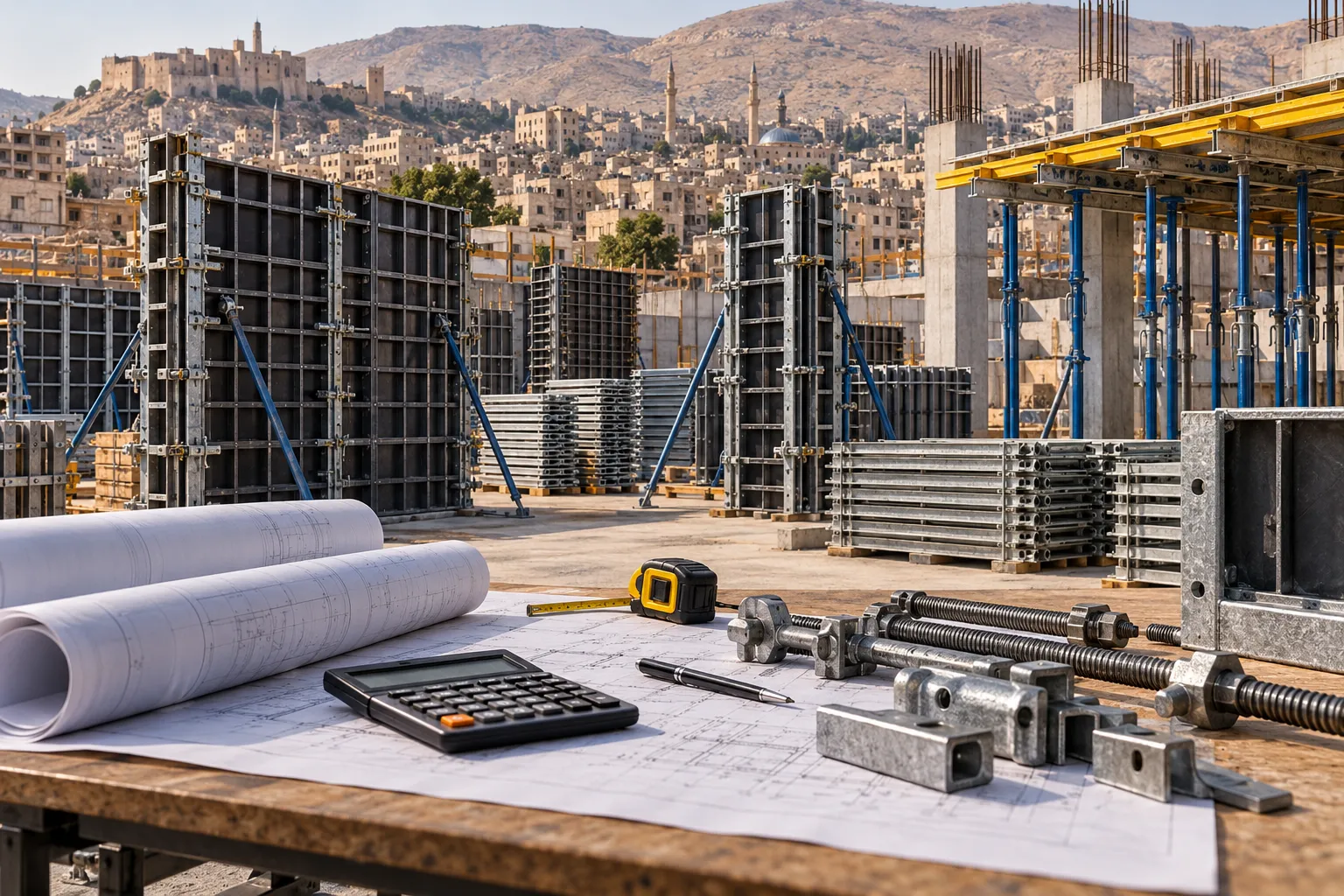
Estimation starts with take-off, not price. The table shows how to measure each package and who normally supplies it, as the basis for a bill of quantities.
| Package | Unit of measure | How to take off | Who supplies |
|---|---|---|---|
| Unit finishing | m² for tiling, paint and plaster; number of doors, windows and sanitary fittings | Survey a sample of units against each block’s progress, then apply it to similar blocks | Finishing suppliers, usually through the main contractor |
| Water and sewer networks | Linear metres per diameter; number of manholes and connections | Survey the existing network, mark what is installed and what is damaged, then measure lengths by diameter and depth | Pipe suppliers, for example GRP pipes for trunk lines |
| Internal roads | m² for asphalt and pavements; m³ for base layers | Survey the alignments and set the layers each road needs | Road contractor, asphalt and aggregate suppliers |
| Services | Linear metres of cable; number of poles, tanks and substations | Check the drawings against the site and list what each block lacks | Electrical and equipment suppliers, and the relevant utilities |
14 Things to Check Before Signing on Syria Government Housing Projects
- Confirm the employer: the Establishment, a public executing company or a partner developer.
- Ask where the money comes from: public budget, buyer instalments or developer funding.
- Check how payments are tied to stages and how each stage is certified as complete.
- Read the price-adjustment clause for the agreed index, the base date and the formula.
- Find out who audits variations later, against which minutes, and what happens if a payment is reversed.
- Fix the contract currency and the exchange rate. Our article on contracts in dollars and the new Syrian pound covers this point.
- Price the performance bond and the advance payment guarantee, and the term of each.
- Inspect existing networks before pricing, since parts may be damaged or out of specification.
- Verify actual progress block by block, not the overall project percentage.
- Ask about partly occupied units and the working hours allowed in them.
- Review the completion period, the delay penalties and what is excluded from them.
- Establish who takes over the works and how provisional and final acceptance are recorded.
- Set your real monthly capacity for execution or supply, and do not commit beyond it on a multi-block project.
- Keep a signed copy of every variation order and committee record before carrying out the work.
Qiwaa Advance: Tunnel Formwork and GRP Pipes for Housing in Syria
Qiwaa Advance is not contracted to the General Establishment for Housing or to any partner developer on these projects.
We work in Syria through Qiwaa Contracting and Qiwaa Trading. The completion packages this article describes touch two parts of our work: water and sewer networks, which Qiwaa Contracting delivers under the EPC model, and finishing materials, which Qiwaa Trading supplies against a bill of quantities. For new partnership blocks and for networks, two systems from our approved agencies also apply: tunnel formwork from Variant Factory LLC, and GRP pipes from the Saudi Amiantit group.
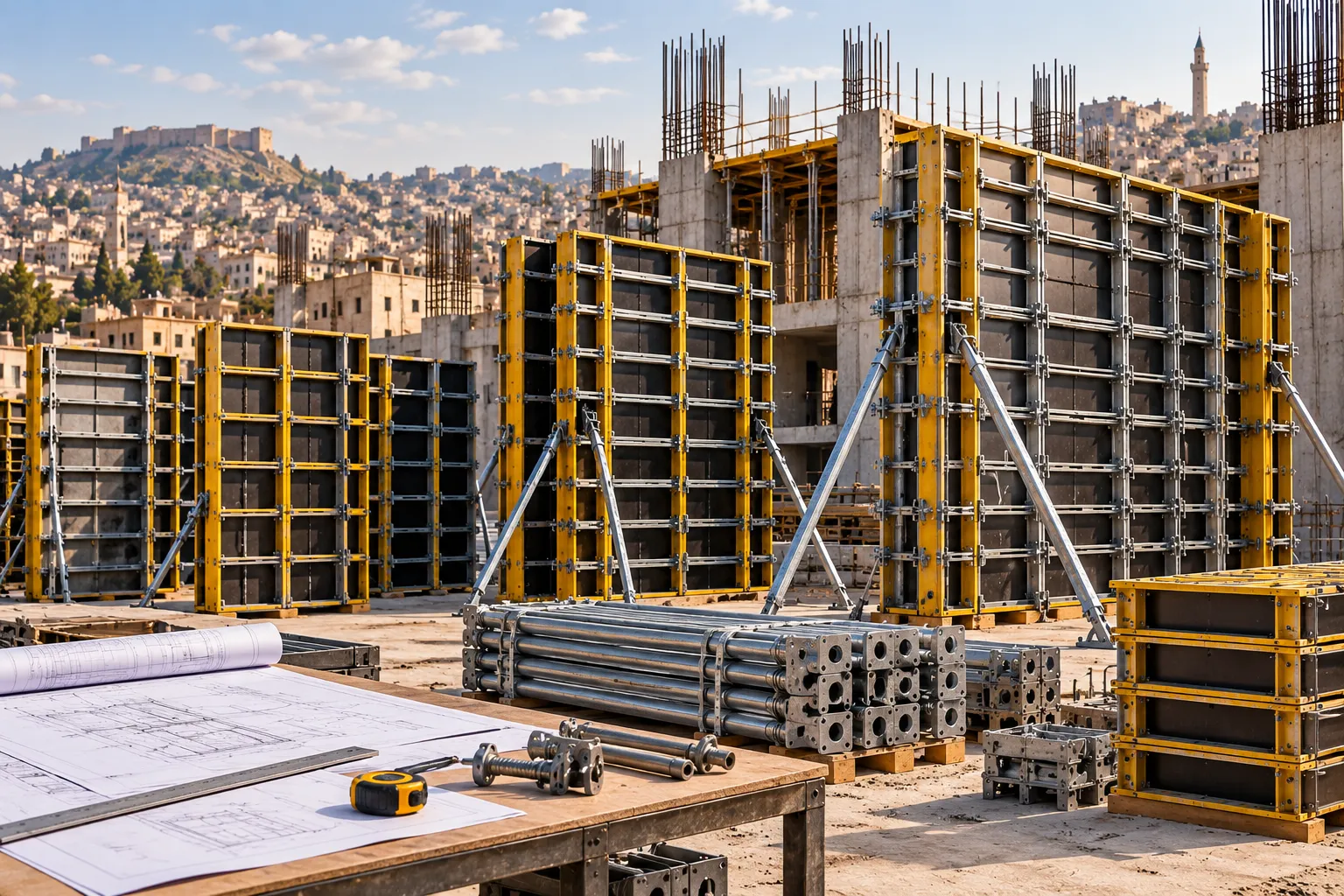
Tunnel formwork suits blocks where the flat and the floor repeat, because walls and slab are cast together in one cycle. We explain how it works in our article on the tunnel formwork system for repetitive projects.
Networks are a separate matter. The New Dimas case cited above shows finished flats waiting for sewerage. For water and sewer lines we supply GRP pipes, and the diameter, operating pressure and soil type decide which class fits.
Tunnel Formwork vs Conventional Formwork for Repeat Blocks: Comparison
| Criterion | Tunnel formwork | Conventional formwork |
|---|---|---|
| Suitability for repetition | Suits identical multi-storey blocks with repeated flats | Suits non-repetitive or small blocks and changing floor plans |
| Floor cycle | Usually shorter, because walls and slab are cast together | Longer, because columns, walls and slab are built in stages |
| Need for skilled labour | Smaller crew, but it must be trained on the system | Larger crew, with skills more common in the local market |
| Surface quality | Smooth, even surfaces that often reduce plastering | Varies with formwork condition and crew skill |
| Upfront investment | High, recovered over the number of reuses | Low, suited to short projects |
Conventional formwork remains the sensible choice for a single block or an irregular plan, where there is too little repetition to justify a tunnel system.
How Qiwaa Advance Supports Housing Block and Network Contractors
On a residential block, we start from the typical block drawings and the number of blocks and floors. Those figures decide whether a tunnel system pays for itself and how often it can be reused between blocks.
On networks, we ask for the BOQ with diameters and lengths, plus the governorate and the programme. Diameter, operating pressure and soil type set the pipe class.
What comes back is a formwork system study or a supply offer sized to the quantities and the delivery point. We name no price or date before that study.
If you have a block file or a network schedule, send it to our team on Qiwaa Advance’s WhatsApp with your expected start date, and Qiwaa Advance’s engineering team will review it before any offer.
Syria Housing Establishment and Ready Homes: FAQs
What happens to allocatees who missed the handover deadline?
The next step had not been announced by 31 October 2026. The Establishment treated its notice as personal notification and a final warning, and on 29 September the ministry extended deadlines for signing contracts and paying obligations to 15 December 2026. Check with your local branch and read the decisions. No penalty has been announced.
Have youth housing instalments in Syria gone up?
We found no official decision on a new instalment by 31 October 2026. In July a ministry official spoke of a study to raise it, and the Establishment said no decision had been issued. On 29 September the ministry decided to recalculate allocated home values without publishing figures.
How many homes does the Sham View project include?
Published figures conflict. The official announcement of 22 September 2026 said the project exceeds 10,000 units across all phases, with 2,000 in phase one, and the assistant minister said on 24 September that it has more than 7,500. We do not settle the difference. The stage-linked payment schedule is the clearest information available to contractors and suppliers.
Can private contractors work on Syria Housing Establishment projects?
Yes, through two routes: completion work on existing schemes, as tendered by the Establishment or its executing bodies, and contracts with the partner developer on partnership projects under that developer’s terms. Director General Tammam Debl said that the private sector, developers and cooperatives could cover about 80% of housing need.
The remaining work on the Establishment’s existing schemes is completion, networks and services, and on new projects the partner developer is the employer, so preparation starts there. If you are pricing a housing block or a network, send the typical block drawings or the network BOQ, with the governorate and programme, to Qiwaa Advance on WhatsApp.
Sources
- Housing calls on allocatees of ready homes in 8 governorates to sign contracts and take possession (Arabic), SANA, 13 July 2026
- Syria’s Housing Establishment starts handing over ready homes in eight governorates (Arabic), Enab Baladi, 6 July 2026
- Housing ministry grants new grace period to late payers in housing programmes (Arabic), SANA, 29 September 2026
- Two million units by 2035: ministry of public works says increasing supply is part of addressing the housing crisis (Arabic), SANA, 24 September 2026
- Syria to build two million homes by 2035 to plug housing shortage, The National, 24 September 2026
- Subscription begins: can partnership projects solve the housing crisis? (Arabic), Enab Baladi, 3 August 2026
- 2,000 housing units in the first phase of Sham View, handover from 2029 (Arabic), SANA, 22 September 2026
- Study of higher instalments threatens housing subscribers in Syria (Arabic), Enab Baladi, 6 July 2026
- Financial control authority uncovers financial irregularities of about SYP 16 billion at the General Establishment for Housing (Arabic), SANA, 14 January 2026