

Buying steel formwork in Syria based on panel prices alone can result in incomplete equipment sets, additional lifting costs, or more formwork than your construction schedule requires. The real challenge is ensuring that the purchased system matches the structural drawings, planned pour sequence, and available site resources.
This guide explains how to select suitable steel formwork systems, evaluate their costs against project requirements, and identify hidden expenses before purchasing. It also covers the technical and commercial details to request from suppliers and how Qiwaa Advance works with Variant Factory to support formwork projects in Syria.
What matters before buying a steel formwork system?
The suitability of a steel formwork system depends on more than its panel dimensions or advertised capacity. For contractors, the key consideration is whether the proposed configuration can cover the required casting zones within the planned construction cycle, without unnecessary equipment or handling constraints.
Two systems with the same nominal panel area may require different quantities of connecting components, special panels, support equipment, and lifting resources. The required set size also depends on how many pour zones must be equipped simultaneously and how quickly the formwork can be stripped and repositioned.
Before comparing steel formwork prices, establish the required configuration against the project drawings, concrete pressure and support requirements, crane availability, and planned reuse. This provides a more reliable purchasing basis than comparing panel area alone.
Steel formwork system components
For procurement teams, the main concern is not identifying standard formwork components, but confirming that the proposed equipment schedule covers the complete installation and planned pour sequence.
A supplier’s component list should account for panel sizes and configurations, corners, stop-ends, tie arrangements, bracing, working platforms, and the lifting or handling accessories required by the selected system. Particular attention is needed where standard panels cannot accommodate openings, intersections, or non-standard dimensions without additional components.
Component compatibility also matters. Steel-framed formwork systems may use replaceable plywood facing, so the purchase evaluation should distinguish between the frame’s reuse potential, facing replacement requirements, and the availability of compatible accessories.
Before approving the offer, request a component schedule linked to the proposed formwork layout. It should distinguish equipment that can be reused between pour zones from components required simultaneously. This helps identify shortages, unnecessary quantities, and additional purchases before work begins.
When is steel formwork more cost-effective than timber?
The economic advantage of steel formwork over timber formwork depends primarily on repetition, equipment utilization, and the construction method.
For projects with repeated wall, column, or slab configurations, modular systems can reduce repeated fabrication and adjustment work. However, these benefits depend on whether crews can reuse the equipment efficiently within the planned pour cycle and whether the site has the required handling resources.
Conventional timber formwork may remain more economical for isolated pours or irregular elements where purchasing specialized panels and accessories would not be justified. A combination of modular formwork and project-specific timber sections may also be practical.
For purchasing decisions, compare the cost per completed pour, considering the initial system investment, expected reuse, labor, lifting, maintenance, and storage. A lower initial price does not necessarily represent the more economical option across the project’s execution schedule.
Read also: Concrete Admixtures in Syria: Improve Ready-Mix Quality
Types of concrete formwork and their uses
Selecting the right steel formwork system requires matching its configuration to the project’s pour sequence, structural requirements, and available handling equipment. For contractors buying steel formwork in Syria, the key is to determine which system can achieve the planned construction cycle without purchasing excess equipment or overlooking essential supporting components.
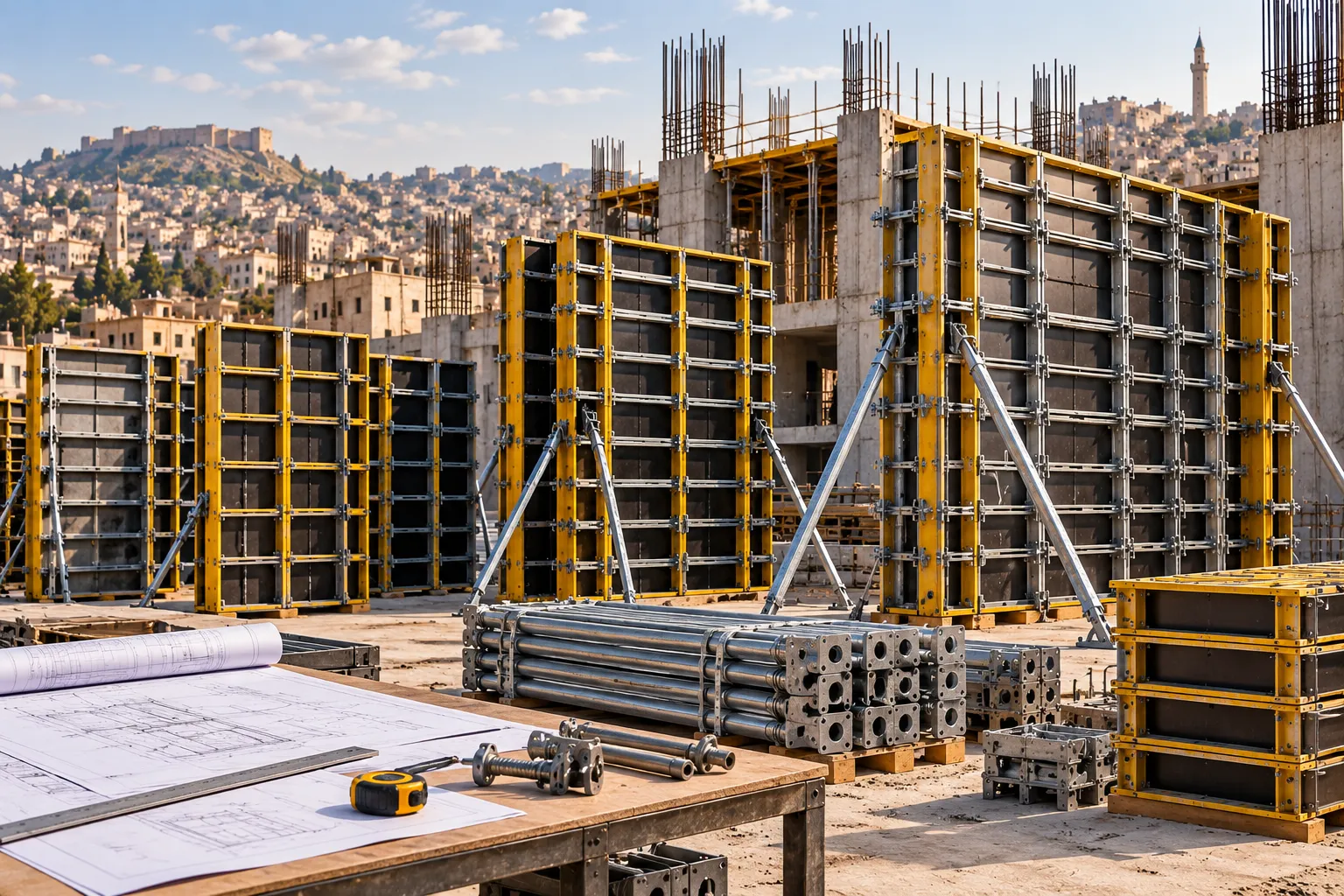
Wall formwork
The choice between lightweight and heavy-duty wall formwork depends on fresh-concrete pressure, pour height, crane availability, and how frequently panels must move between casting zones.
Variant’s HANDI is designed for manual handling and permits fresh-concrete pressure up to 35 kN/m². VARIECO offers 60 kN/m² for configurations up to 3 m and 40 kN/m² up to 4.5 m. For more demanding applications, VARIMAX provides framed panels rated up to 80 kN/m² under the manufacturer’s specified conditions.
These capacities are not interchangeable purchasing criteria. The selected system must accommodate the calculated concrete pressure, placement rate, panel configuration, and required bracing and tie arrangements.
For procurement, compare the equipment needed to cover each planned pour zone, including corners, closures, connections, and lifting requirements. A lightweight system may reduce crane dependency, while larger panels may reduce the number of units handled per cycle. The better choice depends on site logistics and the required production sequence, not the published pressure capacity alone.
Slab formwork and Its supporting props
Slab formwork selection should account for floor-plate repetition, slab thickness, support height, and the equipment that must remain in place while subsequent pours proceed.
Variant offers VARIFLEX, an adjustable beam-and-prop system suited to varying slab layouts, and VARITABLE, which allows assembled tables to be repositioned across repeated slab areas. Its Top Tower shoring systems provide temporary support for applications requiring different load capacities and configurations.
For projects with repetitive floor plates, table formwork may reduce repeated assembly work, provided the site allows efficient repositioning. Beam-and-prop systems can offer greater flexibility around irregular layouts, openings, and changing slab dimensions.
Before purchasing, request an engineered layout showing prop spacing, support loads, formwork heights, and the equipment required for each construction stage. Confirm the stripping and reshoring requirements, since components remaining in service may not be available for the next pour. The purchase quantity should reflect the actual construction sequence, not the total slab area alone.
Column, circular and tunnel formwork
For column formwork, the purchasing decision depends on cross-section variability, repetition, permissible concrete pressure, and whether the same panel set can serve multiple column sizes.
Variant offers systems including VARIMAX, VARIMID, HANDI, and VERTEX 60 for different column configurations. SK100 is intended for circular columns, while RINGFORM serves curved and circular wall applications.
When evaluating column systems, verify the range of cross-sections achievable with the proposed panels and the additional components needed for different dimensions. Reusing one configuration across repeated elements may be more economical than purchasing separate sets, provided the pour schedule permits it.
For projects with highly repetitive wall and slab layouts, Variant’s UNIFORM tunnel formwork allows both elements to be cast within a coordinated cycle. However, its purchasing value depends on layout repetition, extraction clearance, lifting arrangements, and the number of cycles over which the equipment can be utilized.
The objective when comparing concrete formwork systems is to select the configuration that meets the project’s engineering and production requirements at a justified total cost, rather than choosing a manufacturer or system based on its product range alone.
Read also: Heritage Building Restoration in Syria: Solutions for Reconstruction 2026
Concrete formwork prices
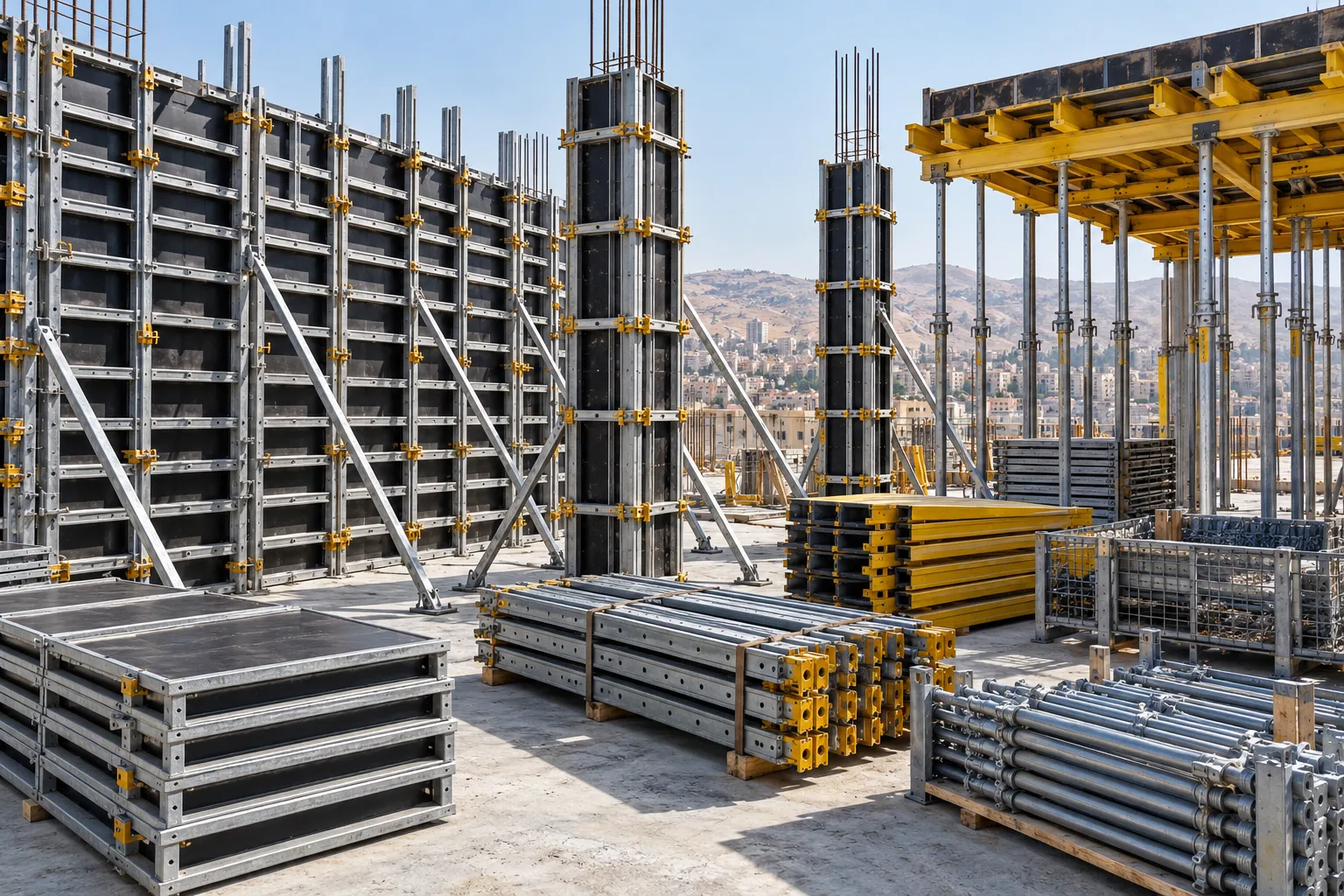
Steel formwork prices in Syria depend on the equipment configuration, required quantities, engineering scope, and delivery conditions. A quoted price per square meter may refer only to the supplied panel area, excluding the components and services required to operate the system. It should not be confused with the cost per square meter of concrete surface formed over multiple uses.
For contractors, the purchasing evaluation should distinguish between the total delivered system cost and the effective cost of using that system across the planned construction cycles. The first covers acquiring a complete equipment set, while the second also considers achievable reuse, erection and stripping labor, crane operations, and maintenance.
A useful initial calculation is:
Equipment cost per m² formed = Total delivered system acquisition cost ÷ Total concrete-contact area formed across planned uses
This measures the acquisition cost allocated to the expected output; labor, handling, and recurring maintenance costs must be assessed separately. The calculation should use realistically achievable reuse rather than the manufacturer’s maximum theoretical capacity.
Variant Factory similarly emphasizes evaluating formwork solutions against their cost of use across construction cycles, with equipment quantities determined by the project layout and execution schedule.
Six factors that determine concrete formwork prices
- Type and configuration of the system: Lightweight, heavy-duty, slab, and tunnel formwork systems require different equipment configurations. Compare the cost of a system that meets the approved engineering requirements, rather than paying for capacity or features the project cannot effectively utilize.
- Formwork area and equipment utilization: The total concrete-contact area is not the same as the panel area that must be purchased. The required set depends on the dimensions of individual pour zones, simultaneous casting requirements, and equipment availability between cycles. Incorrect assumptions can result in excess equipment or additional purchases.
- Concrete pressure and structural requirements: Fresh-concrete pressure, placement rate, pour height, and permissible system loads determine the required panel configuration, tie arrangement, and support components. Compare quotations against the same approved design requirements, not just nominal panel capacities.
- Accessories and replacement components: Panel prices may exclude essential connections, bracing, platforms, lifting accessories, or consumable components. Distinguish reusable equipment from items requiring periodic replacement, and verify that the priced component schedule covers the proposed system configuration.
- Engineering and technical support: Formwork layout drawings, load calculations, assembly documentation, design revisions, and site support may be included in the equipment price or charged separately. Establish which deliverables and services are contractually included, particularly where non-standard elements require additional engineering.
- Logistics and delivery terms in Syria: Equipment volume, shipment arrangements, import-related charges where applicable, unloading responsibilities, and phased deliveries can change the final acquisition cost. Confirm the quotation currency, validity period, delivery basis, and responsibility for additional logistics expenses.
When comparing concrete formwork prices, evaluate competing quotations against the same engineering scope, equipment utilization assumptions, and delivery conditions. A lower purchase price is only advantageous if the system can achieve the required construction output without offsetting costs elsewhere.
What a formwork engineering proposal should include
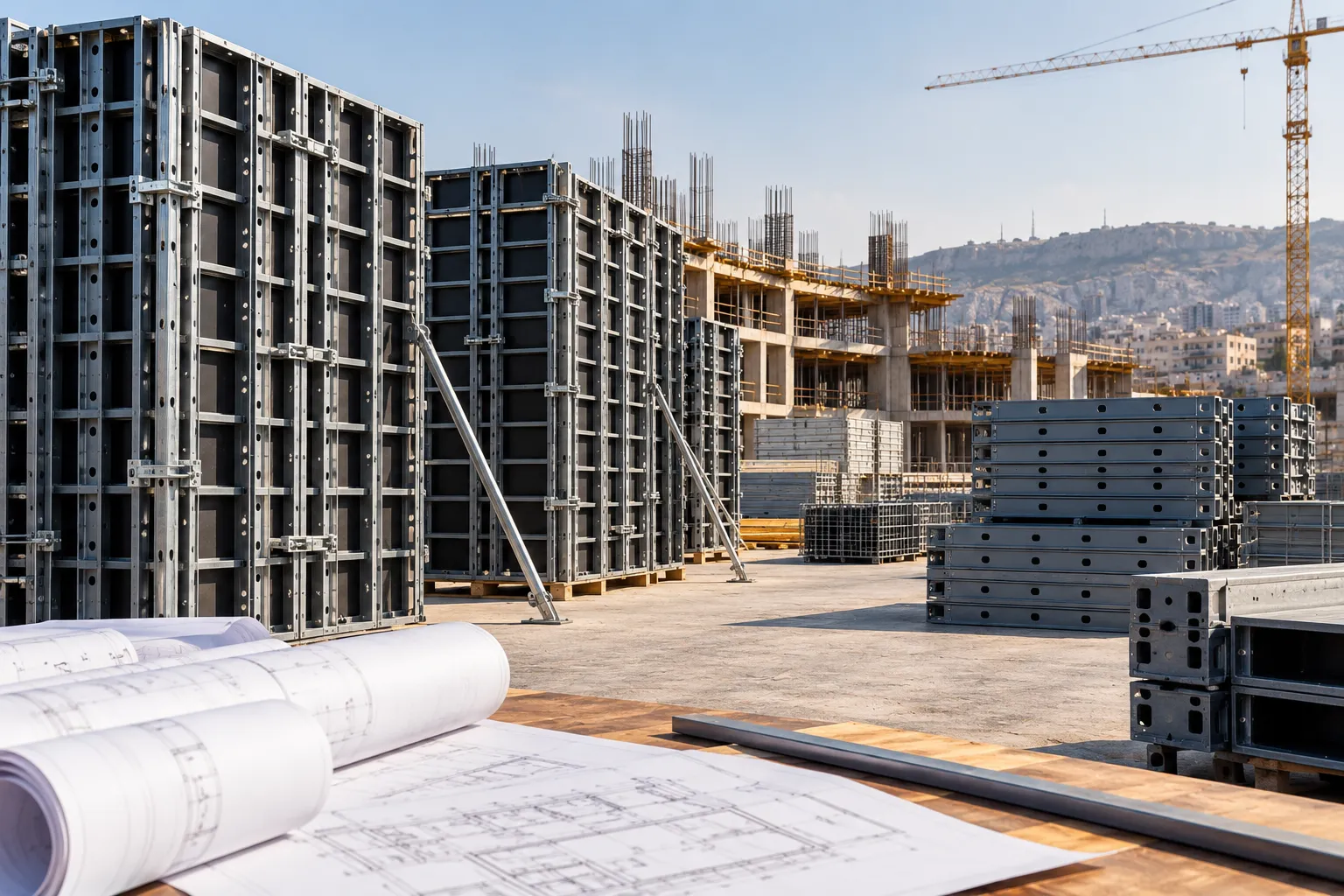
Formwork system design determines whether the proposed equipment can meet the project’s structural requirements and planned concrete pour cycles. Before approving a steel formwork purchase, contractors should verify that the engineering proposal covers actual site conditions, not just standard manufacturer configurations.
The technical review should establish three essential deliverables:
- Verified load calculations: Confirm that fresh-concrete pressure, pour height, placement rate, temporary construction loads, and applicable stability requirements are addressed. Calculations must correspond to the proposed panel, tie, bracing, and support arrangements.
- Pour-specific layout drawings: Request drawings identifying panel configurations, connections, support positions, non-standard details, and the equipment required for each casting zone. These should distinguish components needed simultaneously from those available for reuse in subsequent cycles.
- Engineering and site-support scope: Establish who prepares and checks the design, issues approved revisions, provides assembly and lifting instructions, and supports the crew during initial installation. Training or on-site supervision should be included only where expressly agreed.
A critical purchasing risk arises when the approved construction sequence changes after the equipment has been priced. Revised pour heights, additional simultaneous work zones, or changes to crane access may require different components, revised calculations, or additional equipment.
Variant Factory describes an engineering support process covering project analysis, formwork layouts, component schedules, technical documentation, and potential crew training or supervised initial installation. However, the deliverables and services included in a particular purchase must be confirmed in the contractual scope.
Before approving the technical offer, ensure that the drawings, calculations, equipment schedule, and construction sequence refer to the same approved project revision. Any outstanding engineering work, site-support requirements, or responsibilities retained by the contractor should be identified before the purchase order is issued.
14 points to check before buying steel formwork
A steel formwork purchase checklist should verify whether the proposed system is technically suitable, commercially complete, and capable of supporting the planned construction sequence. Before accepting a supplier’s quotation, check the following:
- Confirm the design basis: Ensure the quotation references the current structural drawings, element dimensions, pour heights, construction sequence, and required formwork quantities. Identify assumptions that require confirmation before final approval.
- Identify the manufacturer and system configuration: Require the exact system name, panel specifications, and approved component combinations. Generic descriptions such as “heavy-duty steel formwork” are insufficient for technical comparison.
- Verify design loads and permissible concrete pressure: Check that the manufacturer’s published capacities are applicable to the proposed arrangement and supported by project-specific calculations, including placement conditions, connections, and temporary stability.
- Match the equipment set to the pour schedule: Verify the number of simultaneous casting zones, relocation sequence, and expected reuse. Ensure the proposed quantity does not depend on components becoming available before they can safely be released.
- Review formwork layout and connection details: Confirm that drawings cover corners, intersections, openings, stop-ends, and non-standard dimensions, including required ties, anchors, and bracing arrangements.
- Check lifting and handling compatibility: Compare panel weights, lifting points, assembly sizes, crane capacity, site access, and relocation routes. Identify any additional lifting equipment or handling restrictions before purchase.
- Reconcile the component schedule with the quotation: Match panel quantities, connections, supports, platforms, and system-specific accessories against the approved layout. Identify excluded items and components requiring separate purchase.
- Assess frame protection and facing replacement: Verify the frame specification, protective finish, concrete-contact facing, and replacement arrangements. Confirm whether damaged or worn facing materials can be replaced without purchasing complete panels.
- Check equipment condition and spare-part availability: Establish whether the supplied equipment is new or used, the applicable inspection criteria, and the availability of compatible replacement components. Include any required spare parts in the purchasing scope.
- Evaluate cost across planned uses: Compare the total acquisition cost against achievable reuse, labor, lifting, maintenance, and storage expenses. Avoid basing the investment decision on the initial steel formwork price alone.
- Compare purchase, rental, and existing equipment options: Where available, assess whether renting or supplementing an existing compatible system is more economical than purchasing a complete new set. Verify compatibility and the full commercial terms before making the comparison.
- Verify manufacturer documentation and traceability: Request technical data sheets, operating limits, assembly instructions, and relevant product identification. Confirm that the supplied configuration matches the documentation used for engineering approval.
- Define engineering responsibilities and technical support: Specify who is responsible for calculations, design checks, drawing revisions, crew training, and initial assembly supervision. Identify included services, exclusions, and any separate charges.
- Confirm delivery and contractual terms: Establish the quotation currency and validity, delivery location, shipment schedule, transport and unloading responsibilities, applicable import charges, and procedures for damaged, missing, or nonconforming components.
The final purchasing decision should be based on a technically approved equipment configuration and a complete commercial scope. Before signing, reconcile the formwork layout, component schedule, engineering deliverables, and quotation to identify discrepancies that could require additional expenditure or disrupt the planned concrete pour cycles.
Choosing a Steel Formwork Supplier in Syria
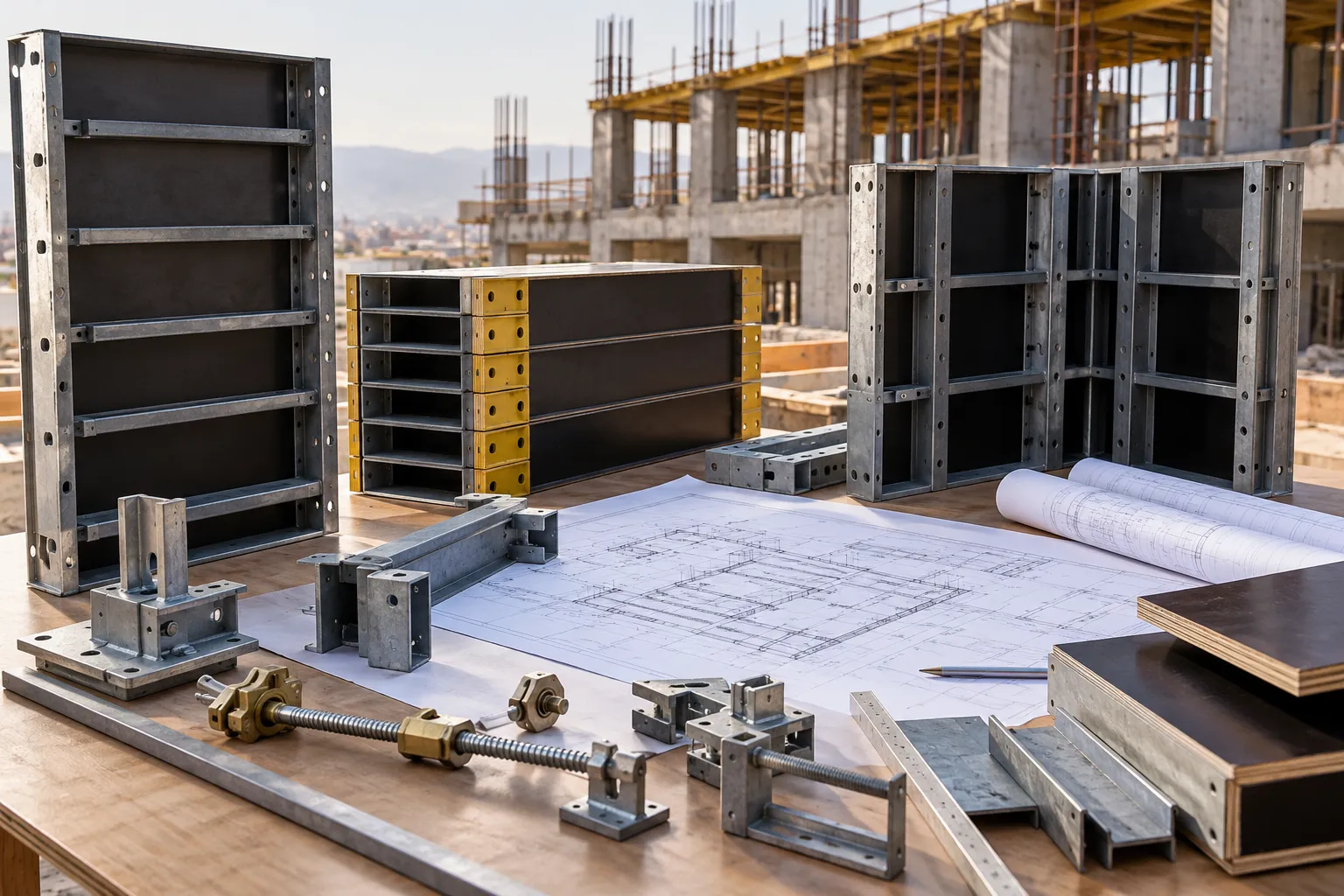
Choosing a steel formwork supplier in Syria requires more than confirming product availability or comparing purchase prices. Contractors need to know whether the supplier can coordinate the specified system with its manufacturer, establish a complete supply scope, and address technical or delivery issues before they affect construction.
A supplier’s value becomes clearer when responsibilities are defined: who coordinates manufacturer-approved configurations, who provides the required technical documentation, and who handles equipment availability and delivery? These arrangements matter particularly when sourcing imported systems that may require additional components or technical support during execution.
Qiwaa Advance: Authorized agent for variant factory in Syria
At Qiwaa Advance, we list Variant Factory among our authorized agencies in Syria. Through this cooperation, we support contractors and developers in sourcing specialized formwork systems and coordinating project requirements with the manufacturer.
Our role includes:
- Project-specific system selection: Reviewing structural drawings, casting sequences, site constraints, and lifting requirements to help identify suitable Variant formwork configurations.
- Manufacturer coordination: Coordinating technical specifications, equipment requirements, and access to manufacturer documentation and support according to the project’s needs.
- Supply and logistics coordination: Arranging formwork equipment supply, shipping, customs clearance, and delivery requirements for projects in Syria.
This cooperation connects the project’s technical requirements with specialized manufacturing expertise and local procurement coordination. Final equipment configurations, engineering responsibilities, and support services remain subject to the approved project requirements and agreed supply scope.
To discuss a steel formwork supply proposal, contact Qiwaa Advance with your structural drawings, planned pour sequence, project location, and required delivery date.
Steel formwork vs timber formwork
The choice between steel formwork and timber formwork becomes a financial decision when contractors assess how each option performs under the project’s actual construction conditions.
| Project condition | Steel formwork | Timber formwork |
|---|---|---|
| Repetitive structural layouts | Modular sets can be reused across similar casting zones, improving equipment utilization | Repeated fabrication and adjustments can increase labor requirements |
| Irregular or frequently changing geometry | Special panels or additional components may increase acquisition costs | Custom fabrication may offer greater flexibility for isolated elements |
| Limited crane availability | Manually handled systems may be viable, subject to component weights and site requirements | May suit smaller assemblies, depending on labor and handling conditions |
| Multiple simultaneous pours | Requires sufficient equipment and support components for overlapping work cycles | Separate assemblies may be fabricated, with additional labor and material requirements |
| Limited future reuse | Purchasing may tie up capital in equipment with uncertain subsequent utilization | May involve a lower initial commitment for short, non-repetitive work |
The decisive factor is the cost of achieving the required construction output, not whether steel or timber is cheaper to purchase initially. For projects combining repetitive and irregular elements, a mixed formwork strategy may be more economical than using one system throughout.
What should a steel formwork supply contract include?
Before issuing a purchase order, contractors should ensure that the agreed technical proposal is reflected in the commercial contract. A technically suitable system can still generate additional costs if drawings, equipment quantities, services, and delivery responsibilities are not contractually aligned.
The agreement should establish:
- Approved equipment scope: Reference the agreed formwork layout and component schedule, including document revisions and priced quantities. Define how substitutions, missing components, and additional equipment will be handled.
- Engineering responsibilities: Identify who provides and approves calculations, technical drawings, assembly instructions, and revisions when construction requirements change.
- Included services and exclusions: State whether manufacturer support, crew training, initial erection supervision, spare components, and subsequent technical assistance are included or separately charged.
- Delivery and acceptance conditions: Specify shipment stages, delivery responsibilities, applicable customs and unloading charges, inspection procedures, and how shortages or damaged components will be resolved.
Variant Factory publishes engineering design, technical documentation, training, and technical support among its services. However, their availability does not mean they are automatically included in every equipment purchase.
The final contract should match the approved technical offer, with responsibilities, exclusions, and additional charges documented before the order is confirmed.
FAQs about steel formwork in Syria
How much does steel formwork cost per square meter?
Steel formwork prices depend on the system configuration, component quantities, engineering scope, and delivery terms. Confirm whether the quoted rate refers to purchased panel area or formed concrete area, as these are different pricing bases.
Is buying or renting steel formwork better for a single project?
Renting may reduce the initial investment for limited use, while buying may offer better value when equipment can serve future projects. Compare the full rental period and associated charges against acquisition, maintenance, storage, and expected reuse costs. Rental availability depends on the supplier.
How long does galvanized steel formwork last?
Galvanizing provides corrosion protection but does not establish a fixed service life. Actual reuse depends on frame condition, handling, maintenance, and replacement of worn components. Review manufacturer inspection and maintenance requirements before estimating long-term value.
How long does steel formwork delivery take in Syria?
Delivery times depend on equipment availability, order specifications, shipment arrangements, customs procedures, and project location. Request separate confirmation of the expected dispatch date and site-delivery date before scheduling installation.