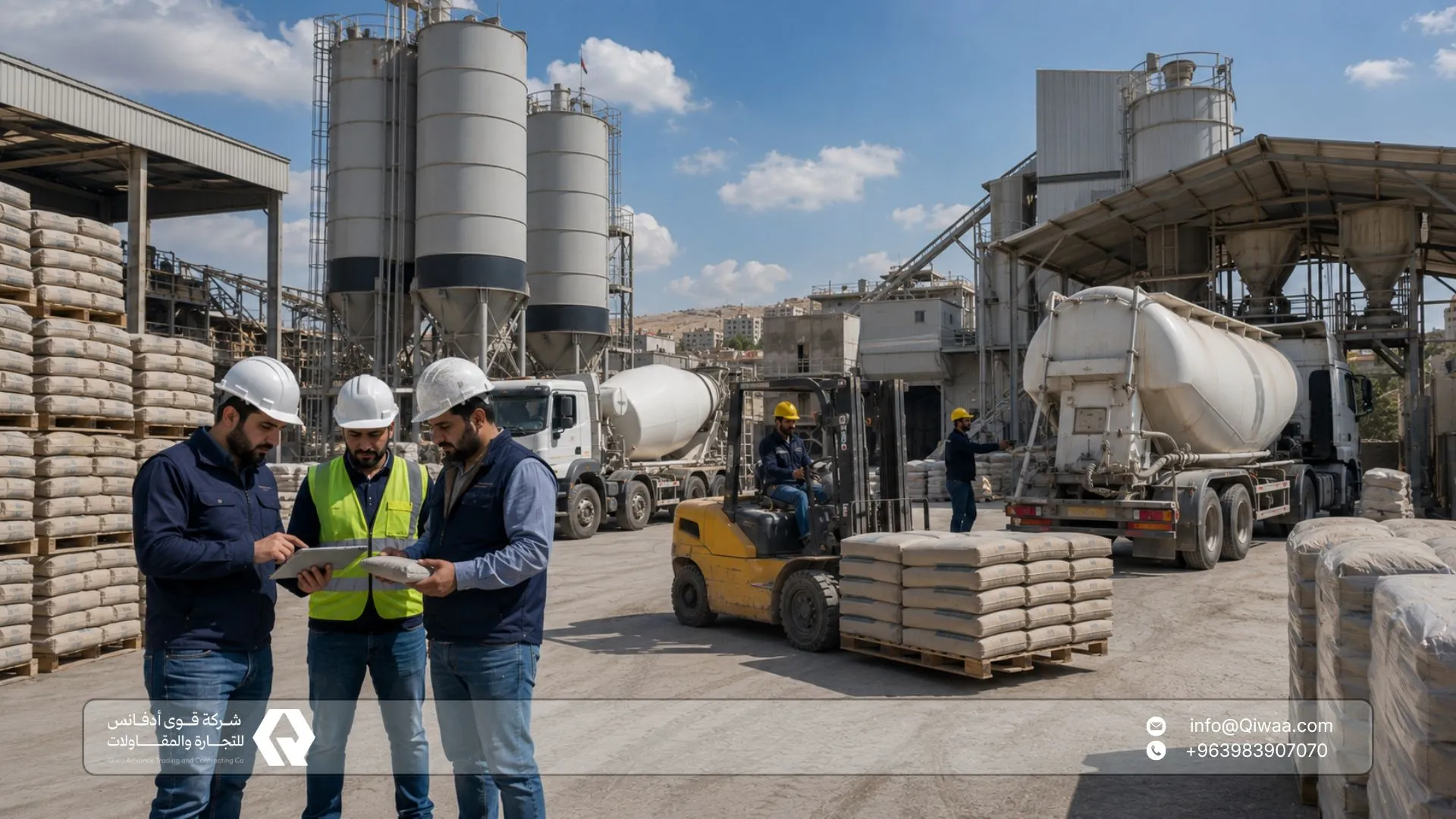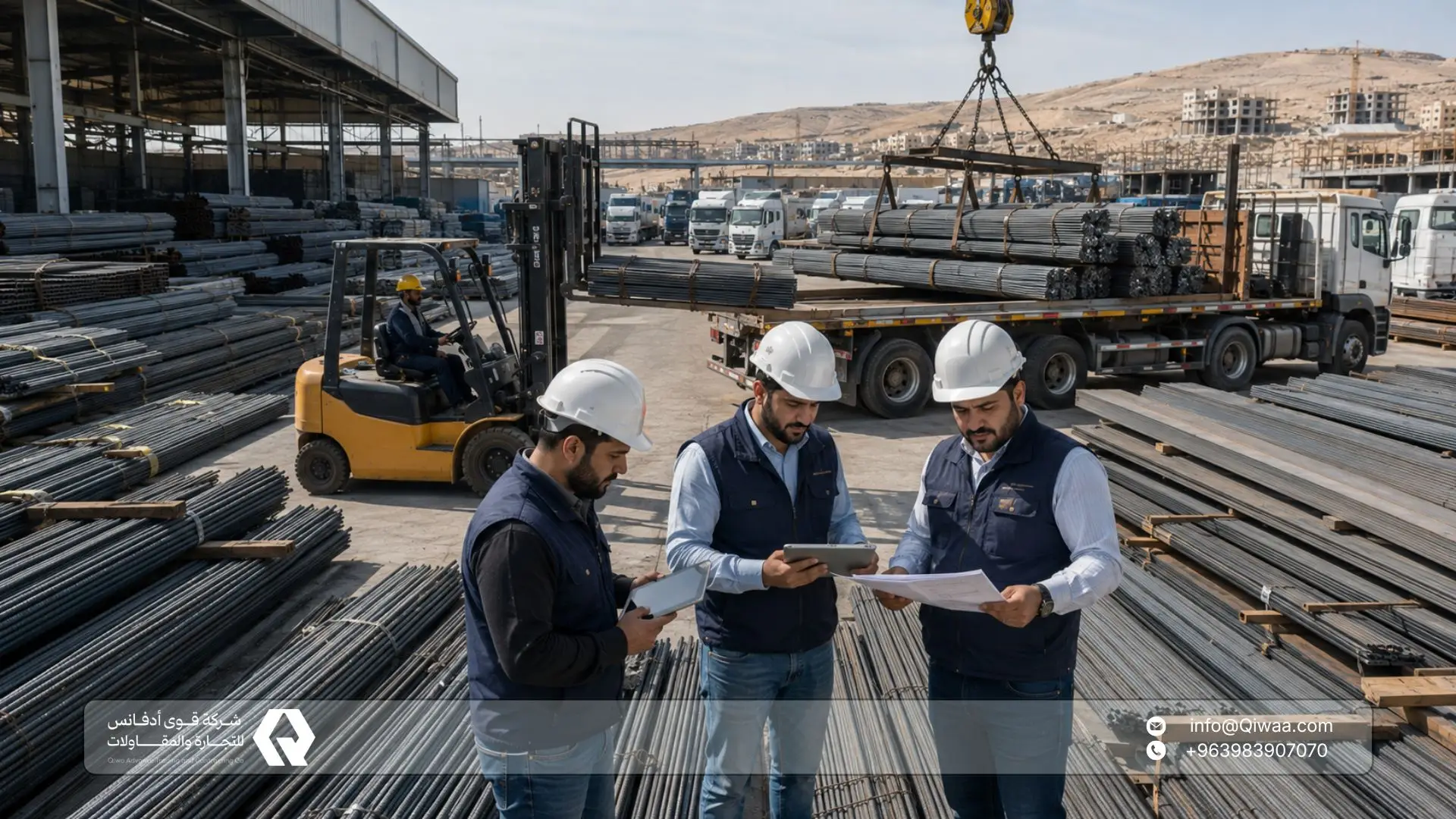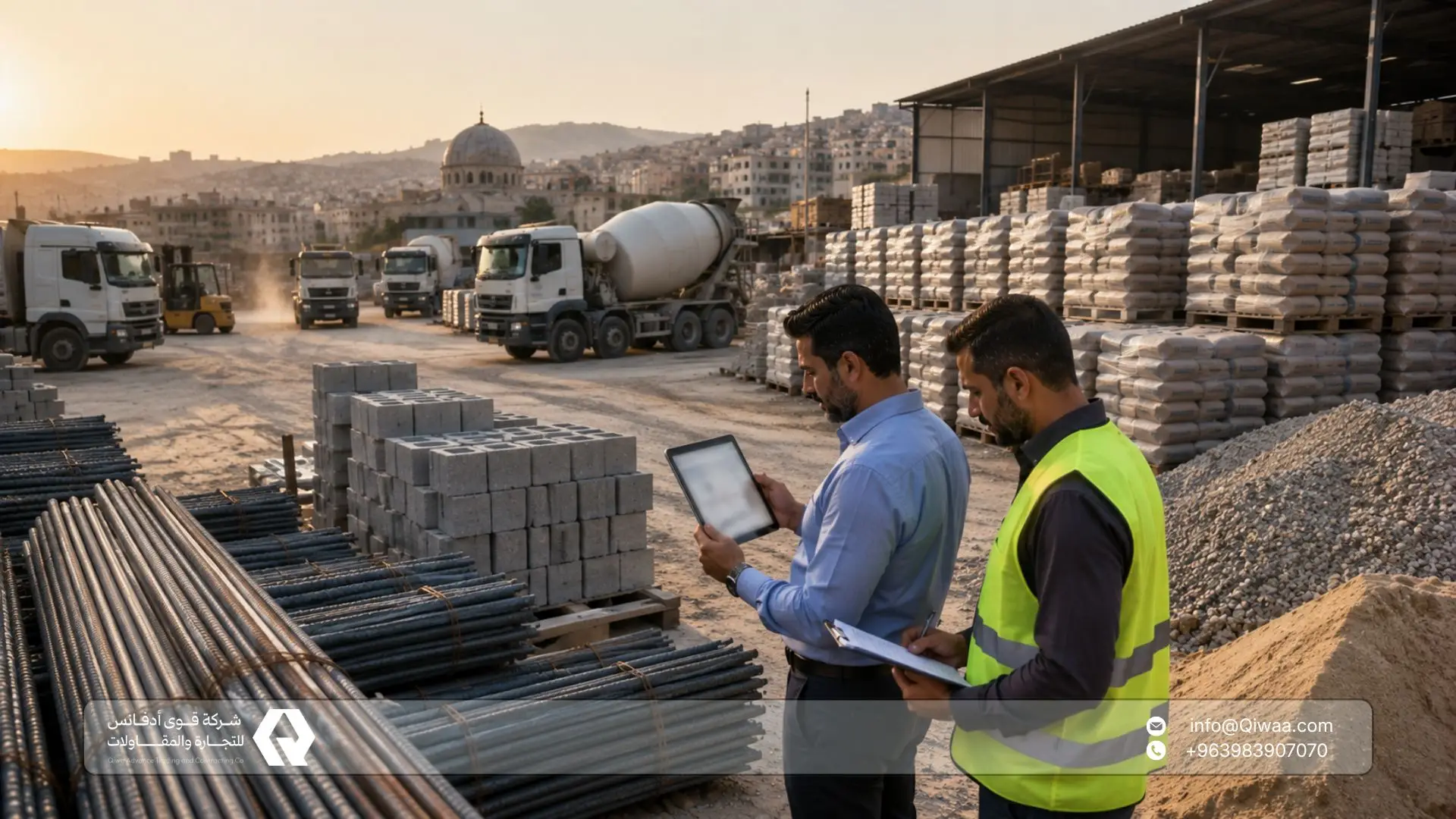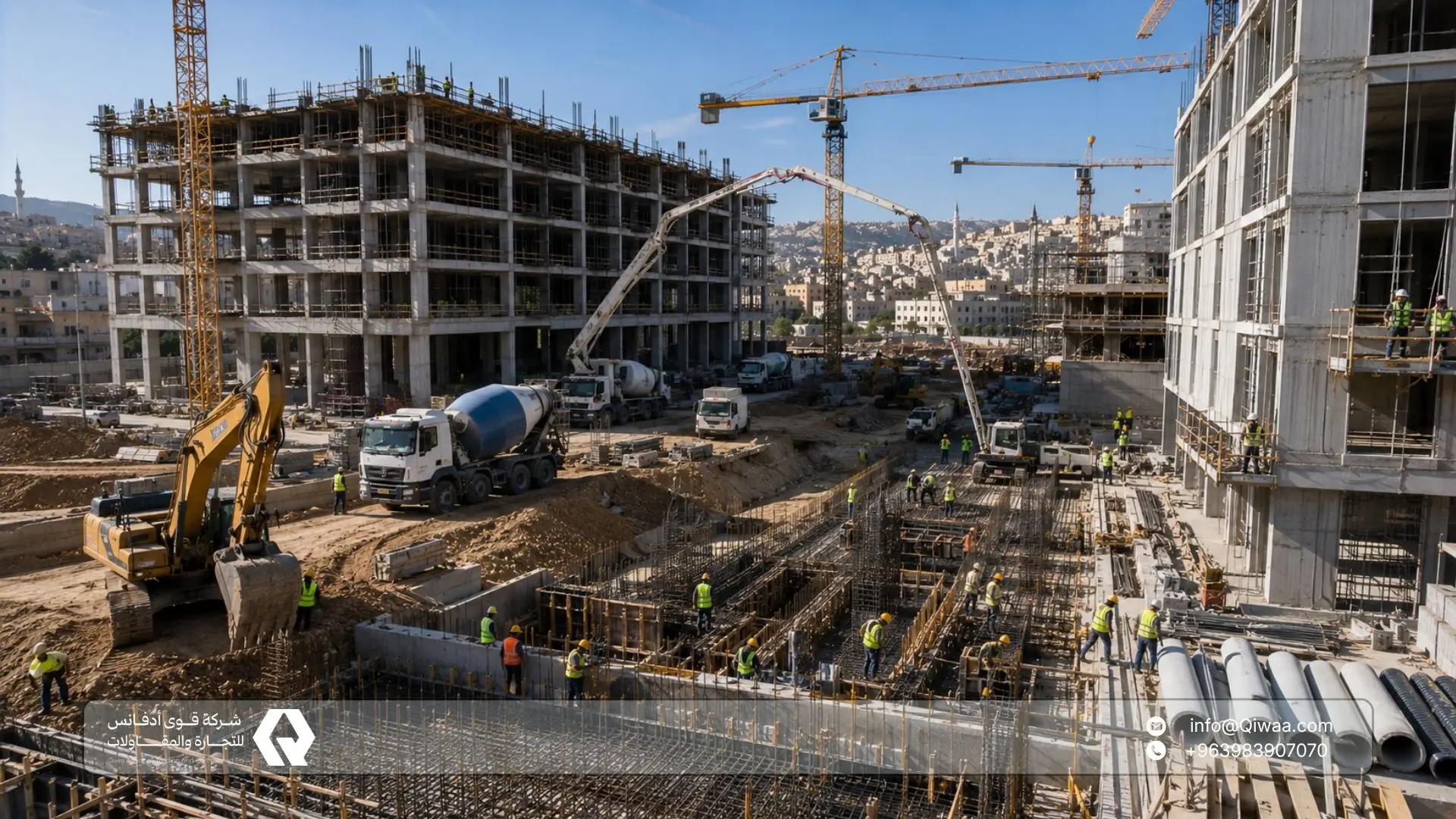


The efficiency of large construction sites in Syria is often determined by the quality of their support systems and by the ability of supplying companies to provide integrated engineering solutions for slabs and thick floor plates. As the need grows to move from traditional improvised solutions to modular load-bearing scaffolding, structural safety levels rise and on-site working risks recede.
In today’s article, Qiwaa Advance explains the difference between access scaffolding and structural support systems. We walk you through the different classes of shoring towers by load capacity and the engineering methods for calculating and distributing on-site support points, helping you make a safe and reliable supply decision that protects your project’s schedule and speeds up delivery.
The Difference Between Load-Bearing Scaffolding and Access Scaffolding in Structural Support Systems
Confusing access equipment with load-bearing systems is a danger that threatens the stability of the entire concrete structure and multiplies the likelihood of collapse during execution.
You can avoid these risks by identifying the equipment that best suits your site’s structural requirements, as follows:
Access Scaffolding
Access scaffolding is designed to give personnel access to building façades for finishing and exterior cladding work. From an engineering standpoint, it must not be used as a substitute during the structural pouring of slabs, for the following reasons:
- It lacks base jacks capable of transferring heavy concentrated loads directly into the ground.
- Its stability comes from being tied directly to the building’s walls, not from self-balancing under vertical compressive loads.
- It relies on thin steel sections designed to reduce the system’s weight and speed up its transport, not to resist high compressive stresses.
Shoring Towers
Shoring towers are relied upon to carry the live and dead loads imposed on formwork and fresh concrete while pouring thick concrete slabs or complex structural beams.
The shoring system keeps the structure stable during curing through specialized mechanisms, chiefly:
- Steel alloys that prevent the posts from bowing under sustained loads over long periods.
- Lattice bracing, in which the vertical standards are fitted with horizontal and diagonal braces to prevent the lateral displacement caused by the movement of concrete pumps or by wind.
- Adjustable heads and bases that ensure vertical pressure is transferred evenly to the supporting structure below without causing differential settlement.
Field confusion between access equipment and load-bearing systems threatens the safety of the entire concrete structure and multiplies the risk of sudden collapse. Contact our engineering team today to ensure you select the structural equipment best suited to the nature of your project.
Read also: Slab Formwork Company in Syria: How to Choose Between Prop Systems and Table Forms for Your Project?
Classes of Shoring Towers by Certified Load Capacity and Areas of Use
The success of execution on your project depends not only on providing props, but also on matching the load capacity of the steel system to the actual weights of the concrete masses. To avoid financial waste or exposing the structure to localized collapse, equipment must be specified and shoring towers used according to the following load capacities:
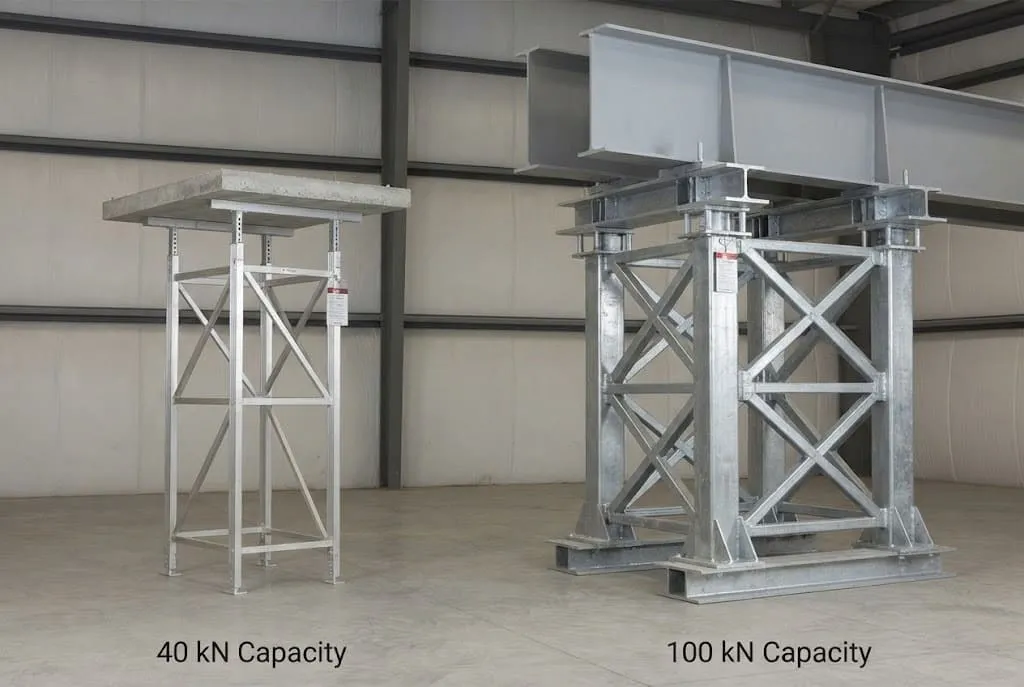
40 kN Load-Capacity Solutions
When you plan to build residential complexes or commercial buildings that rely on hollow-block (hourdi) slabs or solid slabs, this level, which falls within the category of structural scaffolding, is the standard choice for speeding up work on repeated floors. The effectiveness of these solutions on your site comes from characteristics that include:
- Light weight and easy assembly: The frame components are light enough for your crew to carry and assemble by hand, so you do not need to rely constantly on tower cranes.
- Flexible engineering heights: They support your structure’s slabs within a height range of 3 to 6 meters and are fitted with screw heads that give you precise level adjustment before pouring.
- Clear space below: The open design of the vertical standards reduces congestion beneath the formwork, so your workers can move handling carts and store building materials safely.
Heavy-Duty Shoring Systems for Bridges and Large Structures
Infrastructure projects place structural engineers before exceptional challenges that exceed the capabilities of conventional scaffolding. Here at Qiwaa Advance, as one of the prominent industrial scaffolding and heavy-duty scaffolding companies in the market, we provide you with specialized, tested load-bearing scaffolding and shoring towers able to carry up to 100 kN per leg, to secure your structure against heavy loads.
These powerful systems derive their stability from mechanical specifications that include:
- Resistance to dynamic vibrations: They rely on high-rigidity steel alloys that absorb the vibrations produced by pumps placing massive concrete volumes on your site.
- Handling uneven ground: Towers are fitted with pivoting bearing bases that adapt flexibly to slopes and uneven surfaces along your work paths.
- Protecting the structure from buckling: The legs are linked by a dense, tightly fitted network of diagonal connections that prevents any tilt or lateral displacement under the enormous central pressure.
Safe Access Routes for Personnel
These are built as an independent logistics network that integrates with the support structures, allowing your project engineers to reach the upper work platforms without obstructing execution. These vertical routes are designed to strict safety controls based on a set of elements, namely:
- Integrated stair units: Fitted with non-slip aluminum platforms that conform in standard dimensions to the frames of the base metal system on your site.
- Protective barriers: They surround all crossing points with secure guardrails that completely prevent your workers from falling from great heights.
- Intermediate landings: Routes at greater heights include horizontal rest landings that reduce your team’s physical strain during continuous climbing.
Read also: Building Materials in Syria 2026: How to Choose Materials and Read Prices by City?
Methods for Calculating and Distributing Support Points in Shoring and Support Systems
This calls for a complete field study to ensure formwork stability and to prevent differential settlement that would endanger the safety of your project. The erection engineering at this stage depends on several aspects, which we outline for you below:
Determining Exact Spacing Between Load-Bearing Supports
It is important to match the slab’s design loads with the certified load capacity of each support in order to avoid any sagging. The calculation methodology relies on:
- Extracting dead loads by accurately estimating the total weight of fresh concrete, reinforcing steel, and the formwork in contact with the pour location.
- Comparing load capacity by dividing the total value by the maximum capacity of a single prop, with the standard safety factor applied.
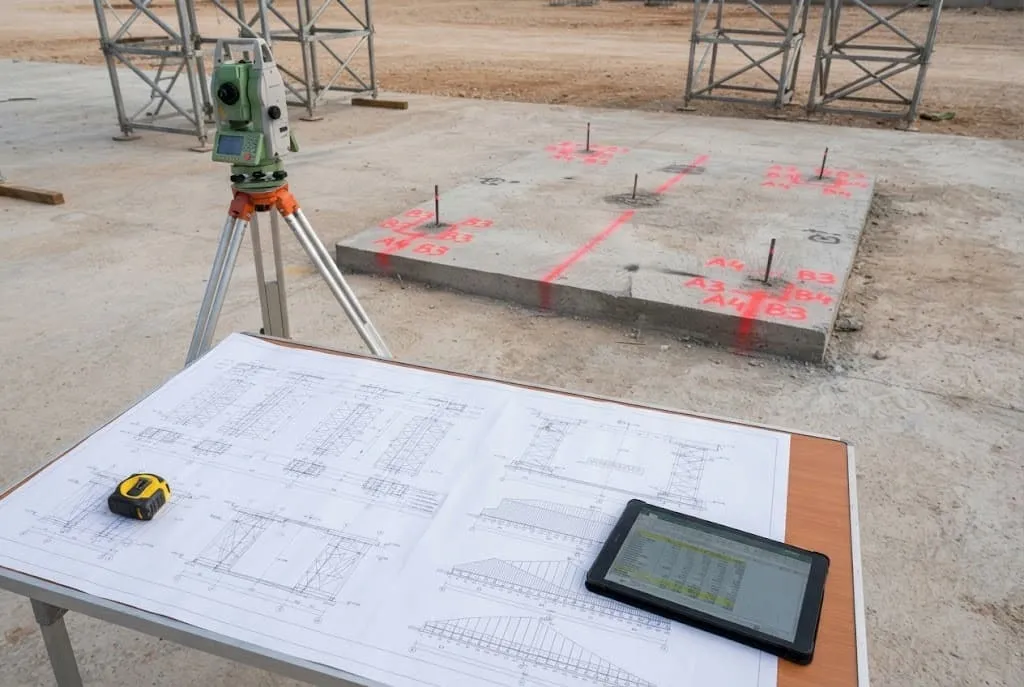
- Projecting field coordinates by drawing the engineering axis grid, so that support bases are fixed at the calculated spacings to provide a solid, stable support foundation.
Quick Erection and Dismantling Methods
These methods shorten assembly and dismantling time and therefore reduce operating costs, without the need for heavy machinery that disrupts site movement, thanks to:
- Hooking the ledgers into place with metal hooks, with no additional bolts or nuts needed on site.
- Manufacturing the elements at carefully considered weights that allow your crew to carry and install them by hand with ease.
- Releasing the joints with light taps of a rubber mallet once the hardening period has passed, without damaging the metal surfaces.
Field Safety Controls to Observe Before Pouring
Their aim is to ensure the metal structure holds together, and they are carried out as follows:
- Check that the vertical posts are plumb with a spirit level to avoid any tilt that weakens load capacity.
- Place wooden boards under the jacks to protect the bases from sinking into soft soil.
- Tighten all diagonal and inclined braces to resist pouring pressure and loads.
- Tighten clamps and bolts securely with approved torque wrenches to prevent vibration and loosening.
- Review the routes of mechanical and electrical services and make sure they do not conflict before closing the formwork.
- Clean the formwork of dust and construction debris with compressed air to prevent defects in the concrete.
- Inspect the electrical connections of the concrete pumps to avoid field hazards.
- Prepare quick backup plans to handle any sudden breakdown during the pour.
Qiwaa Advance Trading and Contracting: Supplier of Load-Bearing Scaffolding Systems in Syria
At Qiwaa Advance, as the authorized agent in Syria of the European company “Variant Factory”, we are committed to providing integrated engineering solutions in support of major projects, drawing on experience in supplying shoring systems and metal formwork to the highest international standards, which ensure execution quality and the safety of structures.
When you are looking for the right partner to secure your site against the weight of heavy formwork, the technical and operational performance comparison between our certified engineering solutions and the traditional alternatives available on the market is set out in the table below:
| Comparison Criterion | Qiwaa Advance Systems (Variant) | Traditional Support Systems on the Market |
|---|---|---|
| Documented load capacity | Engineering-certified up to 40, 70, and 100 kN per leg | Limited to discretionary estimates not documented by technical certificates |
| Upfront engineering support | Detailed layout drawings and accurate load calculation provided | No technical studies; limited to renting or selling equipment |
| Erection and dismantling speed | Based on interlocking modular parts that shorten execution time | Requires intensive labor and long adjustment and fixing times |
| Manufacturing quality and protection | Hot-dip galvanized steel that resists corrosion and environmental conditions | Metals with conventional paint coatings, prone to rust and a weakened structure |
Through this certified system, we ensure complete alignment between your execution requirements and the quantities of equipment supplied, giving work teams a safe and stable environment that prevents waste and keeps the completion schedule on track.
Contact us now to secure your site’s requirements for load-bearing scaffolding and obtain the most suitable integrated engineering solutions in Syria.
Read also: Contracting Companies in Syria 2026: How to Choose a Reliable Contractor for Your Project?
Frequently Asked Questions About Load-Bearing Scaffolding in Syria
How much load can a single leg of shoring towers and load-bearing scaffolding carry?
Load capacity varies with the engineering class of the system. Standard shoring towers carrying 40 kN are available for residential slabs, and heavy-duty towers designed for bridges and large structures accommodate 70 and 100 kN per leg.
Do you provide load calculations and a tower layout plan?
Our engineering team at Qiwaa Advance studies your project’s structural drawings and provides accurate load calculations together with execution drawings that show precisely where the support points are distributed before the pouring stage.
Are the towers suitable for temporary support during erection?
Certainly. These durable metal systems are used effectively to temporarily support precast concrete elements or large steel structures until final fixing and connection work is complete.
How long does it take to erect a single shoring tower?
The modern systems we supply feature modular parts that interlock easily, allowing just two workers to assemble and set up a shoring tower within a few minutes without complicated fastening tools.
What is a shoring system, and how does it differ from ordinary scaffolding?
It is a temporary engineered support system designed specifically to accommodate high vertical loads (such as fresh concrete and thick slabs) and transfer them safely to the ground, unlike access scaffolding, which is used only to give personnel access to façades and finishing work.
What are the main advantages of using bridge shoring in infrastructure?
These specialized systems absorb the enormous dynamic vibrations produced by large concrete pumps and carry the exceptional weights of massive concrete masses without any settlement or structural deflection.
Why are bridge scaffolds essential when pouring elevated beams?
Because they provide an exceptionally strong and rigid bearing network able to adapt to slopes and uneven surfaces, and they secure full stability for the structure against central and lateral load pressure during critical execution stages.
When is heavy-duty scaffolding used instead of conventional shoring towers?
Heavy-duty scaffolding is considered when project conditions require a support capacity, height, or configuration beyond what suits lighter support systems. The need must be determined based on the actual loads, the height of the work zone, the shape of the element, and the requirements of the certified system.
What is the difference between structural scaffolding and industrial scaffolding?
Structural scaffolding is used in construction, support, and access work depending on the type of system, whereas the term industrial scaffolding is usually associated with industrial facility sites that impose special requirements for access and for working around equipment and structures. When carrying concrete or formwork, you must make sure the system is designed from the outset to work as a load-bearing support system.