

The Eagle Hills in Syria framework agreement, signed on 5 October 2026, covers major residential and tourism developments in Damascus and Latakia. But does it create construction contracts that Syrian companies can bid for?
The signing announcement did not disclose a contract value, detailed construction scope or tender schedule. Although Eagle Hills has outlined opportunities for Syrian contractors and suppliers, the commercial terms needed to price individual packages remain unavailable. This article examines what has been confirmed, what the reported investment figures mean, and how companies can assess potential work and prepare before project-specific procurement documents are issued.
What Does the Eagle Hills Agreement in Syria Cover?
On 5 October 2026, Syria’s Ministry of Public Works and Housing and Ministry of Tourism announced a framework agreement with UAE-based Eagle Hills at the People’s Palace in Damascus. The developer’s official statement identifies the Ministry of Public Works and Housing as acting on behalf of government entities.
The agreement covers the planning and development of residential and tourism communities, beginning with Damascus Heights and Latakia Yachts & Marina. Eagle Hills said both projects would move towards implementation, with preparatory and construction works expected to begin soon, but did not specify start dates or individual construction contracts.
According to the Syrian government’s announcement, the projects are intended to support housing development, tourism and local economic activity. For contractors, however, an agreement to develop these projects does not establish the scope, quantities or contractual terms of the works they may eventually undertake.
Framework Agreement vs Construction Contract
A framework agreement establishes the basis for cooperation between parties. A construction contract defines obligations for a particular scope of work. The exact legal effect of either document depends on its terms, which have not been published in full for the Eagle Hills projects.
| Criterion | Framework agreement | Construction contract |
|---|---|---|
| Purpose | Establishes the basis and scope of cooperation | Assigns defined construction obligations |
| Scope of work | May identify projects and development objectives without detailed quantities | Specifies works through contract documents, drawings and technical requirements |
| Pricing | May include investment estimates or commercial principles | Establishes a contract price or an agreed pricing mechanism |
| Schedule | May identify development stages or indicative timelines | Defines contractual milestones and completion obligations |
| Payments and guarantees | May leave project-level terms for later agreements | Sets applicable payment, security and risk-allocation provisions |
A construction contract does not always require a fixed lump-sum price or a BOQ; design-and-build and remeasurement arrangements may use different pricing structures.
For contractors, the practical distinction is between project interest and a priceable work scope. A preliminary budget can support internal planning, but a reliable tender price requires sufficiently defined deliverables, specifications, quantities or measurement rules, site conditions and contractual terms.
Eagle Hills has not published these details for individual Damascus or Latakia construction packages in the official announcements reviewed.
What the Agreement Means for Syrian Contractors
In its official announcement, Eagle Hills identified opportunities for Syrian contractors, suppliers and service providers during project development and operation. The statement also refers to supporting local supply chains and small and medium-sized businesses.
However, this does not confirm specific contract allocations, local-content quotas or supplier qualification criteria. The priority mentioned for qualified Syrian applicants relates to investment participation, which is distinct from construction procurement.
The two developments could generate different types of work. Damascus Heights may require residential construction, building services and supporting utilities, while Latakia Yachts & Marina may involve waterfront infrastructure, marina facilities, hospitality buildings and associated services. These are potential scopes inferred from the announced developments, not published tender packages.
Before committing resources, Syrian companies can prepare documented project references, technical capabilities, equipment and workforce records, financial information and relevant quality documentation. These materials support general contractor readiness, although Eagle Hills has not published project-specific prequalification requirements.
Eagle Hills’ corporate website provides a general supplier registration link. However, its applicability to the Syrian projects has not been established. Contractors should confirm the relevant registration entity and procurement process directly through official company channels before submitting information or relying on any invitation.
The immediate opportunity is to prepare for qualification, not to price an unannounced package. Actual bidding decisions must follow the publication of the relevant scope, procurement requirements and commercial terms.

Eagle Hills Projects in Damascus and Latakia
The Eagle Hills Syria agreement covers two developments: a mixed-use community in Damascus and a waterfront destination in Latakia. Government announcements, the developer’s website and statements made at the signing use different project names.
Contractors should distinguish these names before assessing project opportunities, particularly because the published descriptions do not establish whether every name refers to the entire development or a specific component.
| Developer’s project name | Other published names | What is confirmed |
|---|---|---|
| Damascus Heights | تلال دمشق العقاري (Damascus Hills) | A mixed-use development with housing, retail, hospitality, business facilities and community services |
| Damascus project — additional name | أبراج التضامن (Tadamon Towers) | Named by Mohamed Alabbar at the signing; its relationship to the wider Damascus master plan has not been clarified |
| Latakia Yachts & Marina | اللاذقية السياحي (Latakia Tourism) | A waterfront development centred on a marina, with residences, hotels and leisure facilities |
| Latakia project — additional name | إيكو لايف (Eco Life) | Used in Alabbar’s remarks and a project press release; the exact relationship between the published project names and phases remains unspecified |
Sources: Eagle Hills’ official announcement and SANA’s coverage of the signing.
The distinction matters when checking project documents, approaching procurement teams or assessing potential contracts. A shared location or similar project description does not establish identical contract boundaries.
Both developments form part of the wider Syria reconstruction projects pipeline, but neither has published the detailed construction quantities needed for reliable supplier forecasts.
Damascus Heights Development Plans and Reported Housing Figures
Eagle Hills describes Damascus Heights as a mixed-use development combining residences, commercial facilities, hospitality, schools, healthcare and public spaces. Its Syria project website also identifies villas, townhouses and apartments.
The Damascus project appears as Tilal Dimashq in the government announcement, while Mohamed Alabbar used Tadamon Towers during the signing. The public documents reviewed do not establish whether the latter is another name for the entire development or a component within it.
Published housing figures also require caution:
- October 2026 reports: More than 26,000 residential units and 4,000 hotel units were attributed to the Damascus development.
- May 2026 preliminary plans: An earlier proposal reportedly covered around 33 million m² in Dummar, with approximately 73,000 homes and 3,200 hotel rooms. These figures came from reporting based on an unnamed source.
Neither set of figures appears as an approved unit schedule in Eagle Hills’ framework agreement announcement.
For residential contractors, the distinction is material. A preliminary unit count cannot establish gross floor area, structural quantities or delivery rates without an approved building mix and construction programme.
Suppliers should therefore wait for confirmed phase boundaries, building schedules and technical documentation before using either figure to plan concrete, steel, formwork or equipment capacity.
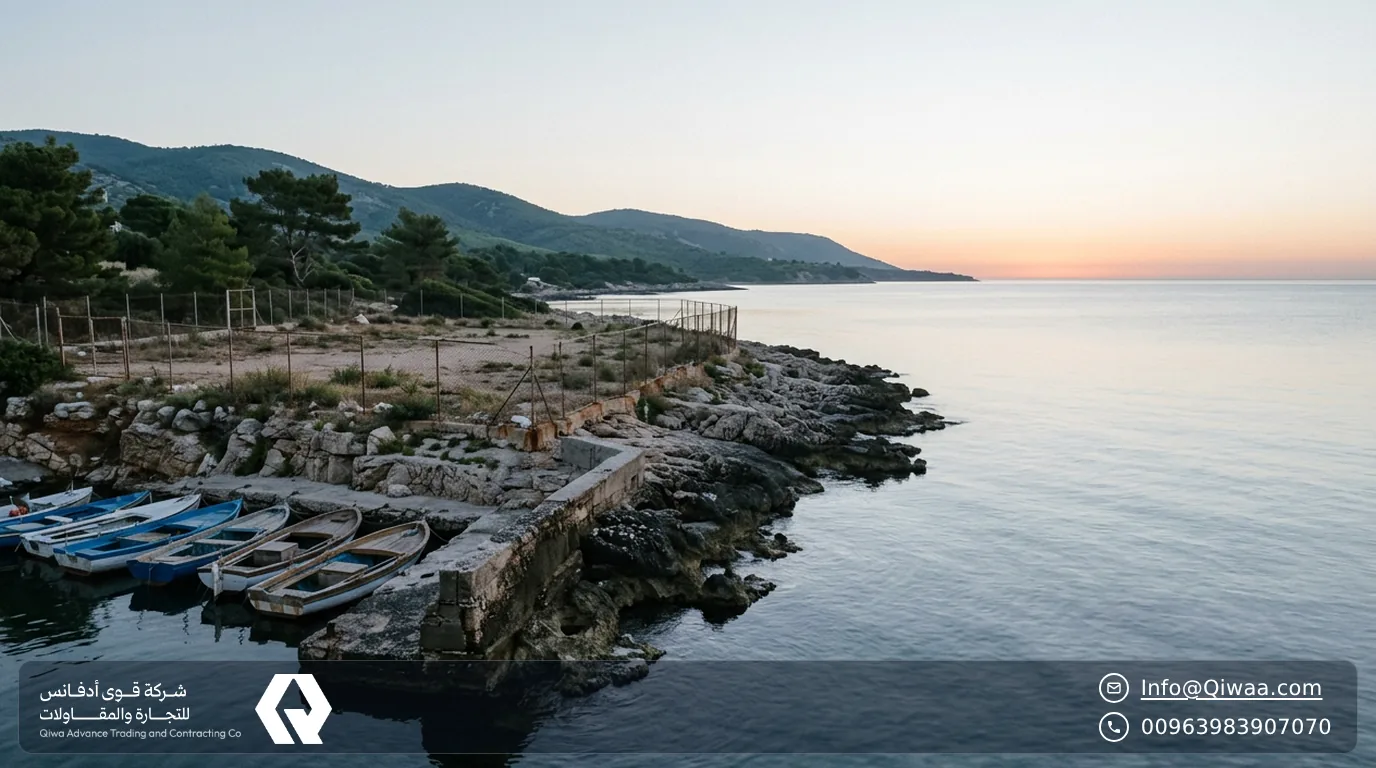
Latakia Yachts & Marina: Project Scope
Latakia Yachts & Marina is the coastal development identified by Eagle Hills. The government describes it as the Latakia Tourism project, while the name Eco Life appears in Alabbar’s statements and a subsequent project announcement.
The developer’s statement confirms a marina-led destination with residential properties, hotels, branded residences and leisure facilities.
Reports published around the signing described approximately 10,000 apartments, 1,000 villas, 4,000 hotel units, extensive green space and recreational routes. These quantities have not been confirmed in Eagle Hills’ published project specifications.
According to an October 2026 project announcement, Tourism Minister Mazen Al-Salhani said the development remained in the design phase. Construction was targeted to begin within five to six months, conditional on completing the plans, administrative procedures and land handover.
For contractors, a marina development raises requirements beyond conventional residential construction. Potential scopes may include marine structures, shoreline protection, waterfront utilities and hospitality infrastructure.
However, the actual marine works cannot be determined without the marina layout, berth specifications, geotechnical information, coastal engineering studies and approved designs.
The minister’s timetable is a conditional target, not a confirmed tender or construction start date. Suppliers should treat the announced project concept as an indication of potential disciplines rather than a basis for ordering materials or reserving equipment.
How Much Is Eagle Hills Planning to Invest in Syria?
Reported investment figures for Eagle Hills Syria range from $9 billion to more than $50 billion. They were published at different stages and do not necessarily represent the same financial measure.
The main figures, in chronological order, are:
- May 2026 — Over $50 billion: An early report based on an unnamed source described two preliminary master plans. The figure was not an approved project budget.
- 12 May 2026 — Up to $18 billion: Mohamed Alabbar discussed planned investments of approximately $11 billion in Damascus and $5–7 billion on the Syrian coast.
- July 2026 — At least $20 billion: Alabbar described planned housing and tourism developments in Damascus and Latakia worth at least that amount.
- 5 October 2026 — Around $9 billion: Some reports associated this investment estimate with the signing, alongside a separate estimate of $16 billion in economic activity. Neither amount was specified as the agreement’s contract value in Eagle Hills’ official statement.
- 14 October 2026 — $16–17 billion: Reuters reported Alabbar’s more recent statement that Eagle Hills planned to invest between $16 billion and $17 billion in its two Syrian projects.
The latest chairman-attributed figure reviewed is $16–17 billion, but it remains a planned investment, not a published construction budget. The signed framework agreement did not disclose an approved contract value or allocate construction spending between Damascus and Latakia.
Contractors should not convert any of these totals directly into potential contract awards or annual material demand. A reliable estimate requires the approved scope of each development, construction phasing, procurement structure and project-specific bills of quantities (BOQs).
For context, compare the Arada Damascus Project and the wider pattern of foreign investment in Syria, while keeping each developer’s figures and contractual commitments separate.
How Syrian Contractors Can Prepare for Eagle Hills Projects
Eagle Hills has announced opportunities for Syrian contractors and suppliers, but its published project information does not yet provide the tender packages, construction schedules or qualification criteria needed for bidding.
The company has a general corporate supplier registration system, but its applicability to Eagle Hills Syria projects remains unconfirmed. The Eagle Hills Syria website offers property and investment registration rather than a clearly identified contractor prequalification process.
Until project-specific procurement information becomes available, contractors can assess their technical capacity, identify suitable types of work and prepare qualification documents. The following approach separates preliminary planning from decisions that require approved designs and contract documents.
Estimating Construction Scope Without a BOQ
Before a bill of quantities (BOQ) is issued, a contractor can use a hypothetical floor-area scenario to assess the scale of a potential residential package.
Estimated gross floor area = Number of apartments × Average usable apartment area × Gross-up factor
For example, consider a hypothetical package of 1,000 apartments:
- Apartment area: 1,000 × 130 m² = 130,000 m².
- Shared areas: Apply an illustrative gross-up factor of 1.2 to account for circulation and common building spaces.
- Estimated gross floor area: 130,000 × 1.2 = 156,000 m².
The apartment count, average area and gross-up factor are assumptions. They do not describe an Eagle Hills construction package or reflect an approved design. The method also assumes the 130 m² represents usable apartment area rather than an already grossed-up floor area.
What can a supplier do with this estimate?
The 156,000 m² figure can help assess the approximate scale of a potential package, but it cannot establish concrete volume, reinforcement tonnage or formwork requirements.
- Concrete and reinforcement: Quantities depend on structural design, foundations, building height, spans and loading requirements. Preliminary consumption rates from comparable projects may support internal scenarios, but actual quantities require project-specific designs.
- Formwork: Requirements depend on the structural system, typical floor layout, number of repetitions and construction cycle. Reusable systems must be evaluated against the programme and building geometry, not total floor area alone.
Contractors should also distinguish total package quantities from peak monthly demand. Even an accurate estimate of overall material quantities will not show the production or delivery capacity required without a construction schedule.
Use the calculation for preliminary capacity screening. Do not treat it as a basis for binding quotations, equipment purchases or material orders.
Contractor and Supplier Roles in Eagle Hills Projects
Large developments can use different procurement structures. A developer may appoint main contractors, engage specialist contractors directly or divide works into separately managed packages.
Eagle Hills has not published the contracting structure for Damascus Heights or Latakia Yachts & Marina. Syrian companies should therefore avoid assuming that every opportunity will pass through a single main contractor.
The qualification evidence generally depends on the company’s proposed role:
| Potential role | Typical qualification focus |
|---|---|
| Main contractor | Comparable project delivery, financial capacity, project management, resources and ability to provide required guarantees |
| Specialist subcontractor | Relevant technical experience, qualified personnel, equipment, work methods and ability to meet programme requirements |
| Material or equipment supplier | Product compliance, manufacturer documentation, test certificates, supply capacity, delivery arrangements and after-sales responsibilities |
These are general procurement considerations, not qualification requirements announced by Eagle Hills.
For Syrian firms, the practical decision is to identify which type of work matches their demonstrated experience and available resources. A specialist contractor may be more competitive within a clearly defined scope than when pursuing a larger package requiring capabilities it does not possess.
Companies should prepare documented references, relevant certificates and capacity records while monitoring official procurement channels. They should also confirm whether any future registration invitation applies specifically to the Syrian projects.
14 Checks Before Bidding on Eagle Hills Contracts
The first four checks support preparation before tenders are released. The remaining checks should be completed against the actual procurement and contract documents.
- Verify the contracting entity. Identify the legal entity responsible for the proposed contract, its authority to procure the works and the available information on project funding.
- Confirm the procurement route. Establish whether your intended scope is likely to be procured directly by the developer, through a main contractor or through another authorised entity. Do not assume the contracting structure has been announced.
- Prepare your qualification documents. Assemble company registration records, relevant classifications, completed-project references, financial information, technical personnel and equipment records.
- Assess your delivery capacity. Compare comparable project experience, available workforce, equipment and existing commitments with the type of package you intend to pursue. Identify any need for specialist partners.
- Verify land and site readiness. Confirm the relevant site boundaries, land handover status, access arrangements and known restrictions before pricing mobilisation and site operations.
- Obtain the complete technical scope. Review the latest drawings, specifications, BOQ or applicable measurement rules, and responsibilities for work interfaces.
- Confirm the contract model. Establish whether the works are lump-sum, remeasured, design-and-build or another arrangement, and identify who carries design and quantity risks.
- Review site and design conditions. Check available geotechnical information, utility connections and other site-specific constraints. Coastal or marina works may require additional marine investigations and design information.
- Identify approval responsibilities. Confirm who reviews material submittals, samples, shop drawings and technical changes, together with the applicable approval procedures.
- Check material sourcing requirements. Establish accepted standards, product approvals, country-of-origin restrictions, import responsibilities, customs costs and required conformity documentation.
- Test the delivery programme. Compare milestones and peak demand with your production, labour, equipment and logistics capacity, including long-lead materials and dependencies on other contractors.
- Review currency and price exposure. Confirm the contract and payment currencies, exchange-rate provisions and whether material-cost or currency adjustments are permitted.
- Examine payment and security terms. Review advance payments, certification and payment periods, retention, bid and performance securities, and the cost and availability of required guarantees.
- Evaluate contractual risks. Check delay damages, insurance, variation procedures, warranty obligations, dispute resolution, governing law and termination provisions before committing to a bid.
These checks are preparation guidance, not published Eagle Hills tender conditions. Companies should rely on the applicable project documents and obtain appropriate contractual advice before accepting material obligations.
Use only verified procurement communications from Eagle Hills or its authorised contracting entities. A general supplier registration, broker account or investment application should not be treated as confirmation of eligibility for a Syrian construction tender.
How Qiwaa Advance Supports Infrastructure and Formwork Projects
The Eagle Hills developments in Damascus and Latakia could generate demand for water infrastructure, construction materials and concrete formwork. However, no project-specific requirements or contracts involving Qiwaa Advance have been announced.
Through Qiwaa Contracting, we undertake Engineering, Procurement and Construction (EPC) works for water networks, treatment plants and desalination facilities in cooperation with Saudi Arabia’s Amiantit. Qiwaa Trading supports material procurement through international manufacturers and authorised suppliers.
For water infrastructure, our partnership with Amiantit provides access to GRP pipe solutions for applications where the approved design supports their use. Selecting a suitable pipe system requires more than nominal diameter and operating pressure. Pressure class (PN), stiffness class (SN), joint compatibility, installation conditions and applicable standards must also be considered.
For repetitive concrete construction, we work with Variant Factory LLC to provide Tunnel Formwork System solutions. These systems can improve construction efficiency when building layouts support repeated wall-and-slab casting cycles. Their suitability depends on structural design, repetition, lifting arrangements and the execution programme.
These capabilities may be relevant to future residential or infrastructure packages, but neither GRP pipes nor tunnel formwork should be assumed to be specified for the Eagle Hills projects.
Coordinated Supply vs Multiple Vendors
Contractors sourcing pipes, fittings or formwork components must decide whether to coordinate purchases through one supplier or engage several vendors. The better approach depends on package scope, technical compatibility, pricing and delivery risks.
| Criterion | Coordinated supply through Qiwaa Advance | Multiple vendors |
|---|---|---|
| Technical coordination | Coordination of documentation for products within our available supply range | Contractor coordinates documentation and interfaces across suppliers |
| Specification compliance | Related products can be reviewed together against project requirements | Each product must meet specifications and interface requirements |
| Procurement flexibility | Limited to available manufacturers and product ranges | Wider choice of manufacturers and sourcing options |
| Delivery planning | Delivery requirements can be coordinated for the agreed supply scope | Contractor manages several schedules and supplier dependencies |
| Warranty and accountability | Responsibilities depend on the agreed supply contract and manufacturer terms | Responsibilities are divided among the relevant supply contracts |
| Commercial evaluation | A consolidated offer may simplify comparison and administration | Separate quotations may increase price competition and sourcing flexibility |
A coordinated supply arrangement can reduce the contractor’s administrative workload for a defined package, but it does not automatically provide lower costs, eliminate interface risks or guarantee delivery.
For critical infrastructure components, the decision should be based on technical conformity, total procurement cost, delivery commitments and clearly defined contractual responsibilities.
What Contractors Need to Specify for GRP Pipes and Tunnel Formwork
Qiwaa Advance can help contractors assess relevant supply options against project-specific technical requirements rather than general assumptions about development size.
For GRP pipe packages, the initial review should cover:
- Network drawings, BOQ and applicable specifications.
- Nominal diameters (DN), required pressure classes (PN) and stiffness classes (SN), where established.
- Design and operating pressures, conveyed fluid and installation conditions.
- Required fittings, joint types, quantities and delivery schedule.
Our team can coordinate relevant technical information and product options through Amiantit. Final design approval and material acceptance remain subject to the appointed designer, consultant and project owner’s requirements.
For Tunnel Formwork packages, contractors should provide typical floor plans, structural drawings, repeated wall-and-slab layouts, the expected number of repetitions and the construction programme.
These inputs help determine whether a reusable tunnel formwork system is technically suitable and worth evaluating commercially. The assessment must also consider lifting arrangements, site access, concrete casting cycles and other execution constraints.
Whether you are evaluating a water-network package or repetitive residential construction, the starting point is a defined scope and the available technical documents.
Planning an infrastructure or concrete construction project in Syria? Send your drawings, BOQ or preliminary specifications, together with the project location and expected delivery programme, to Qiwaa Advance on WhatsApp.
Our team can discuss relevant Amiantit and Variant solutions and identify the additional information needed for a technical and commercial assessment. Any participation in Eagle Hills Syria projects would remain subject to future procurement opportunities and project-specific requirements.
FAQs About Eagle Hills Syria
How much is Eagle Hills investing in Syria?
Eagle Hills disclosed no contract value in its October 2026 framework agreement. On 14 October, chairman Mohamed Alabbar said the company planned to invest $16–17 billion in its Damascus and Latakia projects. This is a planned investment, not a confirmed construction budget. Source: Reuters.
When Will Damascus Heights Construction Begin?
As of 3 November 2026, Eagle Hills had not published a confirmed construction start date for Damascus Heights. Its official announcement anticipated preparatory and construction works beginning soon, without specifying a schedule.
Can Contractors Register for Eagle Hills Syria Projects?
Eagle Hills provides a general supplier registration channel through its corporate website. However, its applicability to Syrian projects remains unconfirmed. The Eagle Hills Syria website currently focuses on property and investment enquiries.
Will Eagle Hills Prioritise Syrian Contractors?
Eagle Hills has expressed support for Syrian contractors, suppliers and local businesses. However, its published statement does not specify a contractual local-content quota or preference for construction bidders. The stated priority for qualified Syrians concerns investment participation.
What Should Suppliers Prepare Before Tendering?
Prepare company credentials, relevant project references, technical certifications, financial records and evidence of delivery capacity. Once tenders are issued, review the BOQ, specifications, project schedule and contract terms before pricing.
Sources
- Agreement with Eagle Hills to develop urban and tourism communities in Syria (Arabic), SANA, 5 October 2026
- Eagle Hills signs framework agreement for the development and construction of residential and tourism communities, Eagle Hills via Zawya, 6 October 2026
- Eagle Hills signs framework deal for Eco Life waterfront development in Syria’s Latakia, Zawya Projects, 6 October 2026
- Syria: investment agreement to develop major urban and tourism projects (Arabic), Al Jazeera Net, 5 October 2026
- Abu Dhabi’s Eagle Hills to develop residential and tourism projects in Syria, The National, 5 October 2026
- Eagle Hills Syria, Eagle Hills, official website, accessed 31 October 2026
- Eagle Hills Studies $50 Billion Syria Projects, Enab Baladi, 6 May 2026
- Alabbar reveals an $18bn investment fund in Syria (Arabic), Al Bayan, 12 May 2026
- Alabbar reveals two projects worth $20bn in Syria (Arabic), Enab Baladi, 16 July 2026