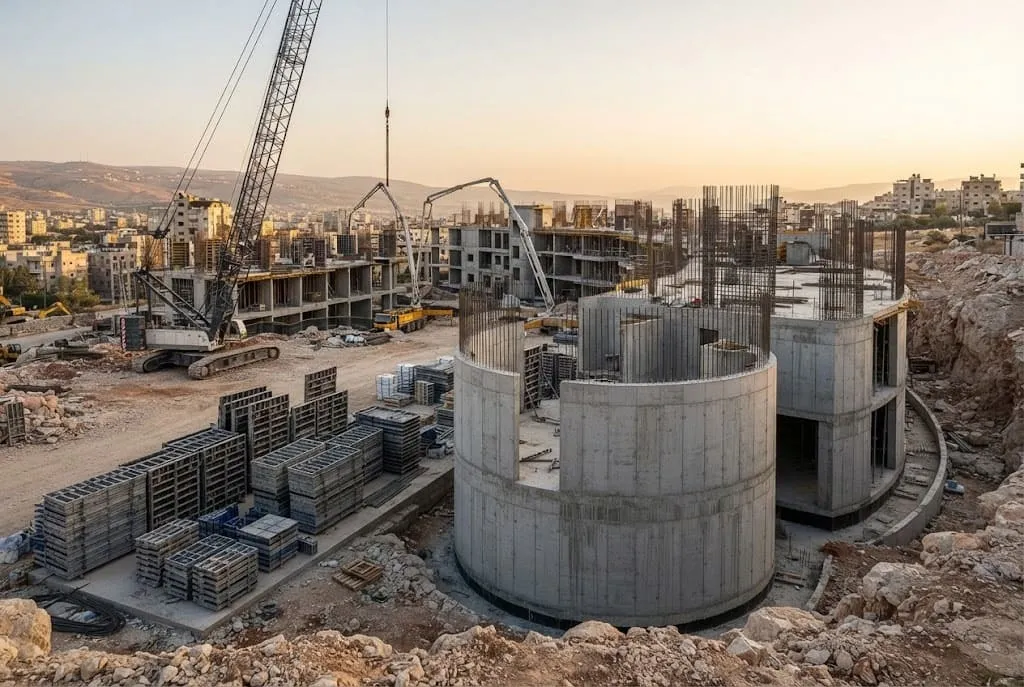


Selecting GRP pipes for water, sewerage, and infrastructure projects requires more than specifying a nominal diameter or comparing prices. GRP pipe specifications must account for operating pressure, structural loads, actual dimensions, material compatibility, and installation conditions. Incomplete requirements can lead to incompatible components, unsuitable pipe configurations, or rejected deliveries.
In this guide, Qiwaa Advance explains how engineers, contractors, and procurement teams can evaluate GRP pipe specifications before approving materials or placing orders. The guide covers:
- GRP pipe composition and the properties that affect performance.
- GRP pipe pressure classes (PN), nominal diameter (DN), and stiffness (SN).
- Dimensional requirements and ISO and AWWA standards.
- Technical specifications, conformity testing, and batch traceability.
GRP pipe materials and specification requirements
GRP pipes are composite piping products used in water supply, drainage, sewerage, and industrial infrastructure. Their suitability depends on how the pipe’s materials, dimensions, and mechanical properties match the intended application.
GRP Pipe materials and construction
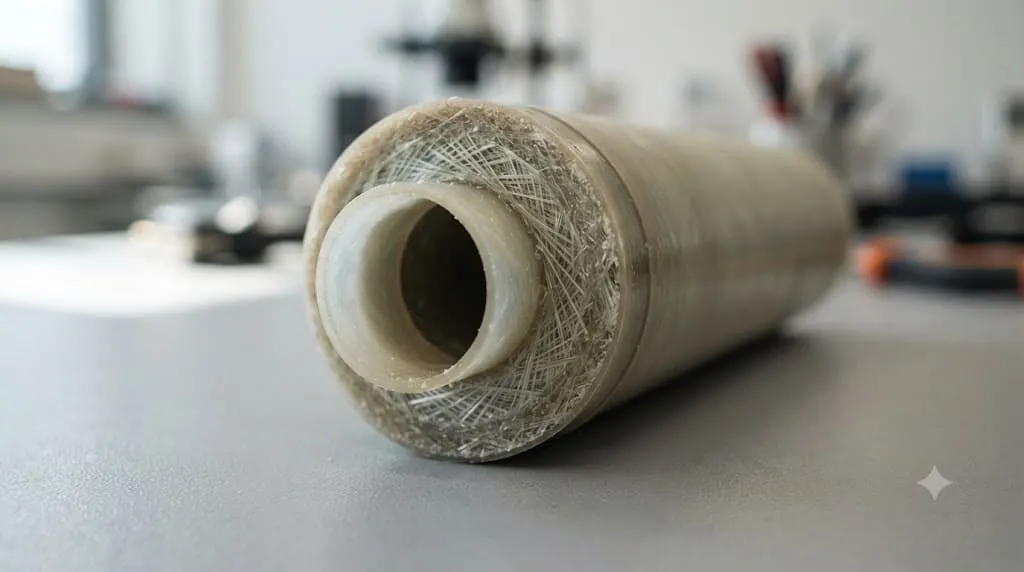
GRP stands for glass-reinforced plastic. These pipes use glass-fiber reinforcement embedded in a thermosetting resin matrix. Depending on the manufacturing process, the pipe wall may contain:
- An inner liner that provides the fluid-contact surface.
- Glass fibers and resin that form the structural reinforcement.
- Outer structural and protective layers that complete the pipe wall.
- A silica-sand core, in designs that use one, to contribute to ring stiffness.
The composition and arrangement of these layers vary by product design and manufacturer. Resin selection, reinforcement, and liner properties must be assessed against the conveyed fluid, operating temperature, and required performance.
ISO 23856:2021 specifies requirements for GRP piping systems based on unsaturated polyester resin, covering pressure and non-pressure applications in water supply, drainage, and sewerage.
Risks of buying GRP pipes without complete specifications
A purchase request stating only “GRP pipe, DN 600” does not define a complete technical configuration. Before evaluating an offer, several requirements must be established:
- Pressure requirements: The applicable pressure class (PN), operating and design pressures, surge conditions, and temperature limitations.
- Structural requirements: The nominal stiffness (SN) and the burial conditions, soil support, and external loads used in structural assessment.
- Dimensional requirements: The nominal diameter (DN), actual internal and external diameters, diameter series where applicable, and compatibility with fittings and joints.
- Material and joint requirements: The liner, resin system, conveyed fluid, and whether the joining arrangement requires thrust restraint.
- Conformity requirements: The governing standard, technical documentation, applicable tests, and acceptance criteria.
Two distinctions are particularly important. DN does not guarantee identical actual dimensions across product designs, so the manufacturer’s dimensional data must be checked before selecting connections and fittings. Likewise, PN describes pressure classification, while SN describes ring stiffness; satisfying one requirement does not establish compliance with the other.
Why GRP specifications matter before Purchase
Complete specifications allow procurement teams to compare technically equivalent offers rather than products that share only a nominal diameter. They also make deviations easier to identify, reduce the risk of incompatible components or unapproved substitutions, and establish the documentation required for product acceptance.
The project designer and consultant remain responsible for determining and approving the engineering requirements. Suppliers and procurement teams must then demonstrate that the proposed products and delivered batches conform to those approved specifications.
Read also: GRP Fiberglass Pipes in Syria: Applications and Advantages in Water Projects
How to match GRP pipe specifications to project conditions
Selecting suitable GRP pipes requires checking their hydraulic capacity, pressure rating, dimensions, and structural performance against the project’s approved design. Manufacturer data sheets provide available configurations, but suitability must be verified against actual operating and installation conditions.
Selecting dimensions, pressure and stiffness
Hydraulic calculations establish the internal diameter required for the design flow, velocity, and allowable head loss. The selected pipe must then be checked for:
- Dimensional compatibility: Confirm the nominal diameter (DN), actual internal and external diameters, applicable diameter series (DS), and compatibility with joints, flanges, valves, and fittings.
- Pressure requirements: Select the appropriate GRP pipe pressure class (PN) based on operating and design pressures, surge conditions, and applicable temperature limitations.
- Structural requirements: Determine the required GRP pipe stiffness class (SN) through structural assessment of burial depth, soil support, backfill compaction, trench geometry, traffic loads, and groundwater conditions.
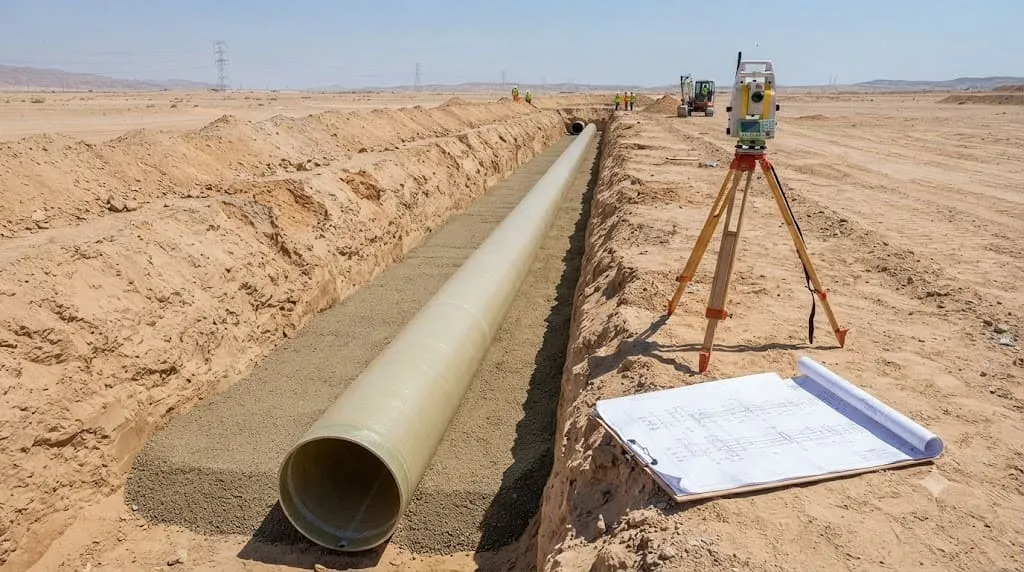
For buried pipelines, pipe stiffness and surrounding soil support must be evaluated together. Potential vacuum or external-pressure conditions also require a separate buckling assessment. Where installation conditions vary along the route, the approved pipe configuration may need to change accordingly.
Verifying GRP pipe standards and conformity
Applicable GRP pipe standards establish the requirements used to assess product performance and compliance:
- ISO 23856:2021: Specifies requirements for GRP piping systems based on unsaturated polyester resin, covering pressure and non-pressure water supply, drainage, and sewerage applications.
- AWWA C950-25: Establishes requirements for fiberglass pressure pipes and joining systems used in potable, raw, and reclaimed water applications.
- AWWA Manual M45: Provides technical guidance for fiberglass pipe design, specification, procurement, and installation.
Pressure and stiffness classifications must be interpreted according to the applicable standard. AWWA pressure and stiffness classes should not be treated as directly interchangeable with PN and SN ratings without checking their units, classification methods, and test requirements.
Before approving a product, confirm that its stated dimensions, pressure and stiffness ratings, joining system, and declared standard correspond to the approved project requirements. Any technical deviations must be identified and resolved before acceptance.
At Qiwaa Advance, we help contractors and project owners review GRP pipe requirements and identify suitable product options through our partnership with Amiantit. Our support includes coordinating technical specifications, available dimensions, pressure and stiffness classes, and manufacturer documentation against the project’s requirements. Final design calculations and technical approvals remain the responsibility of the appointed designer or consultant.
Read also: HDPE Pipe Supply in Syria for Water Networks
How to review GRP pipe specifications before procurement
Once the project requirements are approved, procurement teams must verify that the manufacturer’s proposed pipe configuration matches them. This involves reviewing the product’s dimensions, pressure and stiffness ratings, and technical documentation before approving the offer or accepting delivery.
Reading GRP pipe diameter, pressure and stiffness tables
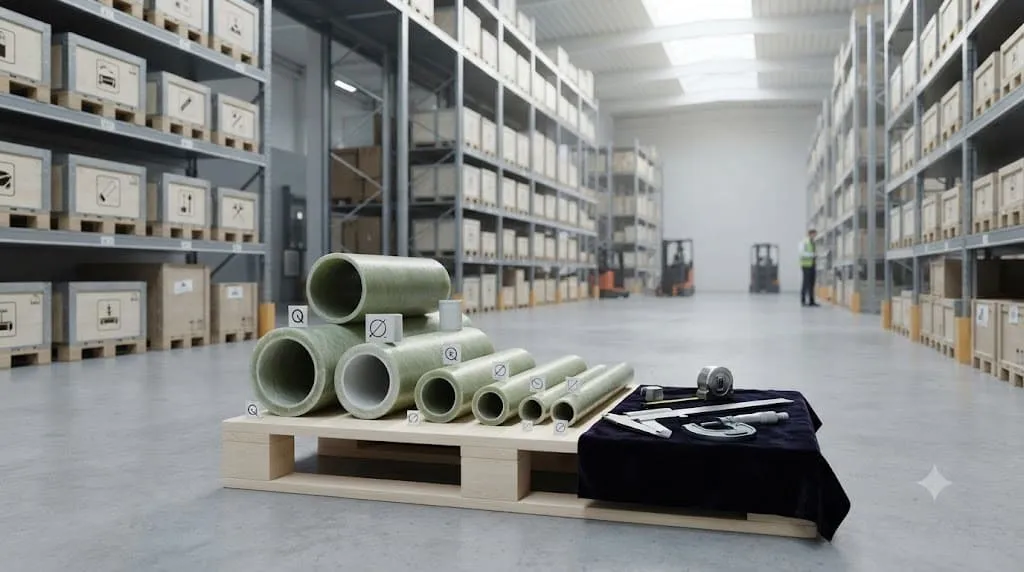
A GRP pipe diameter chart should be read alongside the manufacturer’s pressure and stiffness classifications. The nominal diameter (DN) alone does not establish the pipe’s actual dimensions or confirm that the required PN and SN combination is available.
For example, Flowtite’s published technical data provides the following dimensions for its Standard Pressure Pipe PN 6/10 design:
| Nominal Diameter (DN) | Outside Diameter (de) |
|---|---|
| DN 300 | 324 mm |
| DN 400 | 427 mm |
| DN 600 | 617 mm |
| DN 800 | 821 mm |
| DN 1000 | 1025 mm |
These values apply to the referenced Flowtite design and are not universal GRP pipe dimensions. Other manufacturers and product configurations may use different outside diameters for the same nominal size.
Flowtite’s published range also includes GRP pipe pressure classes PN 6, 10, 16, 20, 25 and 32, with SN 5000 and SN 10000 among its documented stiffness options. Availability varies by diameter, stiffness and product design.
Before approving a product, check the exact DN, PN and SN combination, diameter series, wall thickness, internal diameter, pipe length, and joint dimensions against the current manufacturer’s data sheet.
GRP pipe specification checklist for procurement
A GRP pipe specification checklist helps ensure that quotations are based on equivalent technical requirements. Before issuing an RFQ or purchase order, confirm:
- Application and operating conditions: Conveyed fluid, operating temperature, service environment and material compatibility.
- Standards and approval requirements: Applicable product standard, edition, project specifications and required certificates.
- Dimensions: Nominal diameter (DN), diameter series (DS), actual internal and external diameters, wall thickness and pipe length.
- Pressure requirements: Approved pressure class (PN), operating and design pressures, surge conditions and applicable temperature limitations.
- Structural requirements: Nominal stiffness (SN), burial depth, soil conditions, backfill requirements, external loads and groundwater conditions.
- Materials and joints: Resin and liner requirements, joint type, sealing system, allowable angular deflection and thrust-restraint requirements.
- Product conformity: Approved technical data sheet, required tests, inspection criteria, documentation and permitted deviations.
These requirements should follow the approved engineering design. Procurement teams use them to compare offers and identify departures from the specifications before placing an order.
GRP Pipe testing and batch traceability
GRP pipe testing must distinguish between tests used to qualify a product design, production tests required by the applicable standard, and inspections of the actual shipment.
Relevant test methods include:
- ISO 7509:2015: Determines the time to failure of GRP pipes under sustained internal hydrostatic pressure at a specified temperature.
- ISO 7685:2026: Specifies methods for measuring initial ring stiffness under constant-load or constant-deflection conditions.
- ISO 8639:2023: Covers leaktightness and structural performance testing of flexible, non-thrust-resistant GRP socket-and-spigot joints with elastomeric seals.
These methods assess different performance characteristics. Their applicability and required testing frequency depend on the governing standard, product configuration and contractual specifications. Qualification test reports do not replace production quality records or shipment inspection.
To verify the supplied product, the inspection and traceability file should include, as applicable:
- Dimensional and visual inspection records.
- Relevant qualification and production test reports.
- Packing lists and batch or pipe identification records.
- Records of approved deviations, repairs or nonconformities.
- Material and sealing-component documentation where required.
- The approved product data sheet and manufacturer’s conformity documentation.
The documents must allow the receiving team to match the delivered pipes and fittings to the approved configuration, purchase order and relevant manufacturing batches.
Product acceptance depends on this traceable connection between the approved GRP pipe specifications, the manufacturer’s declared configuration and the materials delivered to site.
How Qiwaa Advance supports GRP pipe supply in Syria
Approved GRP pipe specifications must remain consistent throughout procurement and delivery. Through our partnership with Amiantit, we help contractors, consultants, and project owners in Syria coordinate the technical and commercial requirements of GRP pipe supply.
Our support covers three areas:
- Technical and commercial coordination: Reviewing approved project requirements, including DN, PN, SN, applicable standards, and quantities, to coordinate suitable product options and quotations with the manufacturer.
- Product documentation: Obtaining relevant technical data, conformity documents, and manufacturer clarifications to support product evaluation and approval.
- Procurement and delivery: Coordinating purchase requirements, shipping, customs clearance, and delivery documentation to help keep the supplied configuration aligned with the approved order.
Engineering design approval and final product acceptance remain the responsibility of the appointed designer, consultant, and project owner, according to their contractual roles.
If your project requires GRP pipes in Syria, contact Qiwaa Advance with the application, project location, approved specifications, quantities, and delivery schedule. We can review your supply requirements and coordinate the relevant Amiantit product options.
Read also: Importing Building Materials to Syria and Key Customs Procedures in 2026
FAQs about GRP pipe specifications
What is the difference between PN and SN in GRP pipes?
PN identifies the nominal pressure class, while SN identifies nominal ring stiffness. Pressure selection must account for operating conditions and surge pressure, whereas stiffness selection depends on the structural design and installation conditions. One rating cannot substitute for the other.
How do you verify a GRP pipe certificate of conformity?
Check the manufacturer, product configuration, applicable standard, DN, PN, SN, and joint details against the approved specification. Where batch-level verification is required, confirm that the accompanying inspection and test records can be traced to the supplied products.
Do drinking water and sewerage networks require different GRP pipe specifications?
Yes. Drinking-water applications require suitable fluid-contact materials and applicable potable-water approvals. Sewerage applications may require different pressure, stiffness, joint-tightness, and chemical-resistance characteristics, depending on the network design and conveyed wastewater.
Is the GRP pipe warranty the same as its design life?
No. Design life refers to the intended service period under defined design and operating conditions. A warranty is a contractual commitment with its own duration, coverage, and exclusions. Verify these terms with the supplier before purchase.