


An evaluation committee opens a 40-page submission filled with project photographs, client logos, and a letter from the general manager. Yet the file lacks the financial statements and verified project references required by the tender. Despite its polished presentation, the contractor may fail the qualification review before its financial offer is evaluated.
The problem is not necessarily the contractor’s capability. It is the failure to demonstrate that capability against the buyer’s requirements. A construction company profile introduces a business; a contractor prequalification file provides evidence of its eligibility.
This guide explains how owners assess contractor prequalification, which financial and technical requirements can determine eligibility, and how to prepare verifiable evidence. It includes an annual turnover calculation for a hypothetical USD 2 million contract and a checklist to review before submission.
Contractor prequalification vs construction company profile
A construction company profile presents the firm’s services, project portfolio, and capabilities to prospective clients. A contractor prequalification file serves a different purpose: demonstrating that the firm meets the specific eligibility, financial, technical, and experience requirements established by the buyer.
The documents differ in how their information is organised and evaluated.
| Criterion | Construction Company Profile | Contractor Prequalification File |
|---|---|---|
| Purpose | Introduces the company’s experience and capabilities | Demonstrates compliance with the buyer’s qualification requirements |
| Primary reader | Potential clients, developers, and business partners | Procurement committees, employers, and evaluation consultants |
| Assessment | Reviewed to understand the firm’s suitability and capabilities | Assessed against mandatory qualification criteria and, where applicable, additional evaluation criteria |
| Supporting documents | Project summaries, photographs, company credentials, and selected references | Required legal documents, financial statements, verified project experience, key personnel records, and other specified evidence |
| Missing information | May reduce the profile’s usefulness or credibility | May result in clarification requests or disqualification, depending on the requirement and procurement rules |
A company profile can support a prequalification application, particularly when it includes relevant project experience. However, it cannot replace the required forms or supporting evidence specified in the prequalification documents.
How contractor prequalification criteria are evaluated
Contractor prequalification typically assesses whether an applicant meets defined minimum requirements for financial capacity, relevant project experience, technical resources, and eligibility.
For example, the buyer may require financial statements covering a specified period, minimum annual construction turnover, completed contracts of comparable size and complexity, and qualified personnel for key positions.
Under the Asian Development Bank’s User Guide for Prequalification of Bidders, these minimum requirements are assessed on a pass/fail basis. A contractor that fails a mandatory criterion may be disqualified even if it demonstrates strong performance in other areas.
However, not every contractor selection process follows an identical assessment method. Some procedures combine mandatory qualification thresholds with additional rated criteria. The applicable evaluation method must be established from the buyer’s procurement documents.
Syrian public procurement also permits prequalification. Under Article 11(d) of Law No. 51 of 2004, special tender conditions may require specified financial, technical, and professional qualifications, including prior prequalification for certain contracts.
Article 26 separately allows the contracting authority to restrict a tender to bidders demonstrating the required financial and technical capability, where justified by the nature or circumstances of the work.
For contractors, the practical rule is to identify the applicable qualification procedure and minimum requirements before preparing the application. Strong experience cannot compensate for a missing mandatory requirement unless the procurement rules expressly permit an alternative form of compliance.
Why contractors fail prequalification
A company may possess the required capabilities but fail to demonstrate them through the documents requested by the buyer. Four documentation problems require particular attention:
- Outdated legal documents: Article 11(g) of Law No. 51 of 2004 establishes a three-month issuance limit for the specific documents identified in Article 11(a)(2–5). Contractors should verify which documents are required, whether an exception applies, and any additional validity conditions in the tender.
- Unverified project experience: A project description or photograph does not necessarily establish the contractor’s role, executed contract value, or completion status. Provide owner-issued completion or handover certificates, contract records, or other evidence accepted by the buyer.
- Insufficient financial evidence: Internal turnover figures may not satisfy a requirement for audited financial statements. Submit the financial records and supporting schedules specified in the qualification documents, including any permitted alternatives.
- Unverifiable quality and safety credentials: Where certification is required, identify the issuing certification body, certificate number, applicable scope, and validity period. A statement that the firm follows ISO standards is not equivalent to holding a valid required certification.
Before submission, match every mandatory qualification criterion to its supporting document and page reference. Check whether the evidence establishes the exact requirement, rather than merely describing the company’s capabilities.
This allows the evaluation committee to verify eligibility and helps the contractor identify missing evidence before submitting its application.
Read more: Construction Companies in Syria 2026: How to Compare and Choose

Contractor prequalification financial and experience requirements
Contractor prequalification criteria assess whether a firm has the financial capacity and relevant experience to execute the proposed works. The employer defines the minimum requirements, and the contractor must demonstrate compliance with supporting documents.
The Asian Development Bank’s User Guide for Prequalification of Bidders provides illustrative thresholds for construction contracts. These are not mandatory requirements for Syrian tenders. The actual thresholds, evaluation periods, and accepted evidence must come from the project’s prequalification documents.
| Criterion | ADB Guidance | Evidence Required |
|---|---|---|
| Financial position | Financial statements covering 3–5 years, with positive net worth in the latest year. | Audited financial statements or acceptable alternatives where permitted, including balance sheets and income statements. |
| Similar project experience | Typically one or two substantially completed contracts within 5–10 years, each meeting the specified similarity and value requirements. The suggested value is usually around 80% of the proposed contract. | Contract records, evidence of the applicant’s actual participation, and accepted completion or taking-over documents. |
| Average annual construction turnover | A minimum normally calculated as 2 × V ÷ T, subject to the guide’s conditions. | Annual construction turnover records based on certified payments received for ongoing or completed contracts. |
These criteria test different aspects of eligibility. Turnover demonstrates the scale of construction activity, financial statements indicate financial condition, and similar contracts provide evidence of relevant execution experience.
Meeting one requirement does not compensate for failing another mandatory criterion.
How to calculate contractor annual rurnover
Under Section 3.2 of the ADB guide, the suggested minimum average annual construction turnover is normally calculated as:
Required Annual Turnover = 2 × V ÷ T
Where:
- V is the employer’s estimated contract value, including contingencies.
- T is the contract duration expressed in years.
- 2 is the standard multiplier suggested by the guide.
For contracts lasting one year or less, the guide uses T = 1. For very large contracts, the multiplier may be reduced, but the guide advises against setting it below 1.5.
Consider a hypothetical construction contract with an estimated value of USD 2,000,000 and a duration of 18 months.
- Convert the duration into years: 18 ÷ 12 = 1.5 years.
- Apply the suggested multiplier: 2 × USD 2,000,000 = USD 4,000,000.
- Calculate the required annual turnover: USD 4,000,000 ÷ 1.5 = approximately USD 2,666,667.
Under this example, a contractor with an average annual construction turnover of USD 1,800,000 would not meet the suggested threshold as a standalone applicant.
However, the turnover figure must also be calculated correctly. The ADB method uses certified construction payments received for contracts in progress or completed during the specified reporting years, rather than the total value of contracts awarded.
Before applying, contractors should:
- Identify the actual turnover threshold and reporting period in the prequalification documents.
- Calculate average annual construction turnover using the required financial records and currency conversion method.
- Verify that the supporting figures reconcile with the submitted financial documentation.
The employer’s stated requirement takes precedence over the illustrative ADB formula.
How to prove similar project experience
Contractor prequalification does not assess previous projects by contract value alone. The employer may also examine physical size, type of works, complexity, construction methods, technology, and experience in key activities.
Under Section 4.1 of the ADB guide, the suggested minimum value of a similar contract is usually 80% of the proposed contract value.
For the hypothetical USD 2,000,000 project:
USD 2,000,000 × 80% = USD 1,600,000
The contractor would therefore need qualifying experience meeting the specified criteria and value threshold.
However, for repetitive and contiguous works, such as water transmission pipelines, the ADB guide allows the employer to specify a threshold between 50% and 80%.
That difference matters for infrastructure contractors. A firm with experience installing smaller water networks may satisfy a particular value threshold but still fail if its previous projects do not demonstrate the required pipe diameters, construction methods, complexity, or production capacity.
The relevant value is also the applicant’s actual participation, not necessarily the full contract value. This distinction is important for joint venture partners and subcontractors.
A project experience register should allow the evaluator to verify each claim.
| Field | Information to Record |
|---|---|
| Project | Contract name, location, and scope |
| Employer | Client name and verifiable contact details |
| Contract value | Total value and the applicant’s executed share |
| Relevant experience | Comparable works, quantities, methods, and technical characteristics |
| Applicant’s role | Main contractor, joint venture partner, or subcontractor |
| Completion status | Completion date or accepted substantial completion status |
| Supporting evidence | Contract agreement, accepted certificate or other required proof, and its file reference |
The ADB guide permits satisfactorily and substantially completed contracts where the employer’s selected criteria allow them. Supporting documents may include a signed contract agreement and a Taking-Over Certificate, Contract Completion Certificate, or Performance Certificate, as applicable.
Do not assume that a project photograph, contract award letter, or total project value proves the applicant’s eligibility. Match every claimed project to the exact similarity criteria and evidence required by the employer.
Contractor classification and prequalification in Syria
Syrian contractors must distinguish between official contractor classification and the qualification requirements of a specific tender.
In September 2026, Syria’s Ministry of Public Works and Housing issued a new contractor classification system under Decision No. 7034, subsequently announced by the ministry in October 2026.
The system establishes seven classification categories and six main construction specialisations, including buildings, roads and bridges, water and wastewater networks, electrical works, mechanical works, and well drilling.
The classification framework considers factors such as completed works, professional experience, financial capacity, and technical personnel.
Before applying for a public construction project, contractors should verify:
- Classification category: Whether their current category permits participation in a project within the relevant contract-value range.
- Approved specialisation: Whether the classification covers the type of works being tendered.
- Certificate status: Whether the applicable classification documents satisfy current requirements, including any transitional provisions.
- Tender-specific eligibility: Whether additional financial, technical, experience, or documentation requirements apply.
Official classification does not automatically establish eligibility for every tender.
Under Law No. 51 of 2004, Article 11(d) permits certain financial, technical, and professional qualification conditions, including prior prequalification. Article 26 separately regulates restricted tenders involving bidders with the required capabilities.
The contractor must therefore review both the applicable classification rules and the particular tender documents.
Submission procedures also vary. Where a tender requires separate legal, technical, and financial envelopes, follow the prescribed document allocation. Other procurement procedures may require a different submission structure.
Before submitting, confirm the required classification, financial thresholds, accepted experience evidence, document validity, and submission method. The tender documents—not a generic qualification checklist—determine whether the application is compliant.

How to prepare contractor prequalification documents
Build your contractor prequalification file around the buyer’s qualification criteria, not your company’s existing profile. Start with the Invitation for Prequalification, its required forms, evaluation criteria, and any issued amendments.
Create a compliance matrix that links every mandatory requirement to its supporting evidence. For each criterion, record the required document, its location in the submission, and whether it is complete.
Place an index at the beginning of the file using the same numbering as the buyer’s requirements. Every mandatory criterion should have a traceable document reference before submission. A missing requirement is easier to identify in the matrix than after the application has been submitted.
Required documents for contractor prequalification
The application should follow the buyer’s prescribed forms and document order. Where no specific order is required, organise the supporting evidence into these categories:
- Legal eligibility: Commercial registration, relevant licences, chamber membership where required, incorporation documents, and authorisation of the person signing the application. Verify document validity against the tender requirements.
- Financial capacity: Financial statements for the specified period, supporting audit reports where required, and annual construction turnover schedules calculated using the buyer’s method.
- Relevant project experience: A table of comparable contracts identifying the employer, scope, executed value, applicant’s role, and completion status, supported by the required certificates or contract records.
- Key personnel: Proposed positions, qualifications, experience, and CVs, with availability commitments or signatures where required.
- Equipment and resources: Machinery and equipment required for the contract, supported by ownership, lease, or availability evidence where requested.
- Quality and safety systems: Relevant quality management and occupational health and safety procedures, including valid certifications where specified.
- Client references: Previous employers or clients who can verify project scope, performance, and completion, with contact details and reference letters where required.
Each section should correspond to a qualification requirement. Do not submit documents solely because they appear on a generic prequalification checklist. Verify whether the buyer requires them and whether they demonstrate the stated criterion.
International registration systems may request similar evidence. For example, UNGM Level 1 requires a legal registration document and three independent references, alongside ownership information. UNGM Level 2 requires at least three years since establishment, three recent independent client reference letters, and financial documents covering the last three years.
However, UNGM registration does not establish eligibility for a specific construction tender. Contractors must still satisfy the issuing organisation’s project-specific qualification requirements.
Joint venture prequalification requirements
A joint venture (JV) may allow contractors to combine eligible resources and experience when a single company cannot independently meet the buyer’s requirements. However, combining turnover does not automatically resolve deficiencies in other mandatory criteria.
The ADB User Guide for Prequalification of Bidders provides illustrative requirements for joint venture financial qualification:
- All partners combined: Must meet 100% of the required average annual construction turnover.
- Each partner: Usually must meet at least 25% of the requirement.
- At least one partner: Usually must meet at least 40% of the requirement.
Using the earlier hypothetical turnover threshold of USD 2,666,667:
| Requirement | Minimum Annual Turnover |
|---|---|
| All JV partners combined — 100% | USD 2,666,667 |
| Each partner — 25% | USD 666,667 |
| At least one partner — 40% | USD 1,066,667 |
Figures are rounded up to the nearest dollar and illustrate the ADB guidance, not mandatory Syrian thresholds.
The combined requirement must still be met. Having one partner reach 40% and another reach 25% is insufficient if their combined turnover falls below 100% of the required threshold.
Financial eligibility also extends beyond combined turnover. Under the ADB model, each partner must independently meet applicable eligibility and financial-position requirements, including positive net worth.
Before submitting a joint venture application, contractors should verify:
- Whether the tender permits an existing or proposed joint venture.
- The minimum turnover and experience requirements for individual partners and the JV as a whole.
- Which partner must demonstrate any required specialised construction experience.
- Whether a signed JV agreement or letter of intent is required.
- The partners’ respective scopes and applicable joint and several liability obligations.
The 25% and 40% figures are suggested thresholds. The actual prequalification documents determine the percentages and whether a designated lead partner must meet additional requirements.
16-point contractor prequalification checklist
Before submitting the application, use this checklist to identify requirements that could cause rejection or require clarification.
- Confirm the applicable requirements. Review the latest prequalification documents, amendments, mandatory criteria, and submission instructions.
- Check the application structure. Match each required form and criterion to a supporting document and its page reference.
- Verify legal documents. Confirm registration details, licences, and document issue dates against the specified validity requirements.
- Check signing authority. Ensure the application is signed by an authorised representative and includes the necessary authorisation documents.
- Validate financial statements. Confirm that the required reporting years, audit reports, and financial schedules are complete and consistent.
- Recalculate annual turnover. Use the buyer’s required formula, reporting period, and currency conversion method. Reconcile the figures with supporting records.
- Verify similar-contract eligibility. Check each claimed project’s scope, executed contract value, completion status, and relevance to the required experience.
- Confirm project evidence and references. Attach accepted completion or taking-over records and verify that client contacts can substantiate the claims.
- Check key personnel. Match qualifications and experience to the required positions and provide CVs and availability evidence where requested.
- Verify equipment availability. Provide the required machinery details and acceptable ownership, lease, or availability documents.
- Check quality and safety evidence. Confirm that required certificates cover the relevant scope and remain valid, and attach supporting procedures where specified.
- Verify joint venture compliance. Check the combined and individual partner thresholds, eligibility documents, responsibilities, and signed JV agreement or letter of intent.
- Exclude unsupported experience claims. Do not attribute another company’s or former partner’s experience to the applicant unless the qualification rules expressly permit it.
- Complete mandatory declarations. Disclose contract nonperformance, litigation, conflicts of interest, and other relevant matters where the buyer requires them.
- Check language and document formats. Provide certified translations, signatures, file formats, and electronic submissions as specified.
- Perform the final submission check. Test all page references, verify required attachments, submit through the designated channel before the deadline, and retain an identical submission record.
A complete contractor prequalification file does not guarantee approval. It allows the buyer to verify the applicant’s eligibility and assess its financial and technical qualifications against the published criteria.
The final review should therefore focus on whether every mandatory requirement is supported by acceptable evidence, rather than on the file’s presentation or total number of pages.
Also read: Infrastructure Contracting in Syria: Choosing the Right Contractor
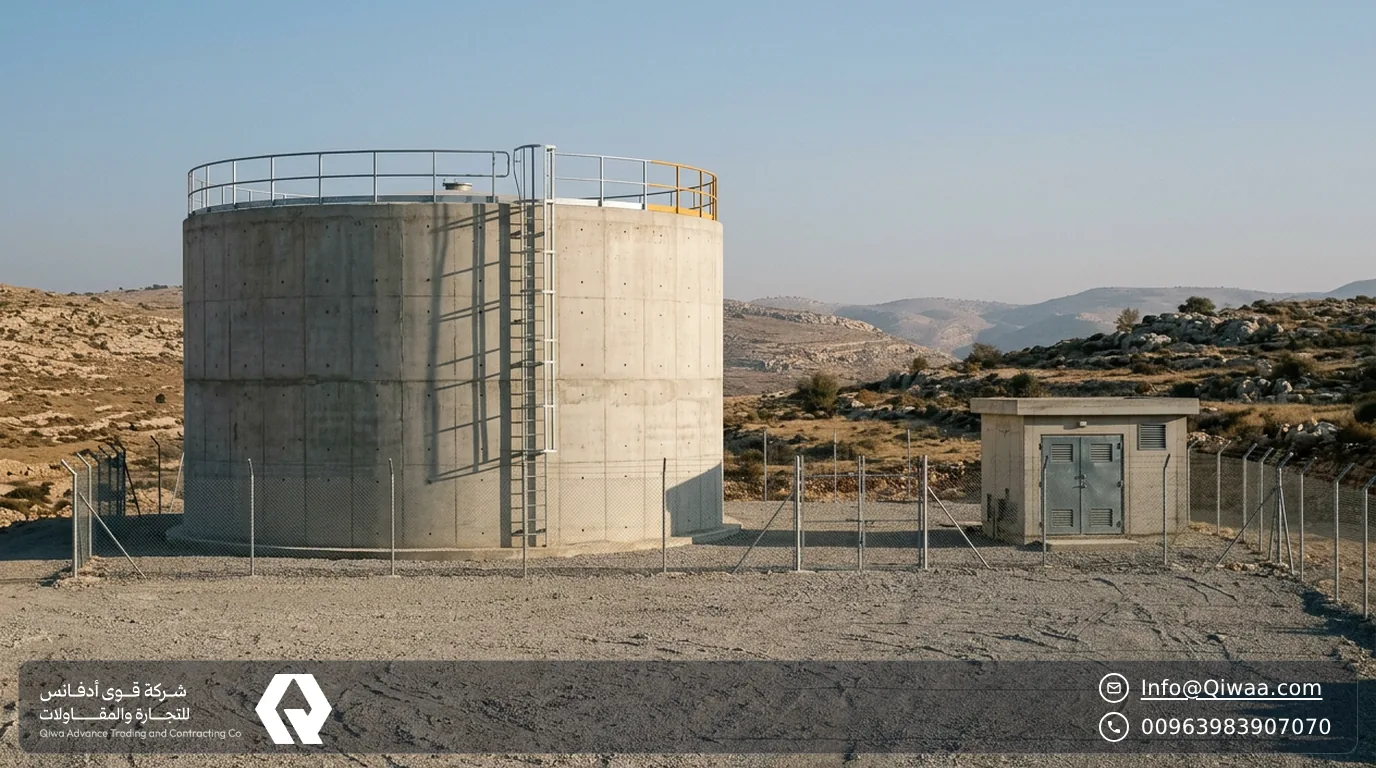
Qiwaa Advance’s EPC contracting and supply capabilities in Syria
At Qiwaa Advance, we operate in construction and infrastructure through two relevant divisions. Qiwaa Contracting undertakes EPC projects involving water networks, treatment facilities, and specialised construction systems, while Qiwaa Trading focuses on sourcing construction and industrial materials through international supplier and manufacturing relationships.
For companies seeking supply or subcontracting opportunities, the important distinction is between introducing their capabilities and demonstrating eligibility for a specific contract.
Qiwaa Advance provides a supplier registration link on its website. However, registration should not be confused with formal contractor prequalification or treated as confirmation that a company qualifies for a particular project.
Supplier registration vs contractor prequalification
Supplier registration establishes an initial business relationship or introduces a company’s capabilities. Contractor prequalification evaluates whether an applicant meets the requirements of a particular procurement opportunity.
| Criterion | Supplier Registration | Contractor Prequalification |
|---|---|---|
| Purpose | Introduce the company and its products or services | Demonstrate eligibility for a defined project or contract |
| Information | Company identity, business activities, products, and capabilities | Documents required by the employer’s financial, technical, and eligibility criteria |
| Experience evidence | Relevant project references may support the introduction | Specific experience evidence must satisfy the published qualification requirements |
| Assessment | Initial consideration for potential cooperation | Evaluation against mandatory and other applicable qualification criteria |
| Outcome | Establishes contact or records supplier interest | Determines eligibility for the relevant procurement stage |
Registration does not replace project-specific prequalification or guarantee a contract award. Suppliers and subcontractors should obtain the applicable qualification requirements before preparing detailed submissions.
What to include in a supplier or subcontractor profile
Companies interested in working on construction and infrastructure projects should prepare a concise, verifiable summary of their capabilities.
The most useful information includes:
- Business scope: Clearly identify the products supplied or construction activities performed, including relevant technical specialisations.
- Geographic coverage: Specify the Syrian governorates and project locations the company can reliably serve.
- Supply or execution capacity: Provide relevant production capacity, delivery capability, available personnel, and equipment, supported by evidence where required.
- Relevant project experience: Identify previous clients, executed scopes, contract values where relevant, and available completion or performance records.
- Quality and safety credentials: Describe applicable procedures and identify any certifications by issuing body, scope, and validity period.
For specialised materials or subcontracted works, supporting technical specifications, manufacturer information, and relevant project references can help establish whether the company’s capabilities match a proposed scope.
Companies should provide additional financial statements, equipment records, personnel qualifications, or project-specific documents only when requested under the applicable qualification procedure.
- Suppliers: Use the Qiwaa Advance supplier registration form to express interest in potential cooperation.
- Subcontractors: Contact Qiwaa Advance to enquire about relevant contracting opportunities and the documentation required for consideration.

FAQs about contractor prequalification
Can a company profile replace a prequalification file?
No. A construction company profile introduces the contractor’s capabilities and previous projects, but it does not replace the forms and supporting evidence required for prequalification. Applicants must demonstrate compliance with the buyer’s financial, technical, experience, and eligibility criteria using the specified documents.
How many years of audited financial statements are required?
The requirement depends on the procurement procedure. The Asian Development Bank’s prequalification guide suggests a financial reporting period of three to five years. UNGM Level 2 separately requires financial documents for the last three years, but supplier registration is not equivalent to contractor prequalification. Always follow the reporting period and evidence requirements stated in the relevant application documents.
How can a contractor prove similar project experience?
Provide verifiable contracts demonstrating the required scope, value, complexity, and completion status. Include the applicant’s actual executed share and the supporting certificates or records accepted by the buyer. A project’s title or photographs alone do not establish similarity. The qualification documents determine how much experience is required and what counts as acceptable evidence.
Is there an official contractor classification system in Syria?
Yes. Syria’s Ministry of Public Works and Housing announced a new contractor classification system in October 2026, following its issuance in September. It establishes categories and technical specialisations for construction contractors. Applicants should verify their applicable classification and any transitional requirements, alongside the additional eligibility conditions of the specific tender.
Can a new contractor prequalify through a joint venture?
Potentially, if the procurement rules permit joint ventures and the partners collectively satisfy the applicable requirements. Under the ADB’s illustrative turnover criteria, all partners combined must meet the full threshold, each partner usually meets at least 25%, and one partner usually meets at least 40%. Individual eligibility and other qualification conditions still apply. A newly established firm should not assume that a partner’s experience automatically resolves every eligibility requirement.
Can missing documents cause prequalification rejection?
Yes. Missing evidence for a mandatory financial, technical, or eligibility requirement may result in disqualification. Some procurement procedures allow clarification of submitted information, but applicants should not assume that missing essential documents can be supplied after the deadline. Check every required form, certificate, financial record, and supporting reference against the published criteria before submission.
Sources
- User Guide for Prequalification of Bidders: Standard Bidding Document, Asian Development Bank, December 2021
- Law No. 51 of 2004 (Public Contracts System), Aleppo City Council data bank, 9 December 2004
- Invitation to submit domestic price offers for the General Authority for Supply and Procurement, SANA, 7 September 2026
- What are the requirements for registration on UNGM, United Nations Global Marketplace, accessed 11 October 2026