

Waterproofing problems often begin with selecting materials that do not match the building’s actual conditions. A system that performs well on a roof may be unsuitable for a basement exposed to groundwater pressure, while overlooking surface conditions, structural movement, or installation requirements can lead to leaks, costly repairs, and project delays. For developers, project owners, and contractors in Syria, understanding how to choose waterproofing materials is essential to protecting construction quality and controlling long-term costs.
In this guide, Qiwaa Advance explains how to evaluate waterproofing materials based on their applications, technical properties, exposure conditions, and compatibility with the surfaces being protected. We compare common waterproofing systems, highlight the specifications that matter when assessing available products, and examine installation and cost considerations to help you select a suitable solution for your project’s requirements.
Why waterproofing systems fail in Syrian buildings
Choosing the wrong waterproofing materials in Syria can leave a building vulnerable to water penetration even when the materials themselves meet the required quality standards. An exposed roof, an underground foundation, and a bathroom floor face different moisture conditions, and each requires a waterproofing system suited to its application. Poor substrate preparation, inadequate drainage, or incorrectly treated joints can also compromise an otherwise suitable system.
For property owners, investors, and contractors, these failures can become particularly costly once construction is complete and the waterproofing layers are concealed beneath finishes or backfill. Understanding the causes of failure helps you identify vulnerable areas, assess the risks, and make better-informed decisions before approving materials or construction work.
Where are buildings most vulnerable to water leakage?
Visible dampness does not necessarily indicate the point where water enters a building. Moisture can travel through construction joints, cracks, and service penetrations before appearing on an interior wall or ceiling. Plumbing leaks and condensation should also be considered before concluding that the waterproofing system has failed.
The most vulnerable areas depend on the building element and its exposure conditions:
- Roofs and terraces: Drain outlets, membrane seams, parapet junctions, equipment supports, and areas where inadequate slopes or blocked drainage allow water to accumulate.
- Basements and foundations: Connections between foundation slabs and walls, construction and movement joints, pipe penetrations, and underground surfaces exposed to groundwater or hydrostatic pressure.
- Bathrooms, balconies, and wet areas: Floor-to-wall junctions, drainage connections, pipe penetrations, and transitions between different construction materials.
These locations require appropriate waterproofing details in the project drawings and specifications. Even when a membrane performs well across an uninterrupted surface, untreated joints and penetrations can become pathways for water infiltration.
What are the costs of inadequate waterproofing?
The cost of waterproofing failure extends beyond replacing a damaged membrane. Water penetration can affect plaster, paint, flooring, and insulation materials. Prolonged moisture exposure may also contribute to reinforcement corrosion and concrete deterioration, depending on the extent of exposure and the condition of the structure.
Repairs become more complicated when the waterproofing system is difficult to access. Locating a leak beneath a tiled terrace, finished bathroom, or backfilled basement wall may require removing surrounding construction layers before the defect can be repaired and the affected finishes reinstated.
For investors and property owners, the resulting costs generally fall into two categories: repair and reinstatement expenses, and potential disruption to the building’s intended use. This makes proper system selection and installation particularly important before waterproofing layers become inaccessible.
How can you evaluate the effectiveness of a waterproofing system?
When reviewing a waterproofing proposal, the key consideration is whether the complete system addresses the building’s exposure conditions, rather than whether a particular membrane or coating is considered high quality.
For example, roof waterproofing must account for surface drainage, junction details, weather exposure, and protection during subsequent construction activities. Basement waterproofing requires a different assessment, including groundwater conditions, hydrostatic pressure, structural joints, and the proposed drainage arrangements.
Before approving the proposed waterproofing system, review the following technical requirements:
- Surface preparation: The condition of the substrate and the preparation necessary for proper waterproofing application.
- Joint and penetration treatment: The specified methods for sealing construction joints, movement joints, drainage outlets, and pipe penetrations.
- Material compatibility: Whether the membrane, primers, sealants, and adjoining components are suitable for use together and for the intended exposure conditions.
- Protection and drainage: The measures needed to protect waterproofing layers from mechanical damage and prevent unnecessary water accumulation.
- Inspection and testing: The quality-control procedures and appropriate tests required before the system is covered or the next construction stage begins.
These requirements also affect project costs. A lower quotation per square meter may exclude necessary joint treatments, drainage components, protective layers, or substrate preparation. Comparing the full waterproofing scope, rather than the membrane price alone, helps you assess both the actual cost and the completeness of the proposed work.
At Qiwaa Advance, we provide contracting and material-sourcing services for construction and rehabilitation projects in Syria. Our role is to help project owners and contractors address the execution and supply requirements defined by their projects’ technical specifications.
If you are preparing a new building or rehabilitation project, contact Qiwaa Advance to discuss your construction requirements and the materials needed for the approved scope of work.
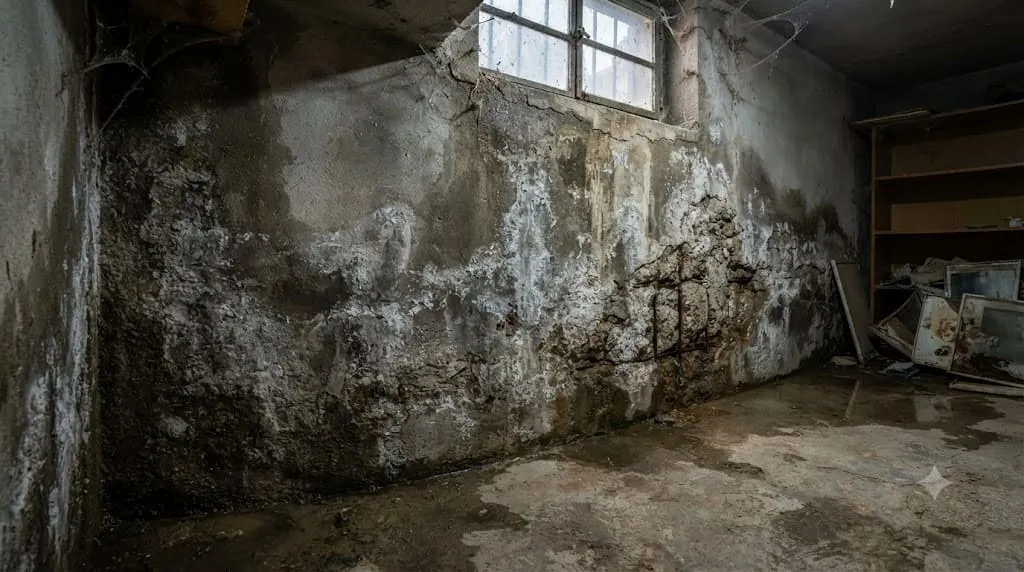
How waterproofing protect foundations from cracking and moisture
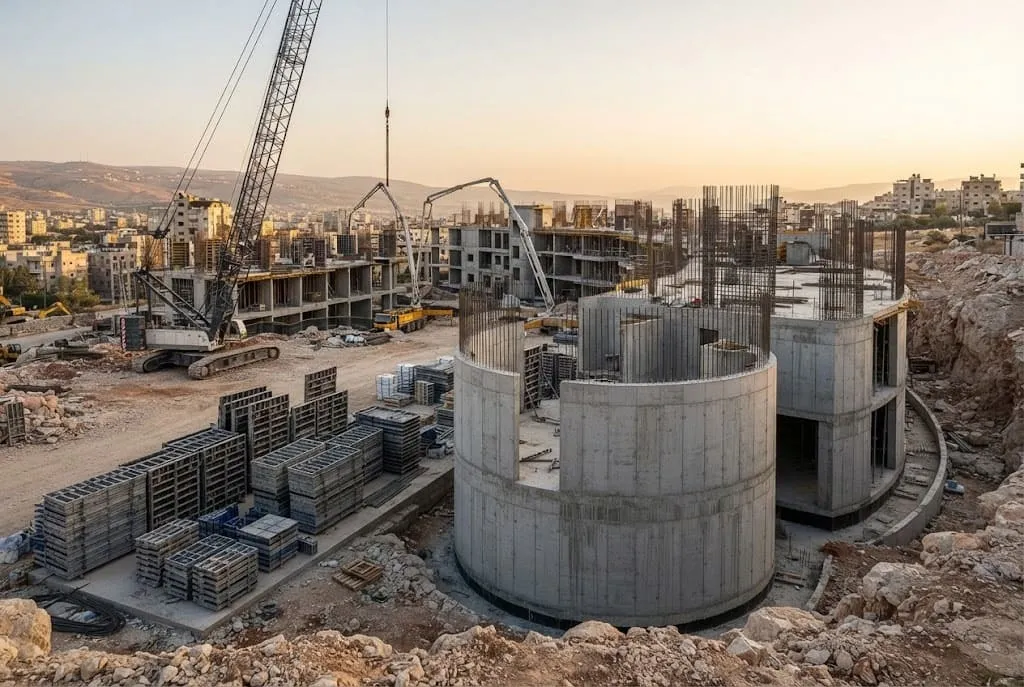
Foundation waterproofing protects concrete foundations and basements by limiting the penetration of groundwater and soil moisture through concrete surfaces, construction joints, and existing cracks. When combined with effective drainage, it also helps prevent water from accumulating against foundation walls, reducing hydrostatic pressure and the risk of moisture-related deterioration.
To achieve this protection, the waterproofing system must address several critical areas:
- Waterproofing membranes: Selecting a membrane suitable for the site’s groundwater conditions and expected water pressure creates a barrier against moisture penetration through below-ground concrete surfaces.
- Cracks and construction joints: Sealing existing non-structural cracks and using appropriate waterstops or joint treatments reduces leakage through vulnerable connections. Where movement is expected, the selected system must accommodate it.
- Pipe penetrations: Sealing service openings prevents groundwater from entering where pipes and utilities pass through foundation walls.
- Foundation drainage: Perimeter drainage, suitable backfill, and surface-water management help direct water away from the structure and reduce pressure against foundation walls.
- Protection during backfilling: Protecting waterproofing membranes from punctures and mechanical damage helps preserve the continuity of the installed barrier.
Waterproofing does not prevent every type of foundation crack. Cracking caused by differential settlement, structural loads, or ground movement requires engineering assessment and appropriate structural treatment. Waterproofing instead limits water entry through susceptible areas and can help reduce moisture-related deterioration, including reinforcement corrosion where water and other necessary conditions are present.
For property owners and developers, these measures help maintain dry, usable basements, protect internal finishes and installed equipment, and reduce the likelihood of disruptive leakage repairs after construction is complete. The appropriate system should therefore be determined from the site’s groundwater conditions, foundation design, and expected exposure—not simply from the lowest installation price.
Contact Qiwaa Advance to discuss your project’s foundation protection, construction, and material requirements.
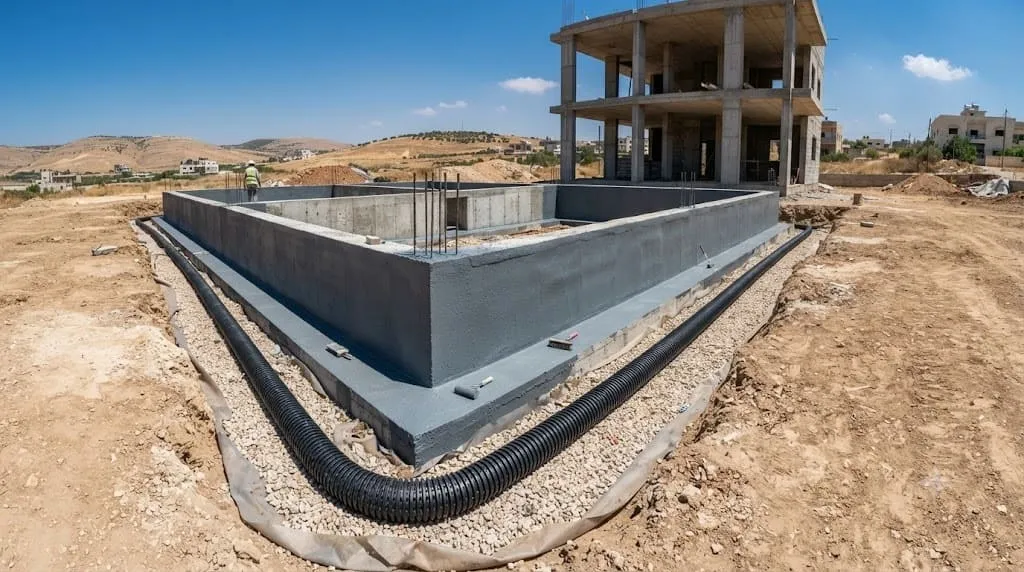
How to choose waterproofing systems for foundations and roofs
Choosing waterproofing materials in Syria requires more than comparing membrane types or prices per square meter. A basement wall exposed to groundwater pressure does not need the same protection as a roof exposed to sunlight, rain, and temperature changes. Selecting the wrong system can lead to persistent leakage, damaged finishes, moisture-related concrete deterioration, and costly repairs after the waterproofing has been concealed.
For project owners, engineers, and contractors, the priority is to match the waterproofing system to the structure’s exposure conditions, then verify that its materials, installation details, and inspection requirements are suitable for the project.
Waterproofing systems by location and application
Different structural elements require different levels of waterproofing protection. The following table outlines the systems worth evaluating for common building applications in Syria.
| Application | Suitable Systems to Evaluate | What Determines the Choice |
|---|---|---|
| Foundations and basement walls | Fully bonded bituminous membranes, approved liquid-applied membranes, and cementitious systems designed for the relevant exposure | Groundwater conditions, hydrostatic pressure, construction joints, drainage, external access, and protection before backfilling |
| Exposed roofs | UV-resistant bituminous waterproofing membranes, PVC or TPO/FPO roofing membranes, and liquid-applied systems rated for external exposure | Sunlight and temperature exposure, roof movement, drainage, ponding risk, and compatibility with insulation and other roof layers |
| Balconies and tiled terraces | Flexible cementitious waterproofing, compatible liquid-applied membranes, or sheet systems approved for use beneath tiles | Surface slopes, drain connections, corners, movement joints, and compatibility with tile adhesives |
| Bathrooms and wet areas | Liquid-applied or sheet waterproofing membranes suitable for installation beneath finishes | Pipe penetrations, floor drains, wall-to-floor junctions, curing requirements, and compatibility with the finishing system |
| Existing buildings and refurbishment | Replacement membranes or compatible overlay systems, subject to an assessment of the existing waterproofing | Condition and adhesion of existing layers, trapped moisture, blistering, damaged joints, and the underlying cause of leakage |
These systems are initial options, not interchangeable specifications. For example, a coating suitable for preventing surface dampness may not withstand groundwater pressure against a basement wall. Similarly, a membrane designed for protection beneath tiles should not automatically be specified for an exposed roof.
The final selection must be supported by the manufacturer’s technical documentation and the conditions established during the project assessment.
Technical criteria for selecting waterproofing materials
Before approving a product or requesting quotations from waterproofing suppliers in Syria, establish the performance requirements that the complete system must meet.
- Water source and pressure: Determine whether the structure faces rainwater, intermittent moisture, standing water, or groundwater under hydrostatic pressure. Below-grade applications exposed to water pressure require a system specifically rated for those conditions, together with an appropriate groundwater-control strategy.
- Waterproofing application side: Identify whether the membrane can be installed on the side exposed to incoming water. Positive-side waterproofing is generally preferred for below-grade structures where feasible. If access is restricted, alternative arrangements require a system specifically designed for that situation.
- Cracks and structural movement: Check the membrane’s documented crack-bridging performance and compatibility with the expected movement of the substrate. Structural cracks and movement joints require appropriate engineered treatment; a flexible coating alone is not a substitute for joint detailing.
- Substrate condition: Verify that concrete is sufficiently sound, clean, and prepared for the selected system. Surface moisture, weak concrete, honeycombing, and uneven substrates can compromise adhesion and create paths for water migration.
- Environmental exposure: For roof waterproofing, assess ultraviolet radiation, thermal movement, roof drainage, and maintenance access. For foundation waterproofing, consider groundwater exposure, backfill conditions, mechanical protection, and compatibility with adjacent construction layers.
- Complete system compatibility: Confirm that primers, membranes, reinforcement tapes, joint treatments, adhesives, drainage components, and protection layers are compatible. A compliant membrane can still fail when installed with unsuitable accessories or incompatible layers.
- Technical documentation and installed cost: Review product data sheets, relevant test results, specified membrane thickness, installation conditions, and available batch documentation. Compare quotations based on the complete installed system—including preparation, accessories, detailing, protection, and inspection—not solely the membrane’s unit price.
A technically sound specification should therefore identify both the required waterproofing performance and the conditions necessary to achieve it on-site.
Common waterproofing installation mistakes and their solutions
Even correctly specified waterproofing systems can fail when installation details are overlooked. The most expensive failures often become apparent only after a basement has been backfilled or a roof has been covered with additional layers.
The following installation errors deserve particular attention:
- Applying membranes over unsuitable substrates: Dust, weak concrete, surface contaminants, or moisture levels outside the manufacturer’s limits can reduce adhesion. Concrete preparation and substrate acceptance should be completed before application begins.
- Leaving joints and penetrations inadequately sealed: Pipe entries, construction joints, movement joints, corners, and drain connections are vulnerable points. Each requires compatible detailing rather than simply extending the main membrane across it.
- Ignoring membrane thickness and seam quality: Insufficient liquid-membrane thickness, incomplete coverage, poorly bonded overlaps, or defective sheet seams can interrupt waterproofing continuity. Inspection should follow the approved system’s installation and quality-control requirements.
- Failing to address drainage: Roof membranes should not be used as a substitute for suitable falls and functioning outlets. Likewise, foundation drainage must be assessed alongside the waterproofing design rather than treated as an unrelated site activity.
- Damaging completed waterproofing: Backfilling, screeding, tiling, and subsequent construction activities can puncture or displace the membrane. Suitable protection and inspection are necessary before the waterproofing is concealed.
- Applying new waterproofing over defective existing layers: During refurbishment, covering blistered or poorly bonded membranes without investigating trapped moisture and the source of leakage can reproduce the original failure. The existing system must be assessed for removal, repair, or compatibility with the proposed treatment.
- Closing the work without documented acceptance: Waterproofing should be inspected at the specified stages, including appropriate seam checks, thickness verification, and any project-required testing. Concealed areas should not be covered before the applicable inspections and approvals are complete.
For bonded waterproofing membranes applied to concrete, ASTM D5295/D5295M-18 provides guidance on surface preparation, including substrate condition, cleaning, and moisture evaluation. Its scope does not extend to selecting the waterproofing system or designing expansion-joint and flashing details. These must be addressed separately through the project specifications and the selected manufacturer’s requirements.
For projects in Syria, Qiwaa Advance can discuss construction and material-sourcing requirements through its contracting and trading services. Providing your foundation or roof drawings, exposure conditions, proposed waterproofing specifications, and project location helps establish the technical and supply requirements that need to be addressed before procurement.
Qiwaa Advance: Sourcing waterproofing materials in Syria
A waterproofing quotation may appear competitive until construction begins and the contractor discovers that essential components were excluded. Missing primers, joint-sealing materials, or protective layers can increase procurement costs and delay work that must be completed before tiling, backfilling, or finishing.
At Qiwaa Advance, we approach construction material supply in relation to the project’s technical specifications, required quantities, and execution schedule. For contractors and project owners sourcing waterproofing materials in Syria, this means evaluating the complete approved system rather than comparing membrane prices in isolation.
What should you check in a waterproofing supply offer?
Before issuing a purchase order, compare quotations against the same technical and commercial requirements:
| Supply Requirement | What to Verify Before Purchasing |
|---|---|
| Complete Waterproofing System | Confirm that the quotation includes the specified membrane or coating, primer, joint treatments, sealants, and protective materials where required. |
| Quantities and Total Cost | Calculate quantities using approved coverage rates, application thickness, overlaps, detailing, and reasonable wastage allowances rather than surface area alone. |
| Technical Documentation | Request the relevant technical data sheets, application instructions, and product identification documents needed for the project’s approval and receiving procedures. |
| Product Alternatives | Check proposed substitutions against the specified system. Any changes requiring technical approval must be referred to the responsible designer or consultant before ordering. |
| Availability and Delivery | Confirm lead times, shelf-life requirements, storage conditions, and delivery quantities against the construction schedule. |
These checks are particularly important for waterproofing systems installed beneath tiles or behind backfilled structures. An omitted component or unsuitable substitute may not become apparent until work is underway, when correcting the supply arrangement can also disrupt other activities.
How Qiwaa Advance supports waterproofing material procurement
Through Qiwaa Trading, we support construction-material sourcing and supply-chain coordination for projects in Syria. Based on your approved specifications and project requirements, we can discuss:
- Material sourcing: Identifying supply options for the specified waterproofing materials and associated components, subject to availability.
- Quantity and specification requirements: Organizing the information needed to request and compare quotations against the approved scope.
- Supply scheduling: Coordinating material requirements with planned construction activities and delivery arrangements.
Our role is to support procurement and supply. Final selection and technical approval of the waterproofing system, together with site preparation, installation, and inspection responsibilities, remain subject to the project’s design documents and contractual arrangements.
If you are preparing to purchase waterproofing materials for a construction project in Syria, share your approved specifications, quantities, site location, and expected delivery dates with our team.
Contact Qiwaa Advance to discuss waterproofing material sourcing and supply requirements for your project.
Read also: Construction Companies in Syria 2026: How to Choose a Reliable Contractor for Your Project
FAQs About Choosing Waterproofing Materials
How do I choose the right waterproofing materials for my building?
Start by identifying where water can enter the structure, the level of water exposure, and the condition of the surface being protected. Then compare waterproofing systems based on their suitability for the application, resistance to expected exposure, compatibility with the substrate, and installation requirements. Material price alone should not determine your choice.
What is the difference between foundation and roof waterproofing?
Foundation waterproofing must address soil moisture, groundwater pressure where present, construction joints, and protection during backfilling. Roof waterproofing must withstand rainfall, temperature changes, UV exposure where applicable, and water accumulation around drains. Each application requires a system suited to its exposure conditions and construction details.
How long should a waterproofing system last?
There is no single lifespan that applies to all waterproofing materials. Durability depends on the selected system, installation quality, exposure conditions, detailing around joints and penetrations, and maintenance. When comparing options, consider the expected service life alongside inspection, repair, and replacement costs.
Can new waterproofing be applied over an existing waterproofing layer?
In some cases, an existing layer can remain in place, provided its condition, adhesion, moisture content, and compatibility with the proposed system have been assessed. Damaged or poorly bonded areas may require removal. The manufacturer’s approved installation requirements should guide the decision rather than assuming that adding another layer will resolve an existing leak.
Which waterproofing materials are suitable for buildings in Syria’s coastal areas?
In coastal areas, choosing waterproofing materials requires evaluating the building’s exposure to rainfall, moisture, sunlight, and salts where relevant. Roofs, basements, and external walls face different conditions, so one waterproofing system will not necessarily suit every application. Assess drainage, substrate condition, and environmental exposure before selecting the material and installation method.
Sources
- [1] Food and Agriculture Organization (FAO): Climate and rainfall distribution in Syria.
- [2] ASTM C1305/C1305M: Test method for crack-bridging ability of liquid-applied membranes.
- [3] Sika: Principles of below-grade waterproofing systems and system components.
- [4] ASTM C836/C836M: Liquid-applied elastomeric membranes for use with a separate wearing course.
- [5] ASTM D6083/D6083M: Liquid-applied elastomeric acrylic roof coatings.
- [6] ISO 13007-5:2015: Liquid-applied membranes for use beneath ceramic tiling.
- [7] ISO 13007-6:2020: Bonded sheet-applied membranes for use beneath ceramic tiling.
- [8] ASTM D5295/D5295M: Preparation of concrete surfaces for adhered (bonded) membrane waterproofing systems.
- [10] Importing Building Materials to Syria and Key Customs Procedures in 2026