

A facade stone quotation may look competitive—until additional costs for custom cutting, architectural details, and delivery start adding up. For contractors and procurement teams comparing building stone prices in Syria, the challenge is knowing whether a lower price per square meter actually means a lower overall cost.
This guide from Qiwaa Advance helps you compare Syrian facade stone options, identify the factors that affect pricing, and calculate material quantities and associated costs, so you can evaluate quotations and plan procurement with greater confidence.
What are building stone prices in Syria in 2026?
There is no single price per square meter of building stone in Syria that accurately represents every stone type, grade, finish, and supply arrangement.
Published 2026 price references provide indicative figures, but the publicly available sources reviewed for this guide do not establish independently verifiable, specification-matched market prices for each Syrian stone type.
Building stone prices in Syria in 2026 cannot be represented by a single reliable rate per square meter. The actual cost depends on the stone type, grade, thickness, finish, and the scope of supply. For a meaningful comparison, contractors and procurement teams should evaluate quotations against the same technical specifications and bill of quantities (BOQ), with clear distinctions between material, delivery, and installation costs.
For project budgeting, the first distinction is whether the quoted rate covers the stone alone, delivery to the site, or a completed installation.
| Pricing basis | What the quotation needs to clarify |
|---|---|
| Ex-works stone price | Material, cutting, and finishing included at the factory or stone yard |
| Delivered stone price | Material cost plus transport, unloading, and any applicable handling charges |
| Supply and installation price | Stone, fixing materials, labor, access equipment, and any separately priced facade details |
Two quotations with the same price per square meter may represent different total costs if one excludes transportation, special cutting, or installation components.
Before comparing offers, confirm the measurement basis, currency, quotation date and validity, material specifications, and included services.
Syrian facade stone types and pricing
Aleppo stone prices
Aleppo stone prices depend on the material’s grade, thickness, dimensions, surface finish, and fabrication requirements.
For projects combining flat stone cladding with carved details, cornices, and window surrounds, these elements should be identified separately in the bill of quantities (BOQ). Special pieces may require different fabrication processes and pricing units, so including them within a general square-meter rate can distort the estimate.
When comparing quotations, ensure that suppliers price the same approved stone sample, dimensions, finish, and quality requirements. A lower offer is not necessarily equivalent if the sorting criteria or fabrication scope differs.
Ruhaibeh stone prices
Ruhaibeh stone prices should be evaluated against the exact material grade, thickness, finish, and source specified for the project.
For large facade projects, the supplier’s ability to maintain consistent material characteristics across deliveries is particularly important. Confirm the approved sample, available quantities, and arrangements for supplying matching material in subsequent batches.
A quotation should also distinguish between standard stone pieces and any specially processed elements. This allows procurement teams to evaluate the proposed material and fabrication costs separately.
Hama stone prices
Hama stone prices vary according to the specific material source, grading, dimensions, and required finish. The regional designation alone is insufficient to establish an accurate unit rate or confirm suitability for a particular facade.
Request the precise stone specification and approved sample before comparing offers. Where required by the project, supporting material test results should also be reviewed against the consultant’s technical requirements.
For facades involving different finishes or non-standard pieces, obtain separate rates rather than relying on one average price for all stonework.
Manufactured stone prices
Manufactured stone prices in Syria depend on the product composition, dimensions, finish, manufacturing quality, and required installation system.
Not all manufactured stone products have equivalent properties or installation requirements. When comparing them with natural stone, assess their suitability for the intended exterior application and review the relevant product documentation.
Confirm whether the quoted rate includes only the manufactured units or also the associated fixing materials and accessories. Any difference in installation requirements should be reflected in the overall cost comparison.
What determines the actual cost per square meter?
For a meaningful comparison of natural stone prices in Syria, procurement teams should evaluate the following factors together:
- Material specifications: Stone source, grade, thickness, dimensions, and approved finish.
- Fabrication requirements: Standard cutting versus corners, cornices, opening surrounds, and custom architectural details.
- Order quantities: Required cladding area, cutting allowance, and quantities of special pieces.
- Installation requirements: Approved fixing system, associated components, and installation scope.
- Delivery conditions: Source location, project destination, handling requirements, and delivery schedule.
The appropriate comparison is ultimately the cost of meeting the same approved scope, not simply the lowest advertised material rate.
Planning a facade stone procurement package in Syria?
Through Qiwaa Trading, Qiwaa Advance supports construction material sourcing and supply coordination based on project requirements. Share your BOQ, stone specifications, required quantities, project location, and delivery schedule to discuss suitable sourcing and supply arrangements. Contact Qiwaa Advance to discuss your stone supply requirements.
Read also: Live Building Material Prices in Syria 2026: How to Read the Steel, Cement and Block Price Bulletin
How to choose Syrian stone for facade cladding
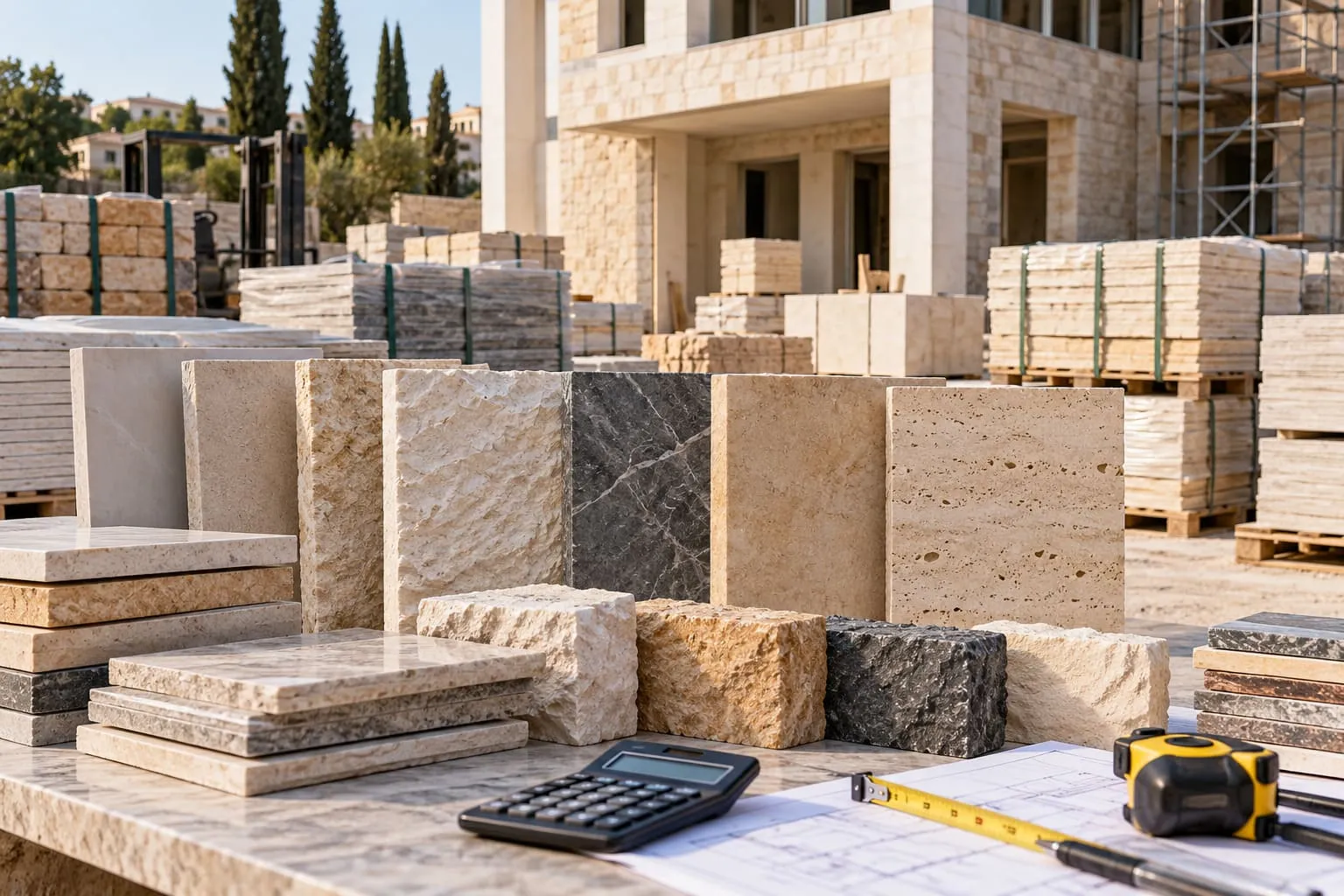
The lowest-priced facade stone is not necessarily the most economical choice. Inadequate material performance, incompatible fixing requirements, or inconsistent batches can lead to additional fabrication costs, replacements, and installation delays.
Before approving Syrian facade stone for your project, evaluate these factors:
- Material performance: Check water absorption, density, and mechanical strength against the project’s specifications and exposure conditions. Request relevant technical documentation or test results where required. For natural limestone, ASTM C568/C568M-22 provides a reference for material requirements when adopted by the project.
- Thickness and fixing compatibility: Confirm that the stone dimensions, thickness, and weight are compatible with the approved facade support and fixing system. These requirements must follow the project engineer’s calculations and approved details, not the supplier’s standard sizes alone.
- Finish and appearance consistency: Approve a representative sample defining the acceptable color variation, surface finish, workmanship, and dimensional tolerances. For large facades, establish acceptance criteria before full-scale fabrication.
- Source and supply continuity: Verify material availability, source consistency, and the supplier’s ability to maintain the approved grade and finish across phased deliveries. Unplanned changes between batches may result in visible differences and replacement costs.
- Total procurement cost: Compare the prices of standard cladding pieces and custom architectural elements separately, including any additional fabrication and delivery requirements.
For projects involving other premium natural finishes, see our guide to Marble and Granite Supply in Syria for Luxury Projects.
How to calculate facade stone quantities
An accurate facade stone quantity takeoff starts with the approved drawings, but the net cladding area alone is not enough to prepare a reliable purchase order. Cutting losses, corners, opening surrounds, architectural details, and replacement pieces must also be accounted for.
1. Calculate the net cladding area
Measure each stone-clad elevation using the approved architectural drawings and relevant shop drawings.
For a straightforward rectangular surface:
Gross facade area = Length × Height
Deduct the applicable door and window openings and any areas excluded from the stone cladding scope, following the project’s agreed measurement rules.
Net cladding area = Gross measured area − Applicable opening deductions
Measure window reveals, returns, projecting features, and other additional cladding surfaces separately where required. If the facade uses different stone types, thicknesses, or finishes, calculate each category independently.
This separation prevents unrelated materials and fabrication requirements from being combined into a single square-meter quantity.
2. Calculate cutting waste and spare quantities
The stone wastage allowance should reflect the actual panel layout, not an arbitrary percentage applied to every project.
Review the approved piece sizes, cutting patterns, corners, facade geometry, and non-standard elements to estimate the additional material needed. Include any specified spare pieces for installation damage or future replacement.
The basic purchasing calculation is:
Flat stone purchase quantity = Net flat cladding area + Cutting allowance + Spare allowance
For example, consider a hypothetical facade with:
- Gross cladding area: 240 m²
- Deductible openings: 36 m²
- Net flat cladding area: 204 m²
- Cutting allowance based on the proposed layout: 12 m²
- Specified spare quantity: 4 m²
Total flat stone purchase quantity = 220 m²
This example illustrates the calculation only. It assumes the openings are fully deductible under the agreed measurement rules and that special architectural pieces are measured separately. The allowances are illustrative, not recommended industry percentages.
3. Convert the takeoff into purchase quantities
A reliable facade stone BOQ should separate items according to how they are fabricated, measured, and priced.
| Material or component | Typical pricing unit |
|---|---|
| Standard flat facade stone | Square meter (m²) |
| Linear cornices and profiles | Linear meter (m) |
| Special corners and edge pieces | Linear meter or piece, depending on design |
| Window and door surrounds | Linear meter or piece, depending on design |
| Custom-cut architectural elements | Piece, linear meter, or agreed schedule |
| Spare stone quantities | Same applicable unit as the material |
Keep these items separate from standard flat cladding when their fabrication or pricing differs, and ensure no quantity is counted twice.
For transport planning, stone weight can also be estimated from the approved dimensions, thickness, and material density. This helps determine handling and delivery requirements, particularly for large or phased orders.
A drawing-based takeoff, with clearly defined allowances and itemized quantities, provides a stronger basis for comparing building stone supply quotations in Syria and controlling procurement costs.
Preparing a facade stone supply order? Through Qiwaa Trading, Qiwaa Advance supports construction material sourcing and delivery coordination. Share your BOQ, stone specifications, project location, and delivery schedule to discuss your supply requirements. Contact us to share with you a stone supply quotation.
Read also: Marble and Granite Supply in Syria for Luxury Projects
Stone material cost
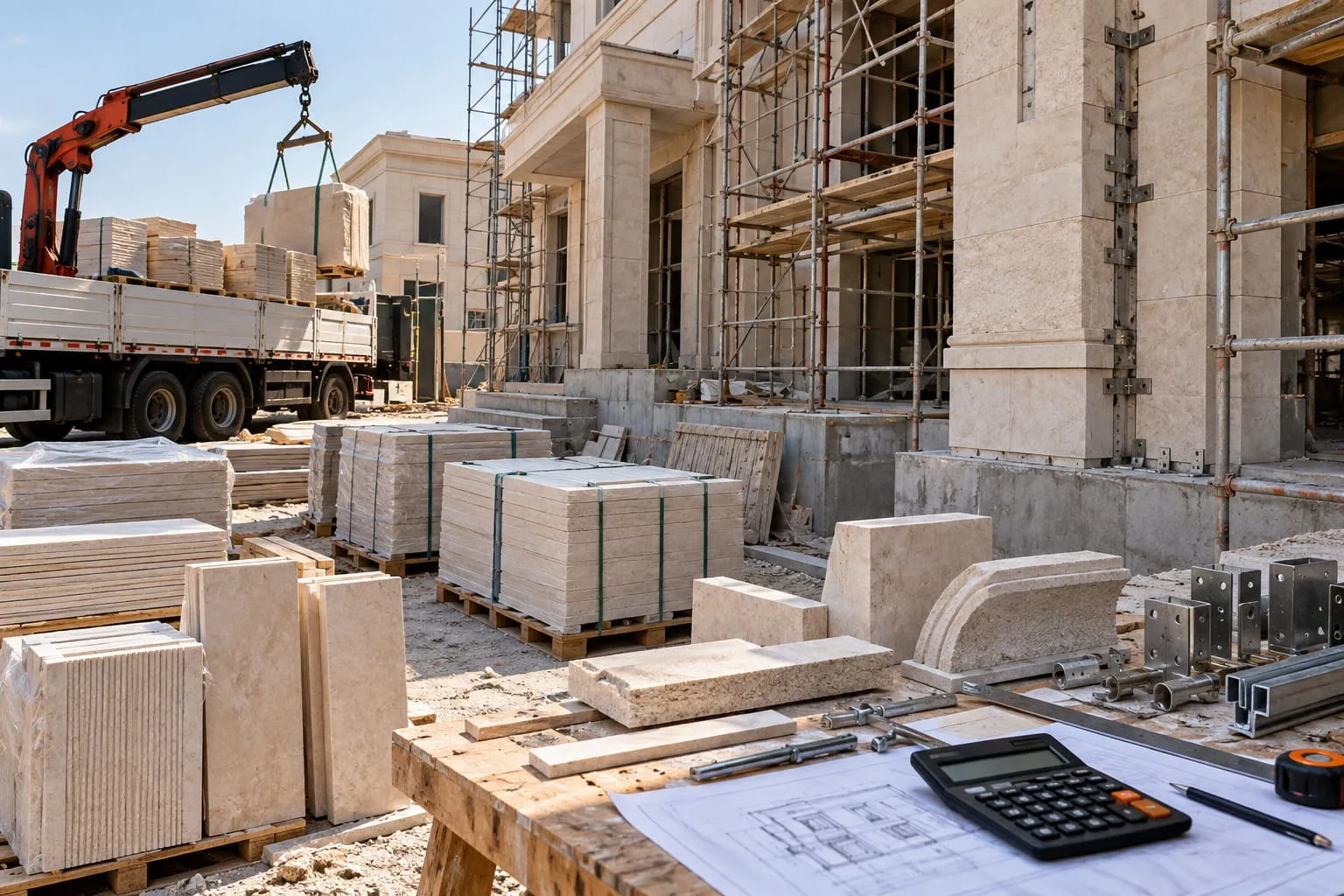
Calculate the material cost using the purchase quantities established in the approved bill of quantities (BOQ), including cutting allowances and specified spare pieces.
Stone material cost = Purchase quantity × Quoted material rate
Using the quantity calculation from the previous section:
- Net flat cladding area: 204 m²
- Total flat stone purchase quantity, including allowances: 220 m²
The material cost is therefore 220 m² multiplied by the supplier’s quoted rate, provided that the rate covers the specified stone, dimensions, and finish.
Architectural elements priced separately, such as cornices and custom surrounds, must be added using their respective quantities and quotation rates. Confirm whether standard cutting, finishing, and packaging are already included to avoid counting these expenses twice.
Stone installation cost
Stone cladding installation costs in Syria depend on the approved fixing method, installation complexity, site conditions, and the scope included in the contractor’s quotation.
The main cost considerations are:
- Fixing system: Mortar-based installation or an engineered mechanical anchoring system, as specified and approved for the project.
- Supporting components: Anchors, brackets, subframes, and associated fixing materials where required.
- Site preparation: Substrate preparation and any necessary corrective work before installation.
- Execution requirements: Installation labor, facade height, accessibility, and architectural complexity.
For natural dimension stone, ASTM C1242-26 provides guidance on attachment-system design and installation. Its applicability should be assessed against the project’s approved specifications and relevant building requirements.
Where installation is quoted per square meter:
Installation cost = Measured installed area × Agreed installation rate
Unlike material purchasing, installation quantities should follow the contract’s measurement rules and should not automatically include unused cutting allowances or spare stock.
Additional fabrication, transport, and site costs
Before finalizing the budget, check whether the supplier’s and installation contractor’s quotations include:
- Custom cutting, carved details, cornices, and opening surrounds.
- Scaffolding, lifting equipment, and other facade access requirements.
- Transport, protective packaging, unloading, and site handling.
- Special surface treatments, inspections, or testing required by the specifications.
Price any excluded items separately, using the relevant measurement unit and agreed scope. Avoid adding costs already covered by the material or installation rates.
Calculate the total cost per installed square meter
To estimate the complete stone facade cost per m², combine the applicable project costs:
Total facade cost = Stone material cost + Installation cost + Additional fabrication and site costs + Transport and handling
Include applicable taxes, allowances, or other contractual costs where they are not already covered.
Then calculate:
Cost per installed m² = Total facade cost ÷ Net measured installed facade area
This gives procurement teams a project-level cost benchmark, rather than a material-only rate. When comparing different quotations, ensure that the facade scope, measurement basis, approved fixing system, and included services are equivalent.
For broader material procurement considerations, read our guide to Building Materials in Syria: Types, Suppliers & Delivery.
Qiwaa Advance: Building stone supply in Syria
Securing building stone for construction projects in Syria involves more than obtaining a competitive quotation. The specified material must be available in the required quantities, meet the approved project requirements, and arrive in line with the construction schedule.
Through Qiwaa Trading, we support construction material sourcing and supply coordination, including natural stone and other finishing materials.
Our approach connects procurement requirements with the project’s execution needs:
- Specification-based sourcing: Reviewing the required stone type, grade, thickness, dimensions, finishes, and approved material specifications.
- Quantity and quotation coordination: Organizing supply requirements around the BOQ, including separately specified architectural elements.
- Supply and delivery planning: Coordinating sourcing and delivery arrangements according to the project location, quantities, and construction stages.
Material selection, fixing-system design, and final technical approvals remain subject to the project engineer’s and consultant’s requirements.
Need wholesale building stone supply in Syria?
Share your BOQ, approved stone specifications, project location, and delivery schedule with Qiwaa Advance to discuss sourcing options and request a project-specific supply quotation. Contact us via WhatsApp
FAQs About Building Stone Prices in Syria
FAQs about building stone prices in Syria
How much does natural stone cost per square meter in Syria in 2026?
Natural stone prices in Syria depend on the stone type, grade, thickness, finish, and delivery terms. A single market-wide rate would not provide a reliable basis for procurement. For accurate budgeting, obtain dated supplier quotations based on the same approved specifications, quantities, and delivery location.
Which Syrian stone types are suitable for facade cladding?
Aleppo, Ruhaibeh, and Hama stone are among the natural stone options considered for facades in Syria. Suitability depends on the properties of the specific material, environmental exposure, architectural requirements, and approved fixing system. Evaluate material test results and approved samples rather than relying on the stone’s regional name alone.
How much does stone cladding cost per square meter including installation?
The installed stone cladding cost per m² includes the purchased stone, applicable cutting allowances, fixing materials, installation labor, transport, and any additional work required by the project. Divide the total cost of the defined facade scope by the measured installed area to calculate a comparable unit cost.
How do stone thickness and finish affect the price?
Stone thickness affects material consumption, piece weight, and handling requirements, while surface finishes and custom profiles influence fabrication costs. Thicker pieces or more complex finishes may increase costs, but the actual difference depends on the material and processing method. Compare quotations using identical specifications.
How much extra stone should a facade project order for wastage?
There is no universal stone wastage allowance suitable for every facade. Calculate additional quantities from the approved panel layout, cutting requirements, corners, and special pieces. Keep specified replacement stock separate from cutting waste, and confirm the final purchasing allowance before placing the order.
Does a wholesale stone supply quotation include transport and installation?
Not necessarily. Wholesale building stone quotations in Syria may cover materials only or include delivery and unloading, depending on the agreed terms. Installation is a separate scope unless explicitly included. Confirm the delivery location, handling responsibilities, included services, and any exclusions in writing before issuing a purchase order.