

Comparing ceramic tile prices in Syria can be challenging when suppliers offer different grades, specifications, and delivery terms. Choosing tiles based on price alone can lead to unsuitable materials, wasted quantities, and unexpected project costs.
Qiwaa Advance helps contractors and project owners source ceramic and porcelain tiles according to project specifications and supply requirements. This guide helps you make informed purchasing decisions by covering:
- Ceramic tile prices in Syria in 2026 and the factors affecting cost per square meter.
- Tile types, suitable applications, and quantity and cost calculations.
- Specifications and supply controls to reduce purchasing risks.
Ceramic tile ptices in Syria 2026 by type
The ceramic tile price per square meter in Syria depends on the specific product being purchased, not simply whether it is classified as ceramic or porcelain. For a reliable 2026 budget, contractors should use dated supplier quotations that identify the product, its specifications, and the applicable delivery terms rather than treating general market estimates as confirmed purchase prices.
The following categories require different considerations when establishing a project-specific price:
- Floor ceramic tiles: Request a price per square meter for tiles approved for the intended flooring application. Confirm the dimensions, quality grade, surface finish, and applicable performance requirements. Two floor tiles offered at different prices may not provide equivalent durability or suitability for the project’s expected traffic.
- Wall ceramic tiles: Establish the price based on the selected dimensions, finish, grade, and product code. Confirm whether decorative pieces and finishing trims are included or priced separately, particularly when estimating materials for kitchens, bathrooms, or large wall-finishing areas.
- Local porcelain tiles: Request quotations for the specified product rather than using a general porcelain price. Verify the manufacturer, dimensions, thickness, surface finish, and available quantity. When local manufacture is a purchasing requirement, confirm the product’s origin before including it in the budget.
- Imported porcelain tiles: Confirm the manufacturer, country of origin, product specifications, and stock availability. Check whether the quoted price includes import-related charges, transportation, and delivery to the project site, as these costs can affect the final purchasing budget.
For each category, record the ceramic tile price per square meter, currency, quotation date, validity period, product specifications, and delivery terms. This establishes a clearer material-cost reference for your project. Cutting waste, reserve quantities, installation materials, and labor should then be calculated separately to determine the full project cost.
Read also: Live Building Material Prices in Syria 2026: How to Read the Steel, Cement and Block Price Bulletin
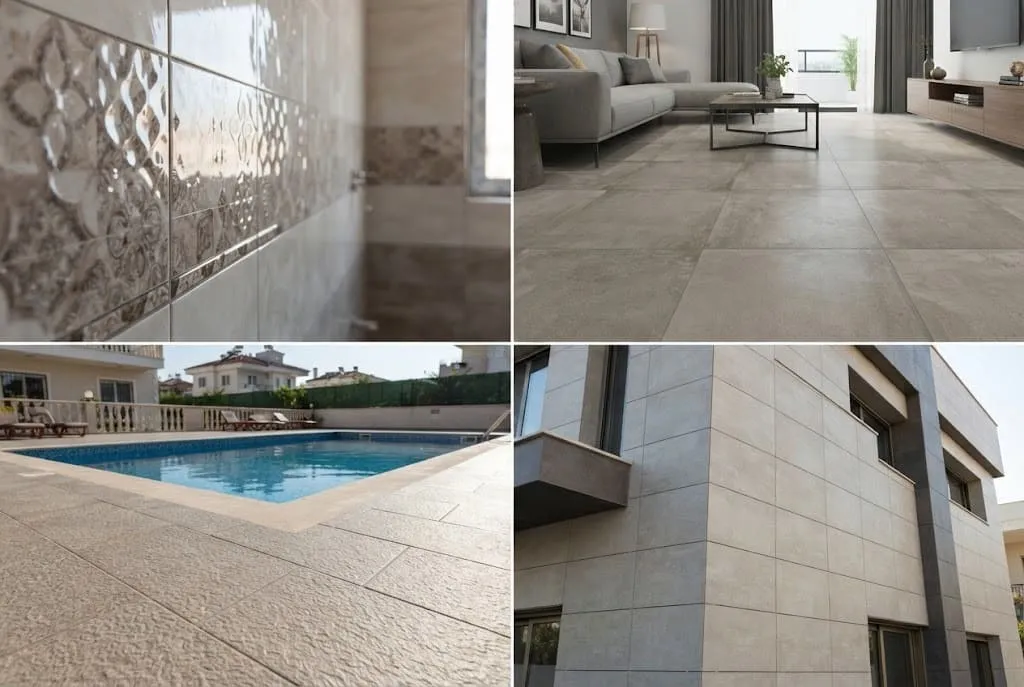
Types of ceramic tiles and their uses in construction projects
Choosing the right type of ceramic tile helps contractors in Syria avoid paying for unnecessary specifications or purchasing materials unsuitable for their projects. Each option should be evaluated according to its intended application, expected traffic, moisture exposure, and technical requirements before comparing the ceramic tile price per square meter.
Glazed ceramic tiles
Glazed ceramic tiles have a finished surface available in various colors and designs. They are commonly used in interior finishing, although suitability for floors depends on the product’s performance rating.
- Kitchen and bathroom walls: Glazed surfaces are generally easy to clean and maintain.
- Residential floors: Floor-rated products can be suitable for spaces with light or moderate foot traffic.
- Interior wall finishes: Different sizes and designs accommodate project specifications.
Before comparing prices, confirm whether the product is approved for floor or wall use and check its grade, dimensions, and surface durability. A lower-priced wall tile is not necessarily a suitable substitute for a floor-rated product.
Porcelain tiles
Porcelain is a dense, low-water-absorption type of ceramic tile, available in glazed and unglazed finishes. It can suit applications with demanding performance requirements, provided the selected product meets the project’s specifications.
- Residential and commercial floors: Products rated for the expected traffic and wear conditions.
- Entrances and corridors: Tiles with suitable surface durability and slip-resistance properties.
- Interior walls: Porcelain finishes compatible with the wall structure and fixing system.
When evaluating porcelain tile prices, compare products approved for the same application. Porcelain classification alone does not establish wear resistance or slip safety, so verify the manufacturer’s technical specifications before selecting a higher-priced option.
Anti-Slip ceramic tiles
Anti-slip ceramic tiles are designed or selected to provide appropriate surface traction in specific conditions. Slip resistance is a performance characteristic that can apply to both ceramic and porcelain tiles, rather than a separate material category.
- Balconies and terraces: Outdoor floors exposed to rain and moisture.
- Pool surrounds: Wet areas where barefoot use must be considered.
- External walkways: Pedestrian surfaces exposed to weather conditions.
Before choosing a product, check its documented slip-resistance performance and suitability for the intended location. Compare prices only between tiles that meet the required performance criteria, since surface texture or an anti-slip label alone does not establish suitability.
Exterior Façade ceramic tiles
Ceramic tiles for exterior façades must be approved for outdoor vertical applications and compatible with the project’s installation system. Selecting tiles based only on appearance or price can create compatibility and maintenance problems.
- Building façades: Exterior finishes requiring suitable weather resistance and fixing specifications.
- Main entrances: Decorative cladding exposed to outdoor conditions.
- Exposed exterior walls: Finishes requiring consideration of sunlight, rain, and temperature changes.
Before requesting quotations, confirm the manufacturer’s exterior-use approval, tile dimensions, and compatibility with the proposed fixing system. The ceramic tile price should be assessed alongside installation requirements, as a lower material price does not necessarily mean a lower total façade cost.
Read also: Ceramic and Porcelain Tiles in Syria: Import Sources and Best Options
Ceramic tile selection criteria and price factors
The ceramic tile price per square meter in Syria can vary even between products intended for the same application. For contractors and procurement teams, comparing prices requires checking the specifications behind each quotation to avoid paying more for unnecessary features or selecting tiles that do not meet project requirements. The main factors include:
- Size and thickness: Tile dimensions and thickness can affect product pricing, handling, installation requirements, and cutting waste. Larger formats may require different installation methods, while thickness must suit the intended application. Compare prices using the specified dimensions and thickness, and confirm the actual square meter coverage per box.
- Grade and manufacturing quality: Dimensional accuracy, surface defects, and consistency affect product quality and purchasing value. Lower-priced grades may have different tolerances or acceptable defects. Request the manufacturer’s quality classification and compare tiles of equivalent grades to avoid misleading price differences.
- Origin and surface finish: Manufacturer, country of origin, and finishes such as matte, polished, or glazed can influence the quoted price. Imported tiles are not automatically better than locally manufactured alternatives. Compare products with equivalent specifications and finishes, and verify their suitability for the intended application before choosing based on origin or price.
For a reliable ceramic tile price comparison, request quotations based on the same product specifications, quality grade, and unit of measurement. This helps identify genuine price differences rather than differences caused by products that are not directly comparable.
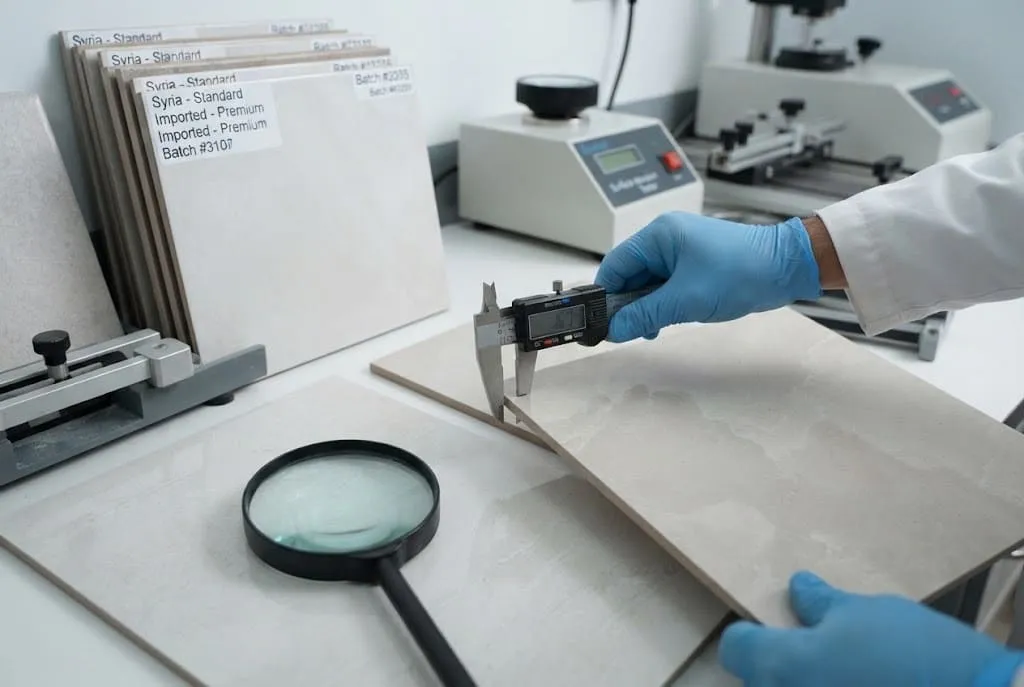
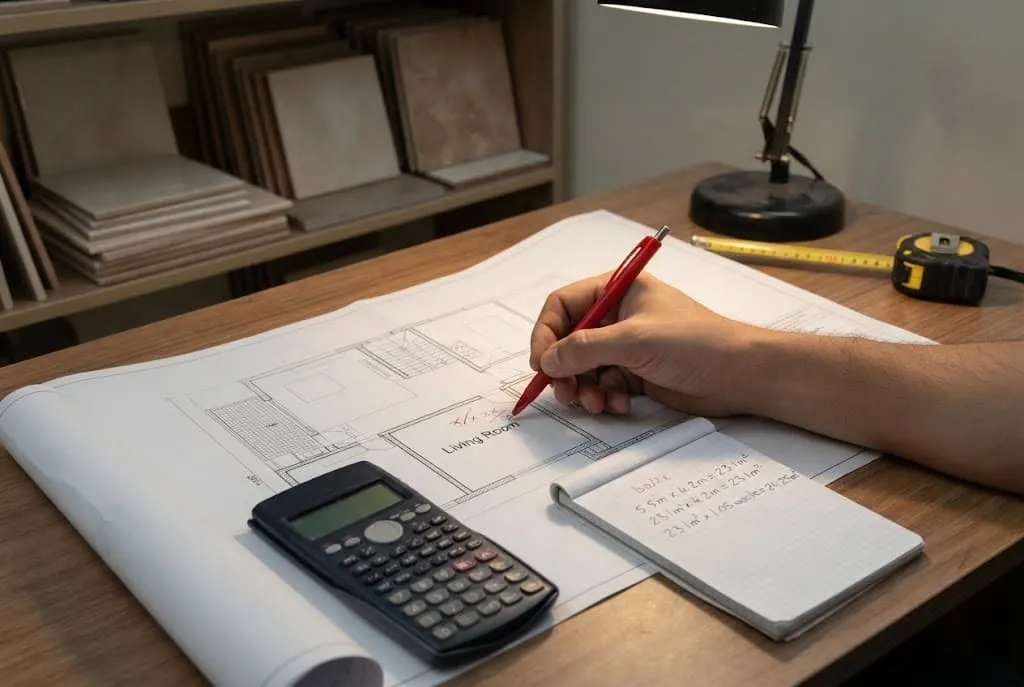
How to calculate the required ceramic tile quantity and avoid waste
Accurate ceramic tile quantity calculation helps contractors in Syria prevent material shortages, control purchasing costs, and avoid unnecessary stock. The calculation should be completed separately for each approved tile type and size, accounting for the actual installation area, cutting waste, and packaging quantities.
Calculate the net area
Measure each floor or wall surface using the approved project drawings or verified site dimensions:
Net area (m²) = Length (m) × Width (m)
For irregular spaces, divide the surface into measurable sections and combine their areas. Deduct openings or excluded surfaces that will not be tiled, according to the project’s measurement requirements.
Keep different tile types, sizes, and finishes in separate quantity calculations to avoid ordering the wrong materials.
Add a waste and breakage allowance
Ceramic tile installation requires additional material for cuts, breakage, and fitting around corners or obstacles. The allowance depends on tile dimensions, room geometry, and the approved laying pattern.
Regular layouts generally require fewer cuts than diagonal patterns or spaces with numerous corners. Determine the allowance from the installation plan rather than applying the same percentage to every area.
Calculate the total ceramic tile quantity
Once the net area and waste allowance are established, calculate the required purchase area:
Required tile area = Net area × (1 + Waste allowance as a decimal)
Calculate this quantity separately for each tile specification. The result represents the estimated material requirement before adjusting for the number of tiles supplied in complete boxes.
Convert the quantity into number of oxes
Ceramic tiles are commonly supplied in boxes with a specified coverage area. To determine how many boxes your project needs, use:
Boxes required = Required tile area ÷ Coverage per box
Round the result up to the nearest whole box, then calculate the actual purchased area:
Actual purchased area = Number of boxes × Coverage per box
Use this final quantity when estimating material costs, since the area purchased in complete boxes may exceed the calculated installation requirement.
Keep Additional Reserve Stock
Consider reserving matching tiles for future repairs or replacement, particularly for products that may become difficult to source later.
Confirm the product code, shade, and caliber markings to maintain consistency with the installed tiles. Calculate any additional maintenance reserve separately from the installation waste allowance to avoid ordering the same contingency twice.
Steps for calculating the cost of ceramic tiles and ancillary materials
The total ceramic tile cost depends on the actual purchased quantity, installation materials, labor, and delivery expenses. For construction projects in Syria, calculating these costs separately helps contractors prepare realistic budgets and identify expenses not included in the supplier’s ceramic tile price per square meter.
- Cost of the main materials: Multiply the actual purchased tile area by the quoted price per square meter, or use the agreed price per box multiplied by the number of boxes. Calculate each tile type separately using its approved specifications and quotation terms.
- Cost of adhesives and fixing materials: Include the appropriate tile adhesive and grout based on the installation area, tile dimensions, joint width, and fixing method. Estimate quantities using the selected manufacturer’s technical coverage data rather than applying a fixed consumption rate to every project.
- Installation accessories and special pieces: Include required spacers, edge trims, movement-joint profiles, and decorative pieces. Measure these items according to their purchasing units, such as linear meters or individual pieces, rather than assuming they are covered by the tile price.
- Installation and labor costs: Calculate labor using the agreed installed area or contract rate. Account for cutting complexity, laying patterns, and any separately priced surface preparation work. Confirm which tasks are included in the installation quotation.
- Transport and delivery costs: Include transportation to the construction site and any separately charged unloading or handling services. Confirm the delivery location, shipment arrangements, and applicable charges before finalizing the budget.
Total ceramic tile project cost = Tile materials + Adhesives and grout + Accessories + Installation labor + Transport and delivery
Check which items are already included in each quotation to avoid double-counting. The final budget should reflect the approved ceramic tile quantities and actual supply and installation conditions, not the advertised material price alone.
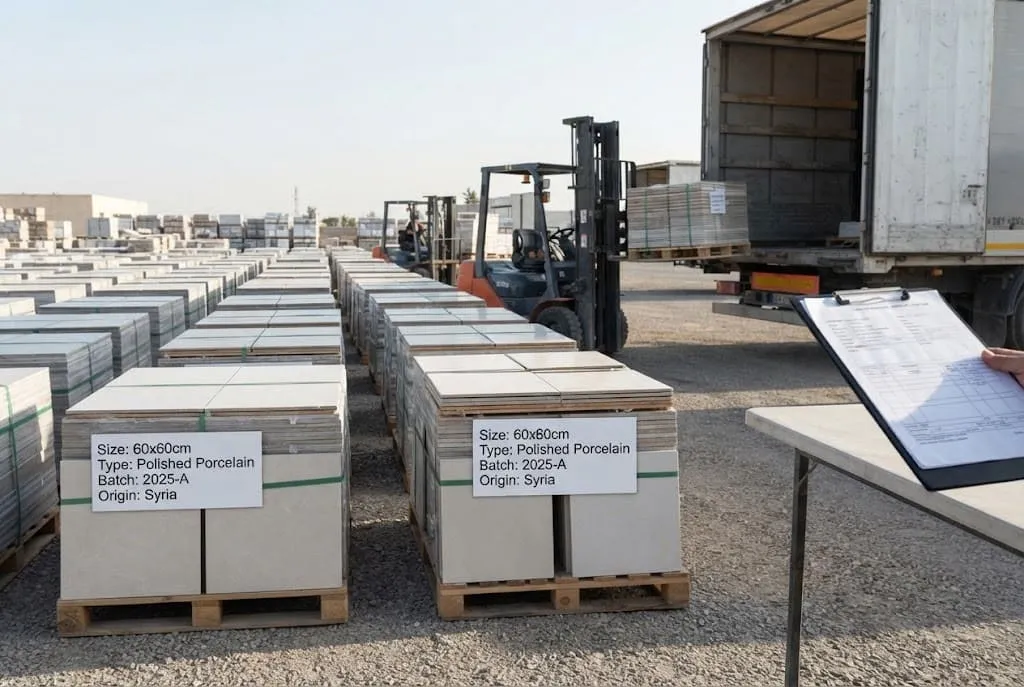
Ceramic Tile Supply Controls for Projects and Order Management
Even when the ceramic tile price and required quantities are approved, incorrect specifications, mismatched batches, or damaged deliveries can increase costs and delay installation. Contractors and procurement teams in Syria should establish clear order and acceptance controls before materials reach the site:
- Confirm approved product specifications: Record the manufacturer, product code, tile type, dimensions, thickness, grade, and finish in the purchase order. Reference the approved sample to prevent substitutions with products that do not meet project requirements.
- Control shade and batch consistency: Check shade, caliber, and production batch identifiers. Request matching products for continuous tiled areas, and agree on how different batches will be separated or approved if a single batch cannot cover the full project.
- Verify ordered quantities: Match the number of boxes and stated coverage against the approved purchase quantity, including cutting waste and maintenance reserves. Confirm availability before scheduling installation.
- Define delivery requirements: Agree on packaging, delivery dates, unloading responsibilities, and any phased shipments needed for the construction schedule. Specify how shortages or damaged materials will be reported and resolved.
- Inspect materials before acceptance: Compare delivered products with the purchase order and approved samples. Check box counts, product labels, packaging condition, and visible damage. Record discrepancies and hold nonconforming materials for review before installation.
These ceramic tile supply controls help procurement teams identify ordering and delivery problems before they affect installation, while keeping material acceptance aligned with the project’s specifications and budget.
Read also: Building Materials in Syria 2026: How to Choose Materials and Read Prices by City
Ceramic and porcelain tile supply services for projects from Qiwaa Advance
Qiwaa Advance Trading and Contracting supports contractors and project owners in Syria with ceramic and porcelain tile supply based on project specifications, required quantities, and construction schedules. Our services help address common procurement challenges, from selecting suitable materials to coordinating their availability and delivery.
Our ceramic and porcelain tile supply services include:
- Reviewing project requirements: Assessing the specified tile types, dimensions, finishes, and quantities to identify suitable materials for the intended application.
- Preparing project-specific quotations: Defining the requested products, quantities, and delivery requirements so contractors can evaluate supply costs against their approved budget.
- Coordinating material sourcing: Arranging ceramic and porcelain supply according to approved specifications and samples, while considering product availability and batch consistency across project areas.
- Planning site deliveries: Coordinating supply arrangements with project schedules and site requirements, including phased deliveries where appropriate.
Clear specifications and coordinated supply arrangements help contractors reduce procurement uncertainties and plan finishing work more effectively.
Contact Qiwaa Advance with your project specifications, required quantities, and delivery location to request a ceramic or porcelain tile supply quotation.
Read also: Building Materials in Syria 2026: How to Choose Materials and Read Prices by City
FAQs about ceramic tile price in Syria
How can I check current ceramic tile prices in Syria in 2026?
Request dated quotations from Syrian suppliers, specifying the tile type, size, grade, and delivery location. Compare prices per square meter using identical specifications and confirm quotation validity.
Why do floor, wall, and porcelain tile prices differ?
Ceramic tile prices vary according to material specifications, dimensions, quality grade, surface finish, and manufacturer. Compare products with equivalent performance requirements rather than price alone.
How many boxes of ceramic tiles should I order for my project?
Calculate the net tiled area, add the required cutting waste, then divide by the coverage per box. Round up to whole boxes and account separately for any maintenance reserve.
What should I verify before accepting a ceramic tile quotation?
Check the product code, dimensions, grade, finish, shade, quantities, unit price, quotation validity, and delivery terms. Confirm that the quoted materials match the approved project specifications.
Does the ceramic tile price per square meter include installation and delivery?
Not necessarily. The quoted price may cover tiles only, excluding adhesives, grout, labor, and transportation. Confirm these costs separately to estimate the total project budget.